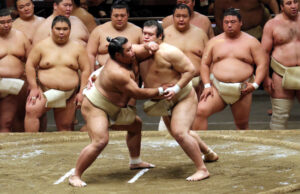
Senshuraku is the final day, the 15th and last day, of a grand sumo tournament. It is the day the championship is usually decided. If wrestlers finish tied for the lead, a playoff settles the title that same day, and the tournament closes with the award ceremony.
The 15th and final day. Senshuraku closes a grand sumo tournament, the honbasho, after two weeks of daily bouts.
The championship is usually decided here. A title chaser needs to win, and sometimes needs his closest rival to lose, so the top-division bouts are scheduled to close the program.
A tie triggers a playoff. If two or more wrestlers finish level at the top, a kettei-sen settles the title that same day. The championship is not shared.
The special prizes are awarded. The three sansho recognize standout wrestlers below the top rank as the basho closes.
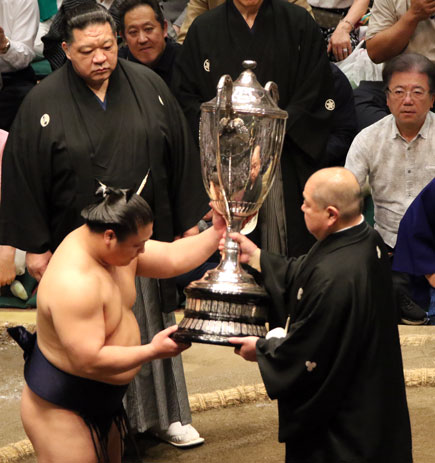
The Emperor’s Cup caps the day. The closing award ceremony hands the champion the Emperor’s Cup along with the other prizes that go to the winner.
What Senshuraku Means
Senshuraku (千秋楽, “the final day”) is the 15th and last day of a grand sumo tournament, the honbasho. The word predates sumo and is used across traditional Japanese performing arts to mark a run’s closing performance. In sumo it carries the weight of a season’s climax: the day the trophies are handed out and the day fans circle on the calendar.
By the time senshuraku arrives, every wrestler has fought through two weeks of daily bouts. The standings are tight, the pressure is highest, and the matchups on the final day are often arranged to put the leading contenders against strong opponents. What was a slow build over 14 days resolves in a single afternoon.
Why the Final Day Matters Most
Senshuraku is when the championship (yusho) is usually decided. A wrestler chasing the title needs to win, and sometimes needs his closest rival to lose. The result can swing on the last few bouts of the day, which is why the top-division matches are scheduled to close the program.
Three things typically come together on the final day:
| What happens | What it is |
|---|---|
| The championship is decided | The yusho usually goes to the wrestler with the best record after the final bouts |
| A playoff, if needed | A tie for the lead is settled the same day by one or more extra bouts |
| The special prizes are awarded | The three sansho recognize standout performances |
The Playoff (Kettei-sen)
When two or more wrestlers finish level at the top of the standings, the title is not shared. It is settled by a kettei-sen (決定戦, “deciding bout”), a playoff held that same day after the regular bouts conclude. The tied wrestlers face off in one or more extra matches until a single champion emerges. The playoff is one of the most charged moments in the sport, since the entire tournament narrows to a single result decided in real time in front of the crowd.
The Special Prizes (Sansho)
The three sansho are decided and awarded around the close of the tournament. These prizes recognize wrestlers below the top rank who stood out over the 15 days, and they sit alongside the championship as marks of a strong basho. You can read the full breakdown of how each prize works on our guide to the three special prizes (sansho).
The Closing Ceremony and the Emperor’s Cup
The tournament ends with an award ceremony. The champion receives the Emperor’s Cup along with the other prizes that go to the winner. It is the formal close of the basho and the image most fans remember from a tournament: the new champion holding the trophy as the hall acknowledges the result.
A champion who runs the table with a clean sweep earns a perfect zensho-yusho, an undefeated title that stands apart from an ordinary championship. Whether the title is decided by a single decisive win, a playoff, or an unbeaten run, senshuraku is where the record set on the banzuke at the start of the tournament meets its conclusion.
How a Tournament Builds to Senshuraku
- Day 1 to mid-tournament: wrestlers settle into form; early leaders emerge.
- Second week: the field thins to a handful of genuine contenders.
- Senshuraku: the leaders meet stronger opponents, the championship is usually decided, a playoff settles any tie, and the special prizes and Emperor’s Cup are awarded.
For newcomers, the simplest way to follow a basho is to watch the standings tighten through the second week and then give the final day your full attention. That is where the championship (yusho) is won.
Frequently asked questions
What does senshuraku mean?
Senshuraku (千秋楽) means “the final day.” In sumo it refers to the 15th and last day of a grand tournament, or honbasho. The term comes from traditional Japanese performing arts, where it marks a run’s closing performance.
What happens on the final day of a sumo tournament?
The championship (yusho) is usually decided, the three special prizes (sansho) are awarded, and the tournament closes with an award ceremony. The champion receives the Emperor’s Cup along with the other prizes that go to the winner.
What happens if wrestlers are tied on the final day?
If two or more wrestlers finish level at the top of the standings, the title is settled by a playoff called a kettei-sen. One or more extra bouts are held that same day until a single champion is decided. The title is not shared.
Is the championship always decided on senshuraku?
The championship is usually decided on the final day, which is why the leading contenders face strong opponents then and the top-division bouts close the program. A playoff on the same day resolves any tie for the lead.
When are the special prizes awarded?
The three special prizes, or sansho, are decided and awarded around the end of the tournament. They recognize standout wrestlers below the top rank and are presented alongside the championship as the basho closes.
What is the Emperor’s Cup?
The Emperor’s Cup is the trophy presented to the tournament champion during the closing award ceremony on the final day. The champion receives it along with the other prizes that go to the winner of the basho.