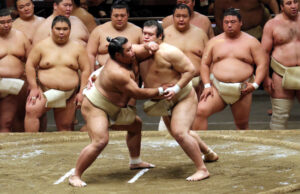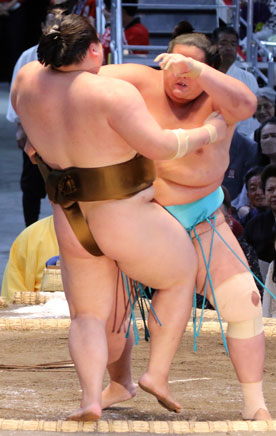
A mono-ii (literally “raising an objection”) is when sumo’s ringside judges dispute the referee’s verdict. A judge raises his hand, the judges gather in the ring to confer and may review video, then either uphold the call, reverse it, or order a rematch.
The gyoji is not the final word. The in-ring referee must point his fan to a winner instantly and can never call a draw, but the ringside judges can challenge that call.
A mono-ii is the formal objection. One shimpan raises his hand, the judges climb into the ring to confer, and they may consult a video replay before deciding.
There are three possible outcomes. The judges uphold the call, reverse it (gunbai-sashichigae), or order a rematch (torinaoshi) when the finish is too close to call.
It is routine, not an insult. The system exists because some finishes are too fast and too close for a single pair of eyes.
Do not confuse it with a mizuiri. A mizuiri is a water break inside a bout that has not ended yet, not a challenge to a verdict.
What a mono-ii actually is
Every sumo bout ends with a verdict, and it ends instantly. The gyoji (in-ring referee) must point his war-fan toward a winner the moment the action stops. He is never allowed to call a draw. That speed is the point: sumo wants a decision, not a deliberation.
But the gyoji is not the final word. A mono-ii (物言い, literally “raising an objection”) is the formal challenge to his call. The shimpan — the ringside judges seated around the ring — can dispute the verdict. One judge raises his hand, the judges climb up onto the ring, and they gather in the center to talk it through. They may also consult a video replay before deciding anything.
If you are new to who stands where and who does what, start with our guide to the gyoji and shimpan. The short version: the gyoji judges from inside the ring in real time; the shimpan judge from the outside and hold the power to overrule him.
Why the referee can be overruled
Sumo bouts are won and lost in fractions of a second. Two wrestlers can hit the clay and step out almost simultaneously. A heel can graze the sand a hair before an opponent’s body lands. The gyoji has one viewing angle and a split second to decide, so the system builds in a check: judges watching from different sides, plus replay.
This is not a sign that the referee failed. The mono-ii exists precisely because some finishes are too fast and too close for any single pair of eyes. Calling for one is a routine part of officiating, not an insult to the gyoji.
The three outcomes of a mono-ii
Once the judges finish conferring, the conference produces one of three results.
| Outcome | Japanese term | What it means |
|---|---|---|
| Uphold | — | The judges agree with the gyoji; his original call stands. |
| Reverse | gunbai-sashichigae | The judges decide the gyoji pointed the wrong way; the verdict is flipped to the other wrestler. |
| Rematch | torinaoshi | The result is too close to call, so the bout is fought again. |
Uphold
The judges look at the finish, agree the gyoji got it right, and the original verdict stands. The wrestler the fan was already pointing at keeps the win.
Reverse (gunbai-sashichigae)
A gunbai-sashichigae (軍配差し違え) means “the fan was pointed the wrong way.” Here the judges conclude the gyoji’s call was mistaken — the wrestler he named as loser actually won — and they flip the result. The gyoji’s fan, in effect, gets corrected after the fact.
Rematch (torinaoshi)
A torinaoshi (取り直し) is a re-do of the same bout, fought again from the start. The judges order one when the finish is so close that they cannot confidently say who touched down or stepped out first. The two wrestlers reset and fight the whole bout over again, beginning fresh from the tachiai — the initial charge that launches every bout.
A different kind of stoppage: the mizuiri
A mono-ii is not the only reason a bout pauses, and the two should not be confused. In a long, stalemated bout — when two wrestlers lock up and neither can break the deadlock — the head judge can call a mizuiri (水入り), literally a “water break.”
During a mizuiri the action is paused, the wrestlers rest and take water, and then they resume from the same position they held when the bout was stopped.
The difference is simple:
- A mono-ii disputes a verdict that has already been given. It can lead to a reversal or a rematch.
- A mizuiri is a pause inside a bout that has not ended yet. The same bout simply continues from where it was frozen.
How a mono-ii fits into the rules
The mono-ii is part of the larger machinery that keeps sumo’s results clean. The gyoji’s instant call, the judges’ power to challenge it, and replay review all serve the same goal: one clear winner per bout, decided as fairly as the speed of the sport allows. For the full picture of how bouts are won, lost, and officiated, see our overview of the rules of sumo.
It also connects to how a wrestler wins. The winning move — the kimarite (winning techniques) — is only recorded once the verdict is final. When a mono-ii reverses a call or forces a torinaoshi, the official technique credited to the bout can change with it.
Frequently asked questions
What does mono-ii mean in sumo?
Mono-ii literally means “raising an objection.” It is the formal challenge raised by the ringside judges (shimpan) against the in-ring referee’s verdict. A judge raises his hand, the judges climb into the ring to confer, and they may review a video replay before reaching a decision.
Can sumo judges overrule the referee?
Yes. The gyoji (referee) must point his fan to a winner instantly and can never call a draw, but his decision is not final. Through a mono-ii, the shimpan can uphold his call, reverse it, or order a rematch.
What are the three possible outcomes of a mono-ii?
The judges either uphold the gyoji’s original decision, reverse it (a gunbai-sashichigae, meaning the fan was pointed the wrong way), or order a torinaoshi, a rematch fought again from the start when the result is too close to call.
What is a torinaoshi?
A torinaoshi is a rematch. It is a complete re-do of the same bout, fought again from the start. The judges order one when a finish is so close they cannot confidently determine who touched down or stepped out first.
What is the difference between a mono-ii and a mizuiri?
A mono-ii disputes a verdict that has already been given and can lead to a reversal or rematch. A mizuiri is a water break called during a long, stalemated bout that has not yet ended — the wrestlers rest, then resume from the same position they held when paused.
What is a gunbai-sashichigae?
A gunbai-sashichigae means “the fan was pointed the wrong way.” It is the outcome of a mono-ii in which the judges decide the gyoji’s call was mistaken and reverse the verdict, awarding the win to the other wrestler.