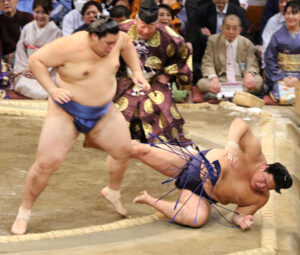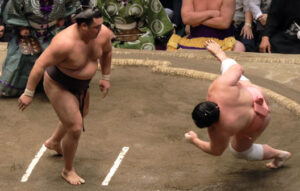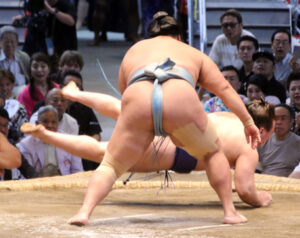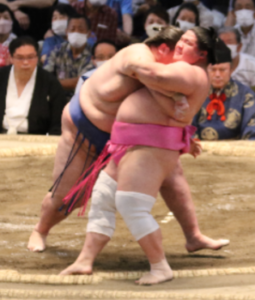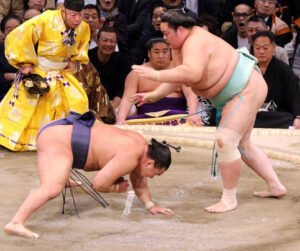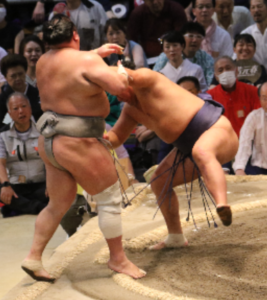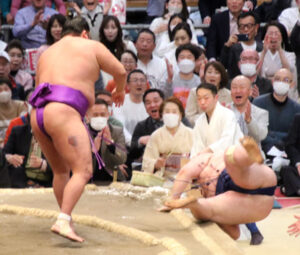
A honbasho is an official grand sumo tournament, the only kind that counts toward a wrestler’s ranking. Six are held each year, one in every odd-numbered month — January, March, May, July, September, and November. Each runs fifteen days, opening and closing on a Sunday, with every top-division wrestler fighting exactly one bout a day. This guide explains the six tournaments, where they are held, how the fifteen days decide promotion and the yusho, and how the modern six-basho calendar came to be.
Six tournaments, fixed calendar: honbasho run in January, March, May, July, September, and November — three in Tokyo, plus Osaka, Nagoya, and Fukuoka.
Fifteen days decide everything: top-division wrestlers fight once a day, and eight wins (kachikoshi) versus eight losses (makekoshi) sets the line between promotion and demotion.
The yusho is the prize: the best fifteen-day record wins the championship, while the sanshō special prizes reward standout performances below the title.
A modern system: the six-tournaments-a-year calendar was only completed in 1958, when the Nagoya honbasho officially began.
Everything in professional sumo bends toward the honbasho. The exhibition tours, the training in the heya, the rivalries that simmer for months — all of it exists to be settled across these fifteen days, six times a year. A wrestler walks into the arena on the opening Sunday carrying a clean slate, and by the second Sunday that slate has become a verdict. For the international fan, the honbasho is the single structure worth learning first: get the rhythm of a tournament, and the rest of sumo starts to fall into place.
The six honbasho, at a glance
The calendar does not change from year to year: the same six months, the same four cities, the same four halls. Only the dates move. This table is the part that holds in any year; the dated table further down carries the years the association has actually published.
| Official name | Common name | Month | City | Venue | Length |
|---|---|---|---|---|---|
| January Tournament | Hatsu basho | January | Tokyo | Kokugikan | 15 days |
| March Tournament | Haru basho | March | Osaka | EDION Arena Osaka (Osaka Prefectural Gymnasium) | 15 days |
| May Tournament | Natsu basho | May | Tokyo | Kokugikan | 15 days |
| July Tournament | Nagoya basho | July | Nagoya | IG Arena | 15 days |
| September Tournament | Aki basho | September | Tokyo | Kokugikan | 15 days |
| November Tournament | Kyushu basho | November | Fukuoka | Fukuoka Kokusai Center | 15 days |
In all 18 tournaments the association has published for 2026 through 2028, Day 1 is the second Sunday of the month and the final day is the Sunday two weeks later. The new banzuke is released before Day 1 — usually on the Monday thirteen days out (13 of the 18); the January release comes earlier, in late December.
The six tournaments and where they are held
The calendar is fixed and circular. Three of the six tournaments take place in Tokyo at the Ryogoku Kokugikan, the spiritual home of the sport; the other three travel to the regional sumo heartlands of Osaka, Nagoya, and Fukuoka. Each basho carries its own name, and regulars use those names as shorthand for the season.
Hatsu — January, Tokyo
The “first” tournament of the year, held at the Kokugikan. It sets the tone for the twelve months ahead and tends to carry an air of fresh resolutions, with the calendar wide open and every ambition still alive.
Haru — March, Osaka
The “spring” basho moves to Osaka, a city known for loud, passionate crowds. The energy in the western hall has a flavour all its own, and the local audience is never shy about making itself heard. Osaka has been a permanent March tournament since 1953, fixed in the same slot it holds today.
Natsu — May, Tokyo
The “summer” tournament returns to the Kokugikan as the year hits its stride. By now the early-season form has settled, and the year’s leaders start to separate from the pack.
Nagoya — July
The July basho takes the sport to Nagoya in the thick of the Japanese summer. The heat is part of this tournament’s lore, a physical test layered on top of the competition. Nagoya is the newest of the six regular tournaments and is co-organized by the Japan Sumo Association and the Chunichi Shimbun. For dates, tickets and who to watch, see our full guide to the July Nagoya tournament.
Aki — September, Tokyo
The “autumn” tournament is the last of Tokyo’s three, back at the Kokugikan. With the year-end picture taking shape, the stakes around promotion and survival start to bite.
Kyushu — November, Fukuoka
The year closes in Fukuoka on the southern island of Kyushu. It is the final reckoning of the season, the last chance to climb the rankings or to claw back a place before the new year resets the cycle. The Kyushu basho began in 1957, one year before Nagoya.
Official dates, year by year
The Japan Sumo Association publishes its schedule up to three years ahead: which hall each tournament is held in, the day the new banzuke is released, and the two Sundays that open and close the fifteen days. These are the association’s own dates, not estimates.
| Year | Tournament | Venue | Banzuke released | Day 1 | Final day |
|---|---|---|---|---|---|
| 2026 | January (Hatsu) | Kokugikan, Tokyo | December 22, 2025 | January 11, 2026 | January 25, 2026 |
| 2026 | March (Haru) | EDION Arena Osaka | February 24, 2026 | March 8, 2026 | March 22, 2026 |
| 2026 | May (Natsu) | Kokugikan, Tokyo | April 27, 2026 | May 10, 2026 | May 24, 2026 |
| 2026 | July (Nagoya) | IG Arena, Nagoya | June 29, 2026 | July 12, 2026 | July 26, 2026 |
| 2026 | September (Aki) | Kokugikan, Tokyo | August 31, 2026 | September 13, 2026 | September 27, 2026 |
| 2026 | November (Kyushu) | Fukuoka Kokusai Center | October 26, 2026 | November 8, 2026 | November 22, 2026 |
| 2027 | January (Hatsu) | Kokugikan, Tokyo | December 21, 2026 | January 10, 2027 | January 24, 2027 |
| 2027 | March (Haru) | EDION Arena Osaka | March 1, 2027 | March 14, 2027 | March 28, 2027 |
| 2027 | May (Natsu) | Kokugikan, Tokyo | April 26, 2027 | May 9, 2027 | May 23, 2027 |
| 2027 | July (Nagoya) | IG Arena, Nagoya | June 28, 2027 | July 11, 2027 | July 25, 2027 |
| 2027 | September (Aki) | Kokugikan, Tokyo | August 30, 2027 | September 12, 2027 | September 26, 2027 |
| 2027 | November (Kyushu) | Fukuoka Kokusai Center | November 1, 2027 | November 14, 2027 | November 28, 2027 |
| 2028 | January (Hatsu) | Kokugikan, Tokyo | December 24, 2027 | January 9, 2028 | January 23, 2028 |
| 2028 | March (Haru) | EDION Arena Osaka | February 28, 2028 | March 12, 2028 | March 26, 2028 |
| 2028 | May (Natsu) | Kokugikan, Tokyo | April 24, 2028 | May 14, 2028 | May 28, 2028 |
| 2028 | July (Nagoya) | IG Arena, Nagoya | June 26, 2028 | July 9, 2028 | July 23, 2028 |
| 2028 | September (Aki) | Kokugikan, Tokyo | August 28, 2028 | September 10, 2028 | September 24, 2028 |
| 2028 | November (Kyushu) | Fukuoka Kokusai Center | October 30, 2028 | November 12, 2028 | November 26, 2028 |
How the six-tournament calendar came together
The six-basho year is a modern arrangement, not an ancient one. For much of sumo’s history every tournament was held in Tokyo, and the regional tournaments that now anchor the calendar are comparatively recent additions. The first time a honbasho was ever held outside Tokyo was the spring tournament of 1924, in Nagoya — a move forced by disaster. The Great Kanto Earthquake of 1 September 1923 destroyed the original Ryogoku Kokugikan and left Tokyo in ruins, and sumo had to look elsewhere for a stage.
That original Ryogoku Kokugikan had opened with the summer basho of 1909. Part of its founding purpose was to give spectators — foreign visitors among them — a proper indoor venue where sumo could be watched free of the weather, rather than under temporary roofing exposed to rain and sun. Its loss in the earthquake pushed the sport onto the road and planted the idea of regional tournaments.
The modern calendar then took shape over the post-war decades. Osaka became a permanent, every-year March tournament from 1953. Kyushu followed in 1957, and Nagoya was made an official honbasho in 1958 — the year the six-tournaments-per-year system was finally complete, which is why Nagoya counts as the youngest of the six. The Tokyo home of the three capital tournaments today, the current Ryogoku Kokugikan, has been in use since 1985. So the rhythm that feels timeless to a modern fan is, in truth, only a few decades old. For more on the venue and its district, see our guide to Ryogoku, sumo’s home town.
Fifteen days, one bout a day
The fifteen-day format is the engine of the whole system, and it is unusually demanding. A top-division wrestler steps onto the clay just once each day, so there is nowhere to hide a poor performance and no chance to immediately make amends. Lose, and you carry that defeat into the next afternoon with no rematch in sight. Fifteen single bouts, spread across two weeks, leave a wrestler’s record fully exposed.
That scarcity gives every match its weight. When the gap between promotion and demotion can come down to one result, there is no such thing as a meaningless bout, and the format rewards consistency and durability as much as raw power. If you are new to following the action, our guide to how to watch sumo walks through the daily broadcast and the unfolding standings.
How results drive the banzuke
Sumo’s ranking sheet, the banzuke, is rebuilt after every honbasho, and the fifteen days of competition are its raw material. There is no points system carried across tournaments; each basho’s results feed directly into where a wrestler sits next time. Win more than you lose and you climb; lose more than you win and you slide. The hierarchy is fluid, and a wrestler’s place on the sheet is only ever as secure as his most recent performance.
The dividing line is the eighth win. A record of eight wins or more across the fifteen days is a kachikoshi, a winning record, and it earns promotion or at least holds a wrestler’s ground. Eight losses or more is a makekoshi, a losing record, and it brings demotion. That single threshold governs almost every career in the sport. The exception sits at the very top: a yokozuna, the highest rank, cannot be demoted for a losing record, which is precisely why the title carries such an expectation of dominance. Just below, an ozeki lives by stricter rules, and a run of losing records can cost a wrestler that rank. The full mechanics of the sheet are set out in our guide to the banzuke ranking sheet.
The yusho and the special prizes
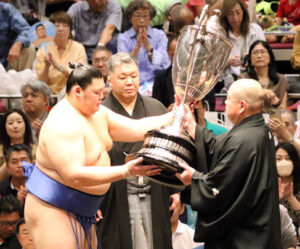
The grand prize of every honbasho is the yusho, the tournament championship, awarded to the wrestler with the best record across the fifteen days. Each division crowns its own champion, but it is the top-division yusho that captures the sport’s attention and the trophies that go with it. A career is measured in large part by how many of these a wrestler can collect, and a yusho is the single clearest statement of supremacy in sumo.
Below the championship sit the sanshō, three special prizes awarded in the top division for performances that stand out beyond the final standings. They recognise outstanding technique, fighting spirit, and notable victories over higher-ranked opponents. A wrestler well short of the title can still leave a tournament decorated, and for those climbing toward the elite, a special prize is often a signpost that something bigger may be coming.
The rhythm of a tournament day
A day at the basho is built like a slow crescendo. The doors open in the morning and the lowest divisions go first, often to a near-empty hall, the young and the unranked grinding through their bouts in relative quiet. As the hours pass the standard rises, the seats fill, and the ceremony swells — the ring-entering rituals, the salt thrown to purify the clay, the drawn-out staredowns before each charge.
By late afternoon the top division takes over, and the building is loud and full. The very last bout, the musubi-no-ichiban, is reserved for the highest-ranked wrestlers in action and serves as the climax of everything before it. When it is over, the next morning the whole arc begins again — from the silence of the lower divisions to the roar of that final clash — fifteen times over, until a champion is left standing.
▶ Read next: Yusho: how the sumo championship works — the title every tournament is fought for.
Frequently Asked Questions
How many honbasho are there each year?
There are six honbasho every year, one in each odd-numbered month: January, March, May, July, September, and November. Three are held in Tokyo at the Ryogoku Kokugikan, the other three in Osaka, Nagoya, and Fukuoka.
When is the next honbasho?
Never more than about two months away: honbasho run in every odd-numbered month, so the next one is always already on the calendar. Find the current month in the dated table above and the next tournament is the next row down. The association publishes its dates up to three years ahead.
How long does a honbasho last?
Each honbasho runs for fifteen days. It opens and closes on a Sunday, and across those two weeks every top-division wrestler fights one bout per day, for a maximum of fifteen matches.
What is the difference between kachikoshi and makekoshi?
Kachikoshi is a winning record — eight or more wins across the fifteen days — and it generally earns promotion or holds a wrestler’s rank. Makekoshi is a losing record of eight or more defeats, which typically leads to demotion on the next banzuke.
What is a yusho?
A yusho is the tournament championship, awarded to the wrestler with the best record over the fifteen days. Every division has its own yusho, but the top-division title is the most prestigious and the one tied most closely to a wrestler’s legacy.
When did sumo start holding six tournaments a year?
The six-tournaments-per-year system was completed in 1958, when the Nagoya honbasho officially began. Osaka had become a permanent March tournament in 1953 and Kyushu started in 1957, so Nagoya in 1958 was the final piece that made Nagoya the newest of the six regular tournaments.
Why are some honbasho held outside Tokyo?
The first honbasho held outside Tokyo was the spring tournament of 1924, in Nagoya, forced by the Great Kanto Earthquake of 1923 that destroyed the original Ryogoku Kokugikan. Over the following decades Osaka, Nagoya, and Fukuoka became permanent regional tournaments, giving the sport the three-city circuit it keeps today alongside Tokyo.