In sumo, toshiyori-kabu — often called “elder stock” — is the share that lets a retired wrestler stay inside the sport as an oyakata, a coach and elder of the Japan Sumo Association. Each share is tied to one of a fixed set of traditional elder names, and the number of shares is strictly limited, which makes them scarce and highly coveted. Without one, a retiring wrestler cannot remain in sumo as a stablemaster or coach. This guide explains what toshiyori-kabu is, why it is so limited and valuable, and how holding one lets a former wrestler build a second career as an oyakata.
Toshiyori-kabu is an elder share, not just a job title. Holding one is what allows a retired wrestler to remain in sumo as an oyakata.
The number of shares is fixed. There are 105 elder names in total, a figure that traces back to the 1927 merger of the Tokyo and Osaka sumo associations.
Scarcity makes them coveted. Because a new share is almost never created, a retiring wrestler must inherit or acquire an existing one — and there are far more candidates than openings.
An oyakata coaches the next generation. Elders run the stables, train young wrestlers and help govern the sport within the Japan Sumo Association.
What toshiyori-kabu is
A wrestler’s career in the ring is short. Bodies wear down, and even the most accomplished competitor eventually steps away from active sumo. For those who want to stay in the sport afterwards — as a coach, a stablemaster, or an official of the governing body — the route runs through an elder share known as toshiyori-kabu (sometimes read nenyori-kabu). Holding one of these shares is what turns a retired wrestler into an oyakata, an elder of the Japan Sumo Association.
Each share carries a traditional elder name — a fixed title handed down through the generations rather than the wrestler’s own ring name. When a former wrestler takes over a share, he also takes on its name and is known by it for the rest of his time in sumo. The share is therefore more than a licence to coach: it is a named seat within the institution, and the supply of those seats is deliberately kept small.
Why the shares are so limited
The defining feature of toshiyori-kabu is that there is a fixed number of them. In total there are 105 elder names. That figure is not arbitrary — it dates back to 1927, when the separate Tokyo and Osaka sumo associations merged into a single national body. The 88 elder names of the Tokyo side and the 17 of the Osaka side were brought together, and the combined total of 105 has anchored the system ever since.
Over the decades the roster of names has shifted in detail. Some old elder names have fallen out of use, while others that did not exist at the time of the merger were added later. But the overall principle has held: the number of shares is capped, and new ones are essentially never minted. That cap is the whole reason the shares are valuable. Because the supply is frozen while the number of wrestlers hoping to stay in the sport keeps renewing, the shares behave like a scarce, closely held asset — passed from one holder to the next rather than created on demand.
Why an elder share is so valuable
For a wrestler nearing the end of his career, an elder share is the difference between a future inside sumo and one outside it. A retiring wrestler who holds a share can carry on as a coach or a stablemaster; one who cannot secure a share has no path to remain as an oyakata and must leave the sport’s professional ranks. With every wrestler facing the same deadline at retirement, demand for the small pool of shares is constant, and a coveted name can be a long time coming.
Eligibility narrows the field further. As a rule, only wrestlers who reached the upper, salaried ranks are in a position to take on a share at all, so the competition is not the entire pool of retirees but a smaller group of accomplished men. Even among them, a wrestler can reach retirement without a share in hand and have to wait for one to open up. Because of this, securing toshiyori-kabu is one of the quiet dramas that plays out around the end of a sumo career — a question of timing, connections and which names happen to be available.
There has historically been one route around the scarcity. A wrestler with an exceptional record — typically a yokozuna with a towering list of championships — could be granted a so-called one-generation elder name, an ichidai-toshiyori, created especially for him and lasting only his lifetime. In practice this exception has become extremely rare and is now effectively closed off, so even the greatest champions are generally expected to take over one of the existing 105 names like everyone else.
How a share lets a wrestler stay in sumo as an oyakata
Once a retiring wrestler takes over a share, he becomes an oyakata and steps into the side of sumo the spectators rarely see. Elders coach young wrestlers, run the training stables — the heya where wrestlers live and practise — and take on the administrative and judging roles that keep the sport running. The most senior among them sit on the boards and committees that govern the Japan Sumo Association itself. A famous fighting career, in other words, can become a long second career in the suit of an elder.
That second career, too, has a clock on it. Elders face a mandatory retirement age — long set at 65 — at which they are expected to leave their posts. In recent years a re-employment scheme has allowed elders to keep working past that point, up to the age of 70, which softens the cliff but adds a wrinkle to the system: while a re-employed elder stays on, his share is not released, so it cannot pass to the next generation in the meantime. A stablemaster, moreover, cannot return to running his stable through re-employment alone. The result is that the movement of shares — who holds which name, and when one comes free — is something sumo watchers follow closely, because each opening shapes who gets to stay in the sport.
Seen this way, toshiyori-kabu sits at the heart of how sumo renews itself. The wrestlers who fill the ring today are coached by the elders of yesterday, and the limited pool of shares is the mechanism that decides which of today’s champions will guide tomorrow’s. It is a system built on scarcity, tradition and timing — and one of the reasons an elder name has always been, in the old phrase, a flower out of easy reach.
Frequently asked questions
Q. What is toshiyori-kabu in sumo?
It is an “elder share” tied to one of sumo’s traditional elder names. Holding a share is what allows a retired wrestler to remain in the sport as an oyakata — a coach, stablemaster or official of the Japan Sumo Association. Each share carries an elder name that the holder takes on as his own.
Q. Why are elder shares so limited and valuable?
The number of shares is fixed at 105 elder names, a total that dates back to the 1927 merger of the Tokyo and Osaka sumo associations. New shares are essentially never created, so a retiring wrestler must inherit or acquire an existing one. With far more candidates than openings, the shares are scarce and highly coveted.
Q. What does a wrestler do after acquiring a share?
He becomes an oyakata and can stay in sumo coaching young wrestlers, running a training stable and taking on judging and administrative roles. Elders face a mandatory retirement age — long set at 65 — though a re-employment scheme can extend their service up to 70.
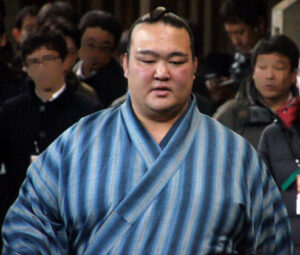
Photos by Michihiro Taguchi.