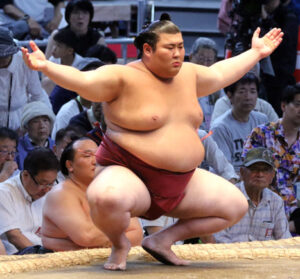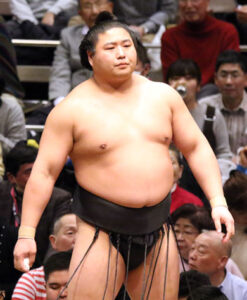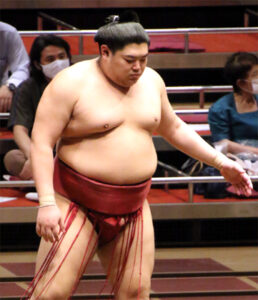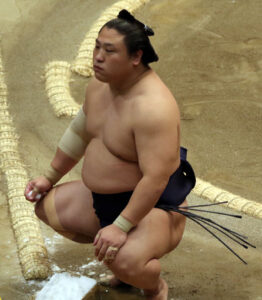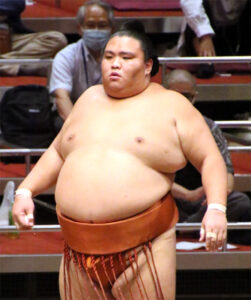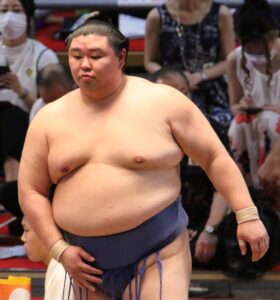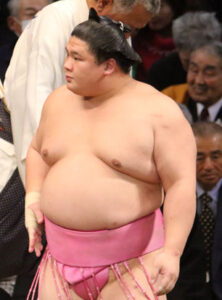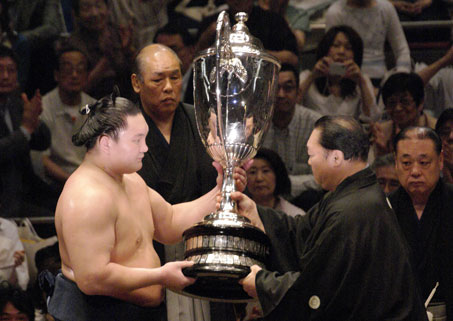
Photo by Michihiro Taguchi.
Hakuho is the greatest yokozuna in sumo history. A yokozuna is the highest rank in professional sumo, and Hakuho holds its defining records: 45 top-division championships, 1,187 career wins, and 16 perfect 15-0 tournaments — all all-time bests. He also won a yusho every year for 16 straight years and ran off a 63-bout winning streak. This guide explains the numbers behind his case as the best sumo wrestler ever.
45 championships — by far the all-time record, 13 clear of Taiho’s 32.
1,187 career wins — the most ever, plus records for top-division wins (1,093) and wins as a yokozuna (899).
16 perfect (15-0) championships — the most of any yokozuna in the six-tournament era.
16 straight years with a yusho and a 63-bout winning streak ended only by Kisenosato.
Oldest champion in the modern era — his final title came at age 36.
The records behind the greatest-ever case
The argument for Hakuho as the best sumo wrestler ever rests on numbers, not opinion. He retired holding the sport’s headline records at once: most championships, most wins, and most perfect tournaments. The figures below put the gap between him and the next-best in plain view.
| Record | Hakuho | Next best |
|---|---|---|
| Top-division championships (yusho) | 45 | Taiho, 32 |
| Career wins | 1,187 | Kaio, 1,047 |
| Top-division (makuuchi) wins | 1,093 | — |
| Wins as a yokozuna | 899 | Kitanoumi, 670 |
| Perfect 15-0 championships (zensho-yusho) | 16 | Taiho, 8 |
| Annual top winner (nenkan saita-sho) | 10 times | — |
Start with the championships. Hakuho won 45 top-division yokozuna titles — 13 more than Taiho’s 32, the next-best on the list, and more than double Takanohana’s 22. He reached 35 of those 45 inside his first ten years from his maiden yusho, ahead of Taiho (31) and Chiyonofuji (30) at the same ten-year mark. His 40th title came at age 32, and he added four more across the following three years and five tournaments.
The win totals are just as lopsided. Hakuho retired with 1,187 career wins, the all-time record, and led three win categories at the same time: the top-division record of 1,093 makuuchi wins and the yokozuna record of 899 wins as well. For scale, the second-place career mark belongs to Kaio at 1,047, and the second-best yokozuna total is Kitanoumi’s 670. He broke the career-wins record on the 13th day of the July 2017 tournament, beating Takayasu for his 1,048th win to pass Kaio.
Then there is sheer dominance. Hakuho recorded 16 zensho-yusho — perfect 15-0 championships — the most of any yokozuna in the six-tournaments-per-year era, far ahead of Taiho and Kitanoumi on 8 and 7. Four of them came back to back, the second-longest such streak in history behind only Futabayama’s five. His final championship in July 2021 was itself a flawless 15-0 run. He was also the annual top winner ten times, including nine straight years from 2007 — both records — and twice posted a single-year mark of 86 wins against 4 losses, in 2009 and 2010.
Underpinning all of it was durability. As a yokozuna he competed in 65 tournaments without missing a day, against only 19 he missed — and most of those absences came late in his career. By comparison, Taguchi gives Taiho 45 full-attendance basho and Chiyonofuji 47.
A retirement ceremony unlike any other
Hakuho’s retirement event began in unusual fashion. Spectators entered not through the main gate but the south gate, where no ticket check was needed — the first and second floors had separate entrances, and staff stood at the box-seat doors so that only first-floor ticket holders could pass through. A bag of materials waited at every seat: a program, a fortune-bag-style thank-you pouch, a guide to original commemorative goods, a 16-page “Hakuho Newspaper,” and notice of a Hakuho television special. Leaving the bags on the seats raised a small worry that someone might walk off with another guest’s set.
The final dohyo-iri
The program opened as a ceremony, with kabuki from Ichikawa Danjuro. Hakuho then wrestled a last bout against his eldest son before performing his final dohyo-iri, the yokozuna ring-entering ritual. At his side stood two men who would go on to wear the rope themselves: Takakeisho as sword-bearer and Hoshoryu as dew-sweeper. GACKT sang both the Japanese and Mongolian national anthems.
The hair-cutting ceremony
The danpatsu-shiki, the cutting of the topknot, followed a notably long opening address. A long line of public figures took the scissors — among them Mori Yoshiro, Kobayashi Akira, Higashiyama Noriyuki, YOSHIKI, and the Giants’ manager Hara. When a Mongolian guest came forward to cut, Hakuho turned to face the far side of the arena, thick with Mongolian supporters. Former wrestlers Harumafuji, Kyokushuzan, the former Kyokukuni and the former Mienoumi each took a turn. So did the stablemasters Kakuryu, Nishonoseki (the former Kisenosato) and Asakayama (the former Kaio), and active wrestlers including Terunofuji, Hokuseiho, Enho and Takakeisho. The final cut went to his master, the former Chikubayama of Magaki stable. Hakuho bowed to all four sides, and the ceremony closed. A bouquet came from his family, his third daughter read a charming essay aloud, and Hakuho gave his closing remarks. He never showed off the new hairstyle, and the event ran well past schedule — it was already dark outside.
An unremarkable beginning
For all that followed, this great yokozuna started with a losing record. In his debut tournament he went 3–4 in the jonokuchi division — a losing start that places him alongside Showa-era yokozuna Tsunenohana (2–3), Yoshibayama (2–5) and the first Wakanohana (2–3). After that stumble he posted just one more losing tournament in the lower divisions, and reached the top makuuchi division at 19. He remains one of a short list of wrestlers to make makuuchi while still a teenager since the opening of the Ryogoku Kokugikan.
The 63-bout winning streak
Sumo fans know that Hakuho’s winning streak was stopped at 63 by Kisenosato. The streak itself is worth a closer look. Of those 63 wins, four came against Kisenosato — and four-win opponents were not rare in that run, with Baruto, Harumafuji, Kakuryu, Kotoshogiku and Tochinoshin all appearing four times each. The most was Kotooshu, with five; fittingly, the very first win of the streak came against Kotooshu.
Sixteen straight years with a yusho
From his championship at the May 2006 basho, Hakuho won at least one yusho every year for 16 consecutive years. The comparison tells the story: Taiho managed 12 straight years, Chiyonofuji 10, and Kitanoumi 9. Hakuho’s final championship, at the July 2021 basho, carried exactly this weight — it sealed the record. That last yusho also came at age 36, the oldest championship ever recorded in the six-tournaments-per-year era.
The great rivalries
Four wrestlers faced Hakuho 50 or more times — a staggering total. Fifty meetings takes at least eight years and two tournaments to reach, and only happens when two men rank near each other and rarely sit out. Measured from their first bout to their last:
- Kotoshogiku — Hakuho 56–7 (including one win by forfeit), spanning 79 tournaments
- Kisenosato — Hakuho 44–16, spanning 74 tournaments
- Kakuryu — Hakuho 44–8 (including a playoff), spanning 75 tournaments
- Harumafuji — Hakuho 37–22 (including a playoff), spanning 68 tournaments
Each of these rivalries played out over roughly 11 to 13 years.
Frequently asked questions
Q. How many championships did Hakuho win?
Hakuho won 45 top-division championships, by far the all-time record — 13 more than Taiho’s 32 and more than double Takanohana’s 22.
Q. What makes Hakuho the greatest yokozuna of all time?
He holds the records for championships (45), career wins (1,187) and perfect 15-0 tournaments (16) all at once, plus a yusho every year for 16 straight years and a 63-bout winning streak.
Q. How many wins does Hakuho have?
1,187 career wins, the all-time record. He also holds the top-division record (1,093) and the record for wins as a yokozuna (899).
Q. How did Hakuho’s career begin?
Modestly. He went 3–4 in his debut jonokuchi tournament, a losing record, then posted only one more losing tournament in the lower divisions before reaching makuuchi as a teenager at 19.
Q. Who ended Hakuho’s 63-bout winning streak?
Kisenosato. Four of Hakuho’s 63 straight wins had come against Kisenosato himself, and the streak’s very first win was against Kotooshu.