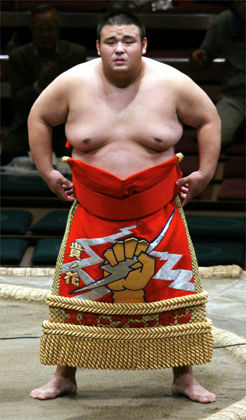
An ozeki is the second-highest rank in professional sumo, sitting directly below the grand champion, or yokozuna. Promotion customarily needs around 33 wins across three consecutive tournaments at the rank just below. Unlike a yokozuna, an ozeki can be demoted, but a struggling ozeki gets a safety net called kadoban. This guide explains what an ozeki is, how the rank is won, and how it can be lost and won straight back.
Ozeki is the second-highest rank in sumo. Only the grand champion, or yokozuna, sits above it on the banzuke.
Promotion customarily needs about 33 wins. The benchmark most often cited is roughly 33 victories over three consecutive tournaments at the ranks just below.
Two straight losing records cost the rank. One losing record makes an ozeki kadoban; a second in a row brings demotion.
The rank can be won straight back. A demoted ozeki who scores 10 wins in the very next tournament is restored to the rank for that tournament.
The comeback rule is a dated regulation. The 10-win route back has been in force since the July 1969 tournament, not sumo folklore.
What an ozeki is
Professional sumo ranks its wrestlers on a list called the banzuke. A wrestler climbs that list by winning and falls back down it by losing. From the top, the order runs yokozuna, ozeki, sekiwake, komusubi, and then the maegashira that fill out the top division. The ozeki stands second only to the grand champion and is described inside the sport as the signboard, the public face of the Japan Sumo Association. Many capable wrestlers spend whole careers just below the rank without ever breaking through.
Sekiwake and komusubi are the two junior titled ranks, and they are the first targets a wrestler aims at once he reaches the top division. Reaching ozeki or above asks for something more than a strong run at those ranks. Because the yokozuna is treated as the ceremonial figurehead of the sport, the ozeki often carries the day-to-day weight of competition at the top of the banzuke, expected to contend for the championship and to set the standard the lower ranks aim at. The rank also serves as the gateway to the very top: a wrestler must hold it before he can even be considered for promotion to yokozuna.
How a wrestler is promoted to ozeki
There is no fixed formula written into the rules, but the benchmark cited again and again is a run of strong tournaments at the titled ranks just below ozeki. The figure most often quoted is around 33 wins across three consecutive tournaments — a wrestler who averages roughly 11 victories in each of three straight basho is generally regarded as having built an ozeki case. The Japan Sumo Association makes the final decision and weighs the quality of those results, not just the raw total, so the number is a guideline rather than an automatic trigger.
When promotion is granted, it is confirmed in a formal notification ceremony. Messengers, or shisha, travel from the Sumo Association to the wrestler’s stable, and the new ozeki delivers a short acceptance address, the kojo, pledging to honor the rank. A recent case shows the scale of what it takes. Aonishiki was promoted to new ozeki on the strength of 34 wins across three tournaments in the titled ranks, an achievement he reached just 13 tournaments after entering at the bottom jonokuchi division. At his notification ceremony he said he would humbly accept the rank and strive not to disgrace the name of ozeki.
Kadoban: how an ozeki can be demoted
Unlike the yokozuna, who can never be demoted, an ozeki is held to the rank by his results. Each tournament runs 15 bouts, and a wrestler who finishes with more wins than losses has a kachi-koshi, a winning record, while one who finishes with more losses than wins has a make-koshi, a losing record. An ozeki who posts a losing record does not drop immediately. Instead he becomes kadoban — placed on notice for the next tournament, the rank effectively on the line.
A kadoban ozeki keeps the rank if he turns in a winning record in the following tournament. The cushion lasts only that one basho, though. If a kadoban ozeki posts a second straight losing record, he is demoted out of the rank, usually dropping to sekiwake. The rule used to swing further: under the six-tournament-a-year calendar the demotion line was once relaxed to three consecutive losing records, but that was judged too lenient and returned to two in a row.
One quirk follows from how a losing record is counted. Any result from zero up to seven wins counts the same for demotion purposes, so on paper an ozeki could hang on indefinitely by alternating eight-win tournaments — even a stretch as poor as 8 wins and 22 losses across two basho would technically preserve the rank. The two-consecutive-losing-record threshold is markedly gentler than the demotion pressure the lower ranks face, which is why former ozeki tend to pile up on the banzuke. In practice the rank still gets surrendered: Takakeisho gave it up at a July tournament with a 5-10 record, his losing record clinched on day 13.
Winning the rank straight back
Demotion from ozeki is not necessarily the end of a wrestler’s time at the rank. Sumo gives a freshly demoted ozeki a fast route back: if he scores 10 wins in the very next tournament after dropping down, he is restored to ozeki for that tournament, without having to grind out the full multi-tournament case a first-time promotion demands. The chance is narrow — it applies only to the single tournament immediately after demotion. This is not folklore but a dated regulation, in force since the July tournament in Nagoya in 1969. It was added as a companion clause at the same time the demotion line was returned to two consecutive losing records, so that a strong wrestler with one bad run need not start the long climb again from scratch.
The history of the rule is written into the careers that followed it. Mienoumi was the first wrestler to win the rank back under the system, and he later climbed all the way to yokozuna after being restored to ozeki. Tochiazuma is the only wrestler to have been demoted from ozeki twice and to have won the rank back both times. Others fell well below ozeki and rebuilt from the bottom of the case rather than using the quick comeback: Kaiketsu and Terunofuji both dropped far down the banzuke and climbed back to the rank from scratch.
Taken together, these rules give the ozeki rank its particular character. It is high enough to mark a wrestler as a champion and as a yokozuna candidate, yet it is governed by results in a way the grand champion’s rank is not. An ozeki must keep producing winning records to hold his place, carries the safety net of kadoban when he stumbles, and has a clear path back if he falls — a balance of prestige and pressure that defines the second-highest rank in sumo.
Current and former ozeki
Because the two-consecutive-losing-record rule is comparatively forgiving, the top of the banzuke usually holds a small group of wrestlers who once held the rank. As of the January 2026 tournament the active former ozeki were Kirishima, Takayasu, Asanoyama, Shodai and Mitakeumi — five in all. Kirishima then used the 10-win comeback route to win the rank back at the May 2026 tournament, while Takakeisho had retired by that point. The roster shifts tournament by tournament as wrestlers reach the rank, lose it, and in some cases climb back to it.
The ozeki rank is the only one above the rank-and-file that can be taken away. The mechanism has its own name and its own arithmetic: see our guide to kadoban, the rule that can cost an ozeki his rank.
Frequently asked questions
Q. What rank is above ozeki?
Only the yokozuna, the grand champion. Ozeki is the second-highest rank in sumo, and a wrestler must hold it before he can be considered for promotion to yokozuna.
Q. How does a wrestler become an ozeki?
There is no rigid formula, but the customary benchmark is around 33 wins across three consecutive tournaments at the titled ranks just below. The Japan Sumo Association makes the final call and weighs the quality of those results. Aonishiki, for example, was promoted on 34 wins over three tournaments.
Q. Can an ozeki be demoted?
Yes. An ozeki who finishes a tournament with a losing record becomes kadoban and is demoted if he posts a second losing record the next time out, usually dropping to sekiwake.
Q. Can a demoted ozeki get the rank back?
Yes. A demoted ozeki who scores 10 wins in the very next tournament is restored to the rank for that tournament. The rule has been in force since the July 1969 tournament.
Q. Who was the first wrestler to use the comeback rule?
Mienoumi was the first to win the rank back under the system, and he went on to reach yokozuna. Tochiazuma is the only wrestler to have been demoted from ozeki twice and won it back both times.
Photos by Michihiro Taguchi.