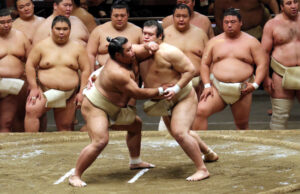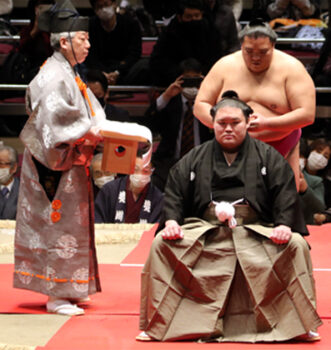
The chonmage is the traditional topknot sumo wrestlers wear, and which style a man wears is decided by his rank. The Japan Sumo Association states it plainly: the rank of a wrestler determines how his long hair is arranged. Makuuchi and juryo wrestlers wear the elaborate oicho-mage, named after the ginkgo leaf the fanned end is meant to resemble. The ranks below wear the plainer chonmage, tied with paper strings. Both styles come from the Edo period, and the association gives a second reason they survived beyond tradition: bound hair protects the head in a fall.
Rank decides the style. Oicho-mage for makuuchi and juryo; plain chonmage for makushita and below.
It is not only decoration. The association says the styles were kept partly because they serve as head protection when a wrestler falls.
A specialist ties it. Sumo’s own hairdressers, the tokoyama, oil and tie every wrestler’s hair. Nobody does his own.
Grabbing it is a foul. Seizing an opponent’s hair is one of sumo’s eight prohibited acts and costs the bout.
Cutting it ends a career. The topknot is snipped off in the danpatsu-shiki, the ceremony that closes a wrestler’s time in sumo.
What the chonmage is
The chonmage is a topknot: the hair is grown long, drawn up from the sides and back, and folded forward over the crown into a knot. The style is a survival from the days when it was the ordinary way Japanese men wore their hair, and it largely disappeared from everyday life generations ago. In sumo it never went away. A wrestler wears his hair in the topknot at all times in public, not only in the ring, and it becomes one of the most recognizable parts of his identity — see the wider history of sumo for how the sport kept so many of these older customs alive.
Which topknot goes with which rank
Sumo is one of the few sports in which a hairstyle is regulated. The association sets it out by division.
| Rank | Style worn | How it is finished | Salaried? |
|---|---|---|---|
| Makuuchi (top division) | Oicho-mage | The end of the topknot is spread across the crown into the shape of a ginkgo leaf | Yes |
| Juryo (second division) | Oicho-mage | As above | Yes |
| Makushita and below | Chonmage | A plainer style, tied with paper strings | No |
The line falls in the same place as almost every other privilege in the sport. Juryo is where a wrestler starts drawing a salary, wears silk instead of cotton, and joins the ring-entering ceremony in an embroidered apron — see our guide to what sumo wrestlers wear for the full set. The fanned ginkgo topknot is simply the version of that boundary you can see from the cheap seats.
One detail is easy to miss on television: the oicho-mage belongs to the ring and to formal occasions. It is a dress style for the moments the public sees, not a permanent fixture a sekitori sleeps in.
Why sumo kept the topknot
The association gives two reasons, and only one of them is sentiment. The first is that the styles descend from the fashions of the Edo period and have been preserved as tradition. The second is practical: the bound hair serves as head protection in the event of a fall. A wrestler thrown off the raised ring lands on packed clay or on the wooden edge of the platform, and the coiled mass on top of his head takes some of that.
It is a rare case of a costume rule that also does a job. Nothing else about the topknot is optional — a wrestler cannot cut it short for convenience — and the fact that the governing body offers a safety rationale alongside the historical one says something about how seriously it is taken.
The tokoyama: sumo’s hairdressers
A wrestler does not tie his own topknot. That work is done by a tokoyama, a specialist hairdresser employed within the sumo world, who trains for years to master the craft. Using a wide-toothed comb, cord, and a sweet-smelling wax that holds the hair in place, the tokoyama shapes a wrestler’s hair before practice, before bouts and for ceremonies, and he is the only person who ever touches it. Their ranks, training and numbers are covered separately in our guide to the tokoyama.
Grabbing the hair is a foul — and the rule got stricter
Because the topknot is a handle sitting on top of a man’s head, sumo has to police it. Seizing an opponent’s hair is one of the eight prohibited acts listed in the rules, and a wrestler who does it loses the bout outright, however the referee’s fan first pointed.
The wording used to be softer. As Michihiro Taguchi records, the rule once said deliberately grabbing the hair, and that word has since been removed. His reasoning for why is worth repeating: nobody grabs a topknot on purpose knowing it will cost him the match, and intent lives inside a man’s head where no third party can inspect it. Leaving “deliberately” in the text meant a grip that decided the bout could go unpunished as long as it looked accidental.
Taguchi points to the case that shows what the old wording allowed. On Day 12 of the November 1964 tournament, Aranami slapped down the advancing Uminoyama; his fingers caught in Uminoyama’s topknot, and two or three pulls dragged him to the clay. The cord binding the hair snapped and Uminoyama’s hair came loose. He protested. The referee’s fan went to Aranami, a mono-ii was called, and after a long conference the judges let the original call stand. The verdict drew the obvious criticism: if that was not a foul, nothing was. The official acting as chief judge was disciplined and stood down during the tournament, and even then the result was not overturned, because there was no precedent for doing so. Taguchi’s summary is that today the win would go to Uminoyama without argument, and that dropping “deliberately” from the rule was unavoidable.
Cutting the mage: the end of a career
Because the topknot is so tied to a wrestler’s identity, removing it carries great weight. When a wrestler retires, his chonmage is cut off in a ceremony called the danpatsu-shiki. Guests, supporters and former rivals each take a single snip of the cords, and the wrestler’s stablemaster makes the final cut that takes the topknot off for good. For a wrestler who has worn the mage every day of his career, the moment it falls is the moment his life in the ring formally ends — which is why the danpatsu-shiki is often an emotional occasion for everyone present.
Frequently Asked Questions
What is a chonmage?
It is the traditional Japanese topknot worn by sumo wrestlers: the hair is grown long, drawn up and folded forward over the crown. The style dates from the Edo period, and sumo is one of the last places it is worn as everyday dress rather than as costume.
What is the difference between a chonmage and an oicho-mage?
The oicho-mage is the elaborate version, with the end of the topknot spread across the crown in the shape of a ginkgo leaf. The Japan Sumo Association states that it is worn by makuuchi and juryo wrestlers, while the ranks below use the plainer chonmage, tied with paper strings.
Why do sumo wrestlers wear a topknot?
For two reasons, according to the association. The styles are inherited from Edo-period fashion and kept as tradition, and the bound hair also serves as head protection if a wrestler falls. It is a costume rule that happens to do a practical job.
Who ties a sumo wrestler’s topknot?
A tokoyama, a specialist sumo hairdresser who trains for years and uses traditional tools and wax to shape the hair before practice, bouts and ceremonies. Wrestlers do not do it themselves.
Can a sumo wrestler grab his opponent’s hair?
No. Seizing the hair is one of the eight prohibited acts in sumo’s rules and costs the offender the bout. The rule once applied only to grabbing the hair deliberately; that qualifier has been removed, so a grip counts against a wrestler whether or not he meant it.
What happens to the topknot when a wrestler retires?
It is cut off in the danpatsu-shiki retirement ceremony. Guests take turns snipping the cords and the wrestler’s stablemaster makes the final cut, which formally ends his career.
Sources
The topknot styles by rank, the ginkgo-leaf naming, the Edo-period origin and the head-protection rationale come from the Japan Sumo Association’s official English introduction, Sumo (sumo.or.jp/pdf/en/sumo_introduction.pdf). The hair-grabbing foul, the removal of the word “deliberately” from the rule, and the November 1964 Uminoyama–Aranami case come from the archive of Michihiro Taguchi at Dohyo no Mokugekisha (dohyounomokugekisya.net), “歴史から見た髷をつかんでの反則負け“. Retrieved August 3, 2026.
Photo by Michihiro Taguchi.