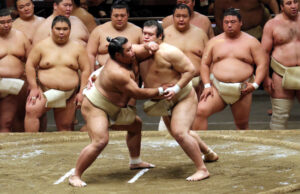
The dohyo-iri is sumo’s ring-entering ceremony — a ritual procession the wrestlers perform before the day’s top bouts begin. The top-division wrestlers file into the ring together in ornate ceremonial aprons, form a circle, and perform a short rite to purify the ring and present themselves to the crowd. A yokozuna has his own grander version, performed alone with two attendants and the white rope of his rank. It is one of the most colorful and solemn sights in sumo, and this guide explains what happens and what it means.
It is a ceremony, not a bout. The dohyo-iri is a ritual entrance the wrestlers perform before the top-division matches, not a contest.
The aprons are keshō-mawashi. Wrestlers wear heavy, richly embroidered ceremonial aprons — distinct from the plain belt they fight in.
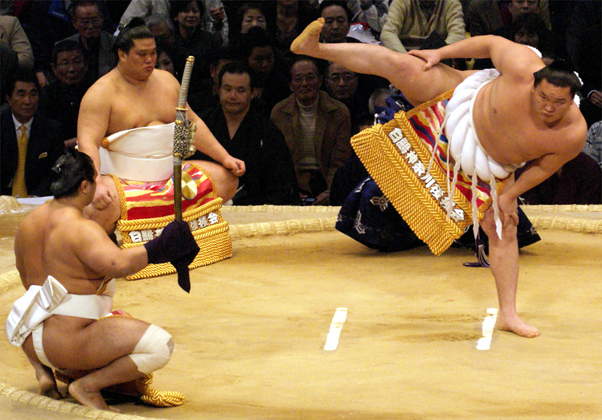
The yokozuna performs his own. A grand champion has a separate, grander dohyo-iri, performed alone with a sword-bearer and an attendant, wearing the white tsuna rope of his rank.
It purifies the ring. The clapping, the raised aprons and the leg-stomp are meant to drive off evil and consecrate the space before the bouts.
What the dohyo-iri is
The dohyo-iri is the ceremony in which the wrestlers enter the ring as a group before their division’s bouts begin. The top-division makuuchi wrestlers — and, earlier in the day, the second-division juryo wrestlers — climb onto the dohyo from the East and West sides in turn, step up in their ceremonial aprons, and form a circle facing outward toward the crowd. They clap their hands, raise their aprons slightly, and lift a leg in a brief stylized movement before filing back out. The whole thing lasts only a few minutes, but the sight of the wrestlers ringed around the dohyo in their embroidered aprons is one of the signatures of a tournament day.
The keshō-mawashi: the ceremonial aprons
The aprons worn for the dohyo-iri are called keshō-mawashi. They are heavy silk aprons, elaborately embroidered with colorful designs and often edged with gold fringe, and each one is unique to the wrestler who wears it. They are quite different from the plain mawashi the wrestlers grip and fight in — the keshō-mawashi is worn only for the ceremony, never for the bout itself. Many are gifts from a wrestler’s supporters or sponsors, which is why the designs range from traditional motifs to company emblems and hometown symbols.
The yokozuna’s dohyo-iri
The grandest version belongs to the yokozuna, the grand champion, who performs his own ring-entering ceremony separately from the group. He enters flanked by two attendants, both top-division wrestlers: a tachimochi, who carries a sword, and a tsuyuharai, or “dew sweeper,” who leads the way. The yokozuna wears the tsuna — the thick white rope, tied around his waist and hung with zig-zag paper streamers like those seen at a Shinto shrine — which is the very emblem of his rank.
Standing alone at the center of the ring, he claps to draw the gods’ attention, extends his arms, and performs the powerful leg-raising stomp, the shiko, bringing his foot down hard onto the clay. The stomp is the ceremony’s signature image: it is meant to drive evil spirits out of the ring and to show the champion’s strength. The crowd watches in near silence, then responds as his foot comes down.
Unryū and Shiranui: the two styles
A yokozuna’s dohyo-iri is performed in one of two recognized styles, named Unryū and Shiranui. The two differ in the arm movements the yokozuna makes during the rite and in the way the great rope is tied at the back. When a wrestler is promoted to yokozuna, he chooses which of the two styles he will perform, and that choice becomes part of his identity as a grand champion. Both styles end in the same emphatic stomp, and to most spectators the difference is a subtle one — a matter of how the champion holds and moves his arms as he rises.
When you’ll see it
The dohyo-iri comes in the late afternoon, marking the shift into the top-division bouts, with the yokozuna’s ceremony following the group entrance. If you are watching live, it is one of the moments worth being settled in your seat for; see how to watch sumo for the rhythm of a tournament day. Beyond the tournaments, a yokozuna sometimes performs a dedicatory dohyo-iri at a shrine on special occasions, such as the New Year, where the ceremony takes on an even more openly religious character.
Frequently asked questions
Key takeaways: The dohyo-iri is sumo’s ring-entering ceremony, performed before the top-division bouts. Wrestlers enter in embroidered ceremonial aprons (keshō-mawashi), form a circle and perform a short purifying rite. The yokozuna performs his own grander version alone, with a sword-bearer and an attendant, wearing the white tsuna rope and ending in a powerful leg-stomp — in one of two styles, Unryū or Shiranui.
Q. What is the dohyo-iri?
It is the ring-entering ceremony in sumo. The wrestlers enter the ring together before their division’s bouts, in ceremonial aprons, and perform a short ritual to purify the ring and greet the crowd.
Q. Why do the wrestlers wear those decorated aprons?
They are keshō-mawashi, ceremonial aprons worn only for the dohyo-iri. Heavily embroidered and often gifts from supporters, they are separate from the plain mawashi the wrestlers fight in.
Q. What is different about the yokozuna’s ceremony?
The yokozuna performs alone, flanked by two attendants — a sword-bearer (tachimochi) and a dew-sweeper (tsuyuharai) — and wears the white tsuna rope of his rank. His ceremony ends in the signature leg-stomp and is performed in one of two styles, Unryū or Shiranui.
Photo by Michihiro Taguchi.