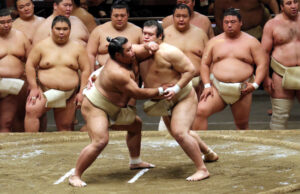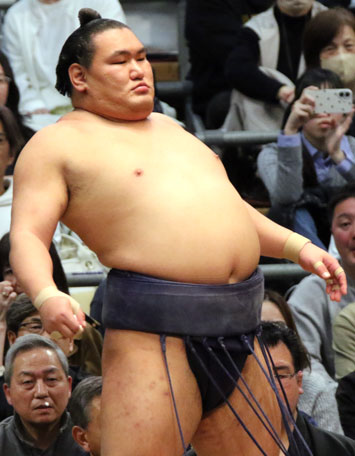
A sumo wrestler, or rikishi, is a professional athlete in Japan’s national sport of sumo, who wins by forcing his opponent out of the ring or to the ground. Sumo has no weight classes, so a lighter man can be matched against a far heavier one. This guide explains how big rikishi are and why, what they eat, how they train, what they earn, and how to become one.
“Rikishi” is the Japanese word for a sumo wrestler. The top rank is yokozuna, and the divisions run, top to bottom, makuuchi, juryo, makushita, sandanme, jonidan and jonokuchi.
There are no weight classes and no upper weight limit. Any size of wrestler can face any other, so most build as much mass as they can.
Only the top two divisions are salaried. Wrestlers in juryo and makuuchi (the sekitori) draw a monthly wage set by rank; everyone below is unpaid and gets a per-tournament allowance instead.
You become one by joining a stable. A recruit passes a physical exam, debuts at the bottom of the ranking sheet and climbs on his win-loss record.
Professional sumo is for men only. Women’s sumo exists as a separate amateur sport.
What is a sumo wrestler?
A sumo wrestler is called a rikishi in Japanese. He competes in sumo, a grappling sport with deep roots in Japan that grew from sacred ritual into a national professional sport — a history traced in our guide to the history of sumo. Professional sumo is run by the Japan Sumo Association, and the men who compete in it are full-time athletes who live, train and rise or fall by the results they post in the ring.
The contest itself is simple to state. Two wrestlers face off on a raised clay ring and a bout is decided in moments: you win by forcing your opponent out of the ring, or by making any part of his body other than the soles of his feet touch the ground. The full set of rules — including the moves that are forbidden — is laid out in our guide to the rules of sumo. The only thing a wrestler wears in competition is the mawashi, the heavy belt that opponents grip to throw and steer each other.
Wrestlers are ranked on a single ladder. The highest rank is yokozuna, the grand champion, and the divisions descend from there: makuuchi (the top division), juryo, makushita, sandanme, jonidan and jonokuchi. Where a wrestler sits on that ladder governs almost everything about his life — whether he is paid, who serves whom at meals, and how close he is to the sport’s elite.
The association’s own English guide fixes what a rikishi is in a handful of points. They are collected here; the pages linked above and below carry the detail.
| What defines a rikishi | As set out by the association |
|---|---|
| Governing body | The Nihon Sumo Kyokai (Japan Sumo Association), which issues the ranking list after every tournament |
| How a bout is won | By forcing the opponent out of the inner circle or throwing him in the dohyo. Touching the ground with any part of the body (the guide names a knee, a fingertip, even the topknot), or putting a toe or heel over the straw bales, loses |
| Weight classes | None. There are no weight limits, so a rikishi can be matched against an opponent twice his weight |
| Tournaments | Six a year, each 15 days: three in Tokyo and one each in Osaka, Nagoya and Fukuoka |
| Bouts per tournament | The two top divisions fight once every day against a different opponent; the lower divisions compete on only seven days |
| Highest rank | Yokozuna, the only rank that can never be demoted |
| Hair | Juryo and makuuchi wear the oichomage, the more elaborate topknot; the lower ranks wear the plainer chonmage |
Size and weight: why sumo wrestlers are so big
The single most important fact about a sumo wrestler’s body is what the sport leaves out: there are no weight classes. A 117 kg wrestler and a 192 kg wrestler can be drawn against each other on the same day, with no division by size. There is also no upper weight limit. Put those two rules together and the incentive is obvious — more mass is usually an advantage, so wrestlers deliberately build their bodies up through training and eating. That is the real answer to why sumo wrestlers are fat: it is not an accident of diet but a rational response to a sport that rewards weight and never penalises it.
How heavy is heavy? The figures below come from the November 2024 Tokyo tournament and from sumo journalist Michihiro Taguchi’s records, rather than from any rule book — because the sport sets no required weight at all.
| Measure (top division) | Figure |
|---|---|
| Heaviest wrestler, Nov 2024 (Shonannoumi) | 192 kg |
| Second heaviest (Nishikigi) | 185 kg |
| Third heaviest (Onosato) | 182 kg |
| Lightest wrestler, Nov 2024 (Suifuji) | 117 kg |
| Wrestlers over 150 kg | 27 of the 42 in the division |
So a typical top-division wrestler today is heavy by any measure, and the heaviest carry close to twice the weight of the lightest. Sumo has also grown heavier over time. In the 1970s the leading wrestlers were around 130 kg and a 150 kg man counted as a giant; the makuuchi-division average was recorded at 129 kg in 1984. The modern game is a heavyweight era by comparison. The extremes sit with the grand champions: the heaviest in history was Musashimaru at 237 kg, followed by Akebono at 235 kg and Dainokuni at 203 kg, while one of the lightest ever, Tochigiyama, held the top rank at 103 kg. Most modern yokozuna fall in the 150–180 kg range.
That size is built, not inborn. Hakuho, the most successful wrestler in the sport’s history, is recorded as entering sumo at roughly sixty-something kilograms and growing to 154 kg over his career. On height, the sport sets no standard at all — there is no minimum or maximum, and no height-based divisions — so a rikishi’s imposing presence comes from the weight he carries rather than from any required stature. The next two sections explain how that weight is put on: through what wrestlers eat, and the daily routine that turns the food into mass.
If it is the numbers you came for, they have a page of their own: how much sumo wrestlers weigh lists the height and weight of all forty-two top-division wrestlers from the association’s own profiles, and sumo wrestler salary by rank does the same for pay. What follows here is the life behind those figures.
What sumo wrestlers eat
The staple of the sumo wrestler diet is chanko-nabe, a wide hot-pot of stock packed with meat — often chicken — along with tofu and a heap of vegetables. It is a balanced, vegetable-heavy meal rather than junk; a wrestler grows large because of how much of it he eats and the routine around it, not because the food itself is unhealthy. Junior wrestlers cook the pot for the whole stable, and it is the dish most people picture when they ask what sumo wrestlers eat.
The detail — the broth, the ingredients, why the chicken version is the traditional favourite, and who eats first around the pot — is covered in full in our dedicated guide to chanko-nabe. What matters here is that the food is only half the story; the other half is how the day is built around it.
Training and a day in the life
A sumo wrestler lives where he trains. New recruits move into a stable, or heya, a communal training house run by a stablemaster, and the rhythm of the day is the same across the sport: hard practice early in the morning on an empty stomach, then a very large midday meal of chanko, then a long nap to let the food settle and add weight. Train hungry, eat big, then rest — that cycle is the engine that builds and holds a wrestler’s size.
The morning practice, called keiko, is conditioning rather than a contest of wins and losses. Its core is moshiai, sparring bouts in which the winner stays on to face the next man, followed by butsukari-geiko, a charging-and-driving drill in which one wrestler repeatedly slams into a partner who absorbs and pushes back. Before they ever reach a stable’s practice ring, recruits also spend six months at the Sumo Training School on the grounds of the Kokugikan arena, learning the fundamentals — shiko (the high leg stomp), teppo (striking a wooden pole to drill the hands and footwork), the shikiri pre-bout crouch, and how to fall safely — alongside general education that includes the history of the sport.
Stable life runs on a strict hierarchy, with the junior wrestlers rising first, cooking, and serving their seniors before themselves. For the full picture of that daily rhythm — the morning practice, the communal meal and the order of the house — see our guide to life inside a sumo stable, or heya.
Salary and ranks: how sumo wrestlers are paid
Pay in sumo is decided entirely by rank, and the dividing line is sharp. Only sekitori — wrestlers in the top two divisions, juryo and makuuchi — receive a monthly salary. Everyone below sekitori, in makushita and the lower divisions, is unpaid; instead they receive a fixed allowance each tournament. That gap makes life planning hard for lower-ranked wrestlers, and it is the practical reason reaching juryo is such a milestone in a career.
Because pay follows rank, where a wrestler sits on the ranking sheet, or banzuke, is what determines whether he earns a wage at all. The salaried scale is structured so that the figure rises with the rank — at the top sits the yokozuna, then ozeki, then the sekiwake and komusubi who make up the rest of the titled ranks, then the rank-and-file maegashira of the top division, and finally juryo. The monthly figures recorded by sumo journalist Michihiro Taguchi run as follows.
| Rank | Monthly salary |
|---|---|
| Yokozuna | 3,000,000 yen |
| Ozeki | 2,500,000 yen |
| Sekiwake / komusubi | 1,800,000 yen |
| Maegashira (top division) | 1,400,000 yen |
| Juryo | 1,100,000 yen |
Wrestlers below sekitori are not on this scale. They receive a set sum per tournament instead — recorded as 165,000 yen in makushita, 110,000 yen in sandanme, 88,000 yen in jonidan and 77,000 yen in jonokuchi — which is why the jump into the salaried ranks changes a wrestler’s circumstances so completely.
The monthly wage is also only part of a sekitori’s income. On top of it come merit money tied to a wrestler’s career record (paid out at each of the six tournaments and built up over a career), championship and special-prize money, the sponsor envelopes handed out for top-division bouts, and allowances for regional tours. This rank-based pay system is not ancient: it was introduced in May 1957 by the Association’s chairman Tokitsukaze — the former grand champion Futabayama — replacing an older arrangement that gave wrestlers no secured wage, and it was structured by rank from the start. For how the ranking sheet that drives all of this is put together, see our guide to the banzuke.
How to become a sumo wrestler
The path into professional sumo begins at a stable. A would-be wrestler joins a heya and must pass the shin-deshi kensa, the new-recruit physical examination, before he can be registered. From there he debuts in maezumo, the preliminary bouts for newcomers, is formally presented to the public in the new-recruit introduction ceremony, and then starts his climb from the very bottom of the ranking sheet — jonokuchi, then jonidan, sandanme, makushita and upward. Every step up is earned on win-loss record; there is no shortcut.
Because promotion is governed by results on the banzuke, a recruit’s progress depends on how he performs tournament by tournament. The system does allow some flexibility on entry — one wrestler, Fujiseiun, joined Fujishima stable through a university connection and passed the recruit examination at the age of 23 under an age-relaxation measure — but once inside, everyone rises the same way: by winning. The destination most aspire to is the salaried ranks and, for a rare few, the rank of yokozuna at the very top.
The topknot: a sumo wrestler’s hair
A sumo wrestler’s hair is worn in a traditional oiled topknot called the chonmage, and the higher-ranked sekitori wear a more elaborate fanned-out version known as the oicho-mage on formal occasions. The style is one of the most recognisable parts of a wrestler’s appearance, set and maintained by a specialist hairdresser. We cover how the topknot is tied, what the different styles mean and the ceremony that marks its cutting at retirement in our dedicated guide to the chonmage.
Women in sumo
Professional grand sumo, run by the Japan Sumo Association, is contested by men only. The ring carries a long-standing tradition of nyonin-kinsei — a prohibition under which women do not enter the dohyo — so there is no female equivalent of a professional rikishi within the Association.
Women’s sumo does exist, but as a separate amateur sport rather than part of the professional game; by one account it has more competitors in Europe than in Japan. Women also compete at the top level in other combat sports — judo, wrestling and boxing among them, including at the Olympics — so the men-only rule is specific to professional sumo’s traditions, not a feature of grappling sports in general.
Almost every term around a rikishi stays in Japanese on an English broadcast. The sumo glossary collects them in one place, with the Japanese and one line of meaning each.
Frequently Asked Questions
How much do sumo wrestlers weigh?
There is no required weight, because sumo has no weight classes and no upper limit. In practice top-division wrestlers are heavy: at the November 2024 tournament the heaviest, Shonannoumi, weighed 192 kg and the lightest, Suifuji, 117 kg, with 27 of the 42 wrestlers over 150 kg. Most modern grand champions fall in the 150–180 kg range.
Why are sumo wrestlers so big?
Because the sport rewards size and never penalises it. With no weight classes, a heavier wrestler can simply be matched against a lighter one, so wrestlers deliberately build mass through training and eating. The size is gained on purpose, not from an unhealthy diet — the food itself is balanced.
What do sumo wrestlers eat?
Their staple is chanko-nabe, a hot-pot of stock, meat (often chicken), tofu and plenty of vegetables, usually eaten with rice and in large quantities at a big midday meal. It is a balanced meal; the size comes from the volume eaten and the routine around it. See our chanko-nabe guide for the full detail.
How much do sumo wrestlers earn?
Only sekitori — wrestlers in the top two divisions, juryo and makuuchi — receive a monthly salary, and it rises with rank, from juryo up to yokozuna. Wrestlers below sekitori get no monthly wage at all, only a fixed allowance each tournament. On top of salary, sekitori also receive merit money, prize money, sponsor envelopes and tour allowances.
How do you become a sumo wrestler?
You join a stable (heya) and pass the new-recruit physical examination, then debut in the preliminary bouts and climb the banzuke from the bottom division upward, advancing on your win-loss record. There is no automatic promotion — every rank is earned by winning.
Are there female sumo wrestlers?
Not in professional sumo, which is men only and keeps the tradition that women do not enter the ring. Women’s sumo exists separately as an amateur sport, with — by one account — more competitors in Europe than in Japan.