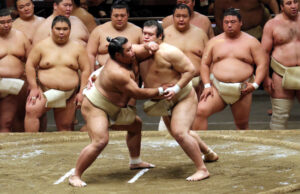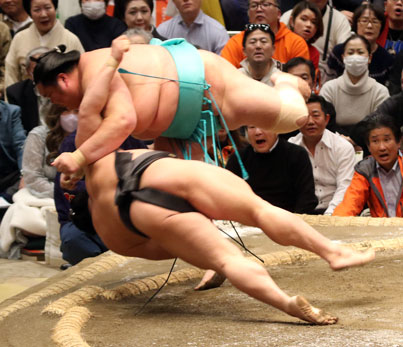
A kinboshi (gold star) is the win a maegashira — a rank-and-file top-division wrestler — earns by beating a yokozuna, sumo’s grand champion, in a regular tournament bout. Only that exact matchup counts. The win raises the wrestler’s career merit pay for the rest of his career.
One matchup only. A kinboshi is awarded for exactly one situation: a maegashira defeating a yokozuna in a regular tournament bout.
An ozeki win does not count. A maegashira who beats an ozeki — the rank below yokozuna — earns no gold star, however impressive the win.
San’yaku are excluded. Komusubi and sekiwake are expected to face yokozuna, so their wins, however dramatic, do not produce a kinboshi.
It pays for life. Per Michihiro Taguchi’s reporting, each kinboshi adds 40,000 yen to a wrestler’s merit pay, paid out every tournament for the rest of his career.
The yokozuna takes the hit. A grand champion who loses to a maegashira is said to have “given up” a kinboshi, logged against him as a marked event.
What a kinboshi actually is
A kinboshi (golden star) is one of the most prized single results in sumo. It is the win a maegashira — a rank-and-file wrestler in the top division — earns by beating a yokozuna, the sport’s grand champion, in a regular tournament bout.
The grand champion is supposed to win. He sits at the top of the banzuke, the ranking sheet that orders every wrestler before each tournament. So when an unheralded wrestler from the lower reaches of the top division topples him, sumo marks the moment with a name, a record, and a reward that follows the winner for the rest of his career.
The one matchup that counts
The kinboshi is defined narrowly, and the details matter. It is awarded for exactly one situation: a maegashira defeating a yokozuna.
- A maegashira beating a yokozuna → kinboshi.
- A maegashira beating an ozeki (champion, the rank below yokozuna) → not a kinboshi.
- A komusubi or sekiwake beating a yokozuna → not a kinboshi.
That last point trips up a lot of newcomers. Komusubi and sekiwake are the titled ranks known as san’yaku — the junior leadership tier just above the maegashira. They are expected to face yokozuna and sometimes beat them, so their wins, however dramatic, do not produce a gold star. The honor is reserved for the rank-and-file sumo wrestler who, on paper, had no business winning.
| Winner | Loser | Counts as kinboshi? |
|---|---|---|
| Maegashira | Yokozuna | Yes |
| Maegashira | Ozeki | No |
| Komusubi / Sekiwake (san’yaku) | Yokozuna | No |
Why a kinboshi pays for the rest of a career
A kinboshi is prized far beyond the single win because of what it does to a wrestler’s pay. The win permanently raises his merit pay, the rikishi-hoshokin, a stipend tied to a wrestler’s career achievements rather than a single tournament.
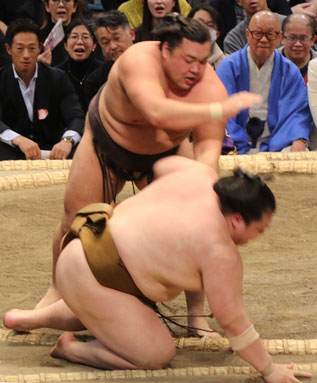
Per Michihiro Taguchi’s reporting, each kinboshi adds 40,000 yen to that merit base, and the added amount is then paid out every tournament for the rest of the wrestler’s career. So a single afternoon’s upset is not a one-time bonus. It becomes a recurring payment that compounds tournament after tournament, year after year. A wrestler who collects several gold stars carries that accumulated value with him long after the bout is over.
That permanence is what separates a kinboshi from an ordinary win on the road to a winning record. A regular victory helps a wrestler finish the tournament with more wins than losses. A kinboshi does that and keeps paying.
What it means for the yokozuna
The honor cuts both ways. When a grand champion loses to a maegashira, he is said to have “given up” a kinboshi — the upset is logged against him, not just chalked up as a loss. It is a marked event, a small dent in the aura a yokozuna is expected to project every day he steps onto the clay.
Taguchi, who reports on every tournament, tracks how many kinboshi each yokozuna has conceded over a career. The count is a quiet measure of vulnerability: a yokozuna who hands out many gold stars is one the rank-and-file have learned to beat. For the wrestlers on the other side, each gold star is a permanent line on the ledger — proof, written into the record and into their pay, that on one day they were the better man.
How to spot one
You do not need the paperwork to know a kinboshi has happened. Watch the crowd. When a low-ranked wrestler beats the grand champion, the arena erupts and seat cushions sail through the air. The maegashira walks off having changed his finances for years, and the yokozuna walks off having given one up.
Frequently asked questions
What is a kinboshi in sumo?
A kinboshi, or gold star, is the win a maegashira — a rank-and-file top-division wrestler — earns by beating a yokozuna, the grand champion, in a regular tournament bout. It is one of sumo’s most prized single results because it permanently raises the winner’s career merit pay.
Does beating an ozeki count as a kinboshi?
No. A kinboshi is awarded only when a maegashira defeats a yokozuna. A maegashira who beats an ozeki — the rank below yokozuna — does not earn a gold star, however impressive the win.
Can a sekiwake or komusubi earn a kinboshi?
No. Komusubi and sekiwake are the titled san’yaku ranks just above the maegashira, and they are expected to face yokozuna. Only a rank-and-file maegashira beating a yokozuna counts as a kinboshi.
How much is a kinboshi worth?
Per Michihiro Taguchi’s reporting, each kinboshi adds 40,000 yen to a wrestler’s merit pay (rikishi-hoshokin), which is then paid every tournament for the rest of his career. A single gold star becomes a recurring payment rather than a one-time bonus.
What does it mean for a yokozuna to ‘give up’ a kinboshi?
When a yokozuna loses to a maegashira, he is said to have given up a kinboshi. The upset is logged against the grand champion as a marked event. Taguchi tracks how many gold stars each yokozuna has conceded over his career.
Why is a kinboshi so prized?
Beyond the prestige of toppling the grand champion, a kinboshi permanently raises the winner’s career merit pay. Unlike an ordinary win, it keeps paying out every tournament for the rest of the wrestler’s career, so its value compounds over time.