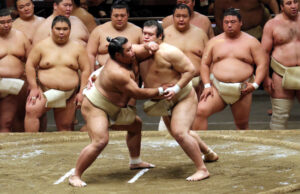
Shikiri is the preparation period before a sumo bout, in which the two wrestlers repeatedly crouch behind their lines, glare, rise, retreat to throw salt, then crouch again. It is a psychological duel over breathing and timing that ends when the clock runs out and the tachiai charge fires.
It is not stalling. The repeated crouching, rising, and resetting is where the bout is half-decided, before either wrestler has touched the other.
The salt has a purpose. A handful of salt is cast onto the ring each cycle as part of the purification ritual, and the walk back to the corner doubles as a reset for body and mind.
It is a psychological duel. Each wrestler reads the other’s eyes, hands, and breathing while controlling his own, hunting for the right instant to launch.
There is a time limit. Shikiri has a set time cap that differs by division, with higher divisions given more time than lower ones.
It ends in the charge. When time is up, the next crouch must lead straight into the tachiai — no more salt, no more retreating to the corner.
What Shikiri Means
Shikiri (the squaring-off, or pre-bout face-off) is the build-up that leads into the tachiai (the charge), the explosive initial clash that starts a sumo bout. It is the part many newcomers misread as stalling. It is not. Shikiri is where the bout is half-decided, before either man has touched the other.
During shikiri, the two wrestlers crouch behind their lines, lock eyes, and glare. They rise, step back to their corners, and reset. They throw salt onto the ring, return, and crouch again. This repeats several times. Each cycle looks like a false start, but each one is doing work: testing nerve, reading the opponent, hunting for the right moment to launch.
What Happens During Shikiri, Step by Step
The sequence follows a predictable rhythm that any spectator can learn to read.
| Action | What it does |
|---|---|
| Crouch behind the line | Both wrestlers settle into a low stance and stare each other down. |
| Rise and step back | Each returns to his corner to reset breathing and posture. |
| Wipe and take water | Stepping back lets a wrestler wipe down and rehydrate between cycles. |
| Throw salt | A handful of salt is cast onto the ring as part of the purification ritual. |
| Crouch again | They square off once more, building toward the eventual charge. |
The salt is not decoration. It belongs to the salt and pre-bout ritual that purifies the ring, and the walk back to the corner doubles as a practical reset for body and mind.
Why Shikiri Is a Psychological Duel
Shikiri is mental as much as physical. While the crowd watches two large men crouch and rise, the wrestlers are doing something invisible: reading each other.
Each man watches the other’s eyes, hands, and breathing. He settles his own breath. He tries to control the timing of the launch, because in the tachiai (the charge), a fraction of a second of advantage at impact can decide everything. The wrestler who feels he has the better read may force the pace. The one who feels rushed may step back to buy a beat. This quiet contest of nerve is why veterans treat shikiri as part of the fight, not a pause before it.
The Time Limit on Shikiri
Shikiri does not run forever. There is a set time cap, and it differs by division — higher divisions are given more time than lower ones. When time is up, an official signals, and the next crouch must lead straight into the charge. There is no more retreating to the corner, no more salt. The two wrestlers settle, set their fists down, and go.
The officials who manage the bout — the gyoji and shimpan — keep the proceedings on schedule and call the action once the wrestlers commit. For how the charge and the rest of the contest are governed, see the rules of sumo.
How to Watch Shikiri Like You Know It
Once you understand the rhythm, shikiri becomes one of the most gripping parts of a sumo bout. Watch for these cues:
- The stare. Notice which wrestler holds the other’s eyes and which one looks away first.
- The breathing. A wrestler who controls his breath controls his timing.
- The final crouch. After the last salt, the energy changes — this crouch is the one that ends in contact.
- The hands. Both fists must come down before the charge. Watch them settle.
What looks like delay is really two athletes negotiating the exact instant of collision. By the time they finally launch into the tachiai, the duel of nerves is already over.
Frequently asked questions
What is shikiri in sumo?
Shikiri is the preparation period before a sumo bout. The two wrestlers repeatedly crouch behind their lines, glare at each other, rise, step back to their corners, throw salt, and crouch again. It builds tension until the tachiai, the initial charge, finally begins.
Why do sumo wrestlers crouch and stand up over and over during shikiri?
Each crouch is a face-off where the wrestlers read each other and settle their breathing. Stepping back to the corner lets them wipe down, take water, and reset. The repetition is a psychological duel over who controls the timing of the eventual charge, not stalling.
Why do wrestlers throw salt during shikiri?
The salt-throwing is part of the pre-bout purification ritual that cleanses the ring. A wrestler casts a handful of salt each time he returns from his corner, which is also why shikiri includes those repeated trips back and forth before the charge.
Is there a time limit for shikiri?
Yes. Shikiri has a set time cap, and the limit differs by division, with higher divisions given more time. When time is up, an official signals, and the next crouch must lead straight into the tachiai charge rather than another retreat to the corner.
What is the difference between shikiri and tachiai?
Shikiri is the build-up before the bout, the repeated crouching, glaring, and salt-throwing. The tachiai is the moment shikiri ends: the explosive initial charge when both wrestlers launch from their lines and collide. Shikiri prepares the timing; the tachiai delivers it.
What happens at the very end of shikiri?
When the time limit is reached, an official signals that the next crouch is the last. Both wrestlers settle behind their lines, place their fists down, and on their own timing launch into the tachiai. There is no more salt or stepping back at this point.