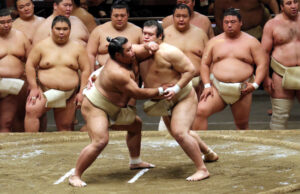
Sumo rules come down to one short contest with one goal: force your opponent out of the ring, or make any part of his body other than the soles of his feet touch the ground. Whoever does that first wins. There are no rounds and no points, and a bout is often over in seconds. Prohibited acts, known as kinjite, can result in a foul loss. This guide explains how you win, the ranks and tournaments, the deciding techniques, and the moves that are banned.
Key takeaways:
- You win by forcing your opponent out of the dohyo ring, or by making any part of his body other than the soles of his feet touch the ground.
- Professional sumo has six ranked divisions, from jonokuchi at the bottom up to the top makuuchi; wrestlers in juryo and above are the salaried sekitori.
- Six fifteen-day grand tournaments, the honbasho, are held each year. A winning record (kachikoshi) moves a wrestler up the rankings; a losing record (makekoshi) moves him down.
- Prohibited acts (kinjite) can result in a foul loss; the judges decide disputed outcomes.
The basic objective: out of the ring or down on the ground
A sumo bout has two ways to win, and both are easy to spot. The first is to push, throw, or force your opponent out of the ring so that he steps or falls beyond its boundary. The second is to make him touch the ground inside the ring with any part of his body other than the soles of his feet. A hand, knee or other body part touching the ground can decide the bout. Close finishes may be reviewed by the ringside judges.
Because either of those settles the contest, sumo bouts are short. Many last only a few seconds. There are no rounds and no points. One wrestler wins, the other loses, and the referee indicates a winner, subject to a judges’ review when the finish is disputed. A referee, the gyoji, declares the winner, with ringside judges on hand to review close calls.
How a bout is lost, in the association’s English guide
The Japan Sumo Association settles the losing conditions in one short passage of its official English guide. Unpacked, that passage reads as two ways of leaving the ring, two of going down inside it, and the fouls it names. Note how little contact it takes: a fingertip or the topknot touching down ends the match.
| What ends the bout against you | Type |
|---|---|
| Forced out of the inner circle | Ring-out |
| A toe or a heel put over the straw bales that mark the circle | Ring-out |
| Touching the ground with any part of the body — a knee, a fingertip, even the topknot | Down in the ring |
| Thrown down inside the ring | Down in the ring |
| Striking with fists | Foul |
| Hair pulling | Foul |
| Eye gouging | Foul |
| Choking | Foul |
| Kicking in the stomach or chest | Foul |
| Seizing the part of the belt covering the vital organs | Foul |
The tachi-ai: how a bout starts
Two short starting lines, the shikiri-sen, are drawn in the center of the ring. The two wrestlers crouch behind these lines, set their fists down, and launch into the initial charge, the tachi-ai. From that first collision the bout runs without a break until one man is forced out or put down.
The starting lines have not always been there. They were introduced in 1928, the same year radio broadcasting and a fixed time limit for the pre-bout staredown came in, so the modern start has under a century of history behind it. The gap between the two lines is now 70 centimeters, widened from an original 60. Before the lines existed, the charge sometimes had the two wrestlers’ heads meet like fighting bulls, and four-grappling bouts, where both men lock onto the belt, were said to be more common than they are today.
The dohyo: the clay ring
The ring is called the dohyo. It is a raised platform built from packed clay and topped with a layer of sand. The fighting area is marked by a ring of partly buried rice-straw bales, and that circle of bales is the boundary the wrestlers are trying to force each other beyond.
The dohyo is treated as a sacred space, which is why so much of the ritual you see before a bout — the salt thrown to purify the ring, the stamping, the careful preparation — takes place on and around it.
The ranks: from jonokuchi up to makuuchi
Professional sumo is organized as a ladder of six divisions. Every wrestler starts at or near the bottom and climbs by winning. From the lowest division upward, the order is jonokuchi, jonidan, sandanme, makushita, juryo, and finally makuuchi, the top division that gets most of the television coverage and crowd attention.
A wrestler’s rank is not fixed. The official ranking sheet, the banzuke, is redrawn before each tournament. Win consistently and you move up; lose and you slide down. Where a wrestler stands on that ladder shapes everything from how often he fights to what he is paid.
That pay distinction is important. Wrestlers in the top two divisions — juryo and makuuchi — are known as sekitori. They are the salaried wrestlers, the ones who have reached the professional ranks proper. Those in the four divisions below earn a small allowance rather than a full salary, so reaching juryo and becoming a sekitori is one of the great milestones of a sumo career.
Within the top makuuchi division there are named senior ranks. At the very top stands the yokozuna, the grand champion, with ozeki the second-highest rank below him. Beneath those come the junior champion ranks, sekiwake and komusubi, and then the rank-and-file maegashira who fill out the rest of the top division.
The tournaments: six honbasho a year
Sumo’s official grand tournaments are called honbasho. Six are held each year, and each one runs for fifteen days. These are the tournaments where rankings are earned and lost, and where the championships that define careers are decided.
During a honbasho, the top-division wrestlers fight once a day, taking on a different opponent each day across the fifteen-day stretch. The wrestler with the best win-loss record in the top division at the end of the tournament takes the championship, the yusho. If two or more finish level, the title is settled by a playoff.
How many days each division actually fights
A tournament runs fifteen days, but only the top two divisions fight all fifteen. Wrestlers in the four ranked divisions below juryo normally have seven scheduled bouts, rather than a bout every day. That is why a wrestler in the lower divisions can vanish from the broadcast for days at a stretch and then reappear. The number of active wrestlers changes; the schedule distinction is between the two salaried divisions and the four divisions below them.
| Division | Days of competition in a 15-day tournament |
|---|---|
| Makuuchi (top division) | 15 — one bout every day |
| Juryo | 15 — one bout every day |
| Makushita | 7 |
| Sandanme | 7 |
| Jonidan | 7 |
| Jonokuchi | 7 |
Kachikoshi and makekoshi: the record that decides your future
You do not have to win a championship to have a good tournament. What matters most for most wrestlers is whether they finish with a majority of wins. A winning record — more wins than losses across the tournament — is called kachikoshi. A losing record, more losses than wins, is called makekoshi.
This single distinction drives the whole ranking system. A kachikoshi generally pushes a wrestler up the banzuke for the next tournament, while a makekoshi pulls him down. Over a career, stringing together winning records is how a wrestler rises from the bottom divisions toward the salaried ranks and beyond. It is why you will often see a wrestler at seven wins and seven losses fighting with everything he has on the final day: that last bout is the difference between kachikoshi and makekoshi.
Kimarite: the winning techniques
The move that wins a bout is called a kimarite, the deciding technique. After each match the winning technique is announced and recorded, which is part of what makes sumo so satisfying to follow closely. The Association lists 82 winning techniques in six groups, with five non-technique outcomes listed separately. A non-technique is an outcome in which the opponent did not apply a winning technique.
It helps to separate the kimarite from the kime-te, the move that set the finish up. The kimarite is whatever actually ends the bout. If a wrestler breaks his opponent’s balance with an overarm throw and then drives him out of the ring, the result is recorded as a frontal force-out, yorikiri, even though the overarm throw was the move that created the opening. The catalogue is large, but in practice only a handful of techniques come up again and again. Pushing and thrusting finishes such as oshidashi and tsukidashi are everyday sights, while the rarer throws and twists are the exception rather than the rule. You do not need to memorize the whole list to enjoy sumo — recognizing the few that come up constantly is enough to follow the action.
Prohibited moves: kinjite
The Association’s English introduction names prohibited acts including closed-fist strikes, hair pulling, eye gouging, choking, kicks to the chest or stomach, and seizing the part of the belt covering the groin. This is an introductory summary, not a substitute for the complete competition rules. A referee’s initial call can be reviewed by the ringside judges. This guide concerns professional grand sumo; do not assume an amateur event uses identical rules. For disputed finishes, see mono-ii.
The hair-pull rule is stricter than it once was. The qualifier “deliberately” was struck from the regulation, so any grab of the hair is now a foul regardless of intent. The reasoning is practical: a third party cannot judge what was in a wrestler’s mind, and a hair-grab that changes the outcome cannot be allowed to stand as a win.
One of the open-hand rules also marks a clear line between professional and amateur sumo. In professional ozumo the open-hand slap, harite, is permitted. In amateur sumo it is a banned move, along with hari-zashi and saba-ori. So a technique that is fair game at the top of the professional ranks would cost an amateur the bout.
There is one more way to lose that surprises newcomers: if a wrestler’s mawashi — the heavy belt that is essentially his only garment — comes completely undone during the bout, he is disqualified. These fouls are rare at the top level, but they are part of why sumo, despite its raw power, stays a disciplined contest rather than a free-for-all.
Sumo keeps its vocabulary in Japanese, which is most of what makes a first broadcast hard to follow. Our glossary of sumo terms gives every word you will hear in one line, and hakkeyoi and nokotta explains the two the referee repeats through every bout.
Frequently asked questions
Q. How do you win a sumo match?
There are two ways. You win by forcing your opponent out of the ring, or by making any part of his body other than the soles of his feet touch the ground. Whichever happens first ends the bout, which is usually over in seconds.
Q. How does a sumo bout start?
The two wrestlers crouch behind two short starting lines, the shikiri-sen, set their fists down, and charge into each other in the tachi-ai. Those lines were introduced in 1928, and the gap between them is now 70 centimeters, widened from an original 60.
Q. How many divisions and tournaments are there in sumo?
There are six divisions, from jonokuchi at the bottom up to makuuchi at the top, with wrestlers in juryo and above counting as salaried sekitori. Six grand tournaments, the honbasho, are held each year, and each runs for fifteen days.
Q. What moves are banned in sumo?
The Association’s introductory guide lists examples such as closed-fist strikes, hair pulling and choking. These can lead to a foul loss. The ringside judges decide disputed calls; see the linked official introduction and our guide to mono-ii.
Q. Is hair-pulling always a foul, even by accident?
Hair pulling is prohibited. A close case should be described using the officials’ decision, rather than inferring intent or declaring that any contact with hair is automatically a foul.
Q. Are open-hand slaps allowed in sumo?
Open-hand striking is part of professional sumo, while a closed-fist strike is prohibited. Amateur competitions have their own regulations; check the governing body for that event.
Read next
- Banzuke: how sumo’s ranking sheet works
- Honbasho: sumo’s six grand tournaments
- Kimarite: the winning techniques of sumo
- The history of sumo
- How to watch sumo live
Photos by Michihiro Taguchi.
Correction, October 2, 2026: separated the six kimarite groups from the five non-technique outcomes, qualified the lower-division schedule, and removed an unsupported blanket comparison with amateur rules. Technical definitions: Japan Sumo Association kimarite list.