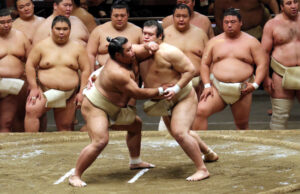
A sumo bout is officiated by the gyoji on the ring and the shimpan around it. The gyoji is the robed referee who stands on the dohyo, calls the wrestlers into action, follows the clash up close, and points his gunbai (war-fan) toward the winner. The shimpan are five ringside judges, drawn from the ranks of sumo elders, seated at the front and the sides of the ring. When a result looks close or contested, they climb onto the dohyo for a mono-ii — a conference in which they review what happened and decide whether to confirm the gyoji’s call, reverse it, or order a rematch. Between them, referee and judges make sure every bout ends with a clear, agreed result.
Watch any sumo broadcast and one figure refuses to blend into the background: a man in a brilliantly coloured robe darting around two enormous wrestlers, barking commands and waving a paddle-shaped fan. That is the gyoji, the referee — the most visible official in the sport, yet only half the story. Ringing the raised clay is a second tier of authority, ready to overrule him at any moment.
The gyoji: referee, ceremony, and traffic cop
The gyoji runs the bout from the moment the wrestlers step onto the dohyo. He announces their names, oversees the ritual face-offs at the starting lines, and watches for the charge that begins the contest. Once bodies collide his job turns almost athletic: he circles the pair at close range, fixes his sightline on the decisive point — a heel near the edge, a hand about to brush the clay — and never stops calling. The clipped shouts urging the wrestlers on are both performance and control.
When it ends, the gyoji must commit. There are no draws in a sumo bout and no replay screen to lean on. He raises the gunbai and points it firmly toward the side he has judged the winner, a verdict delivered within a heartbeat of the finish. He is never allowed to signal indecision; even in the tightest finish, he points one way. If he is wrong, the system around him exists to catch it — but he makes the call first.
The robes and the gunbai
The costume is not decoration for its own sake. The silk robe, modelled on the formal court dress of feudal Japan, signals the ceremonial weight the role carries, and its details shift with the referee’s rank. The gunbai echoes the war-fans samurai commanders once used to direct troops on the battlefield, repurposed here into an instrument of judgement: the fan never touches a wrestler, but the direction it points decides who has won.
A ranked profession, up to the tate-gyoji
The wrestlers are not the only ones climbing a ladder. Gyoji are themselves ranked, advancing over a long career from lower-division bouts to the sport’s biggest matches. Robes, accessories and standing all rise with that progression, so a trained eye can read a referee’s seniority before he says a word. At the very top sits the tate-gyoji, the head referee, who presides over the marquee bouts that close each day’s top-division card.
What a trained eye is reading is mostly the tassel hanging from the fan. The Japan Sumo Association assigns each grade of referee a colour, and the footwear and accessories follow the same ladder.
| Gyoji grade | Tassel on the fan | Feet | Also carries |
|---|---|---|---|
| Tate-gyoji (the top two) | Purple, or purple and white | Straw sandals over white tabi socks | A short sword, and an inro case at the waist |
| Sanyaku-gyoji | Vermilion | Straw sandals over white tabi socks | An inro case at the waist |
| Makuuchi-gyoji | Red and white | White tabi socks | — |
| Juryo-gyoji | Blue and white | White tabi socks | — |
| Below juryo | Blue, or black | Barefoot | — |
The ladder has eight rungs, and the Association publishes who stands on each. Counting its referee roster on August 3, 2026 gives 42 gyoji in total, distributed like this.
| Grade | Japanese | How many hold it |
|---|---|---|
| Tate-gyoji | 立行司 | 2 |
| Sanyaku-gyoji | 三役行司 | 3 |
| Makuuchi-gyoji | 幕内行司 | 8 |
| Juryo-gyoji | 十両行司 | 9 |
| Makushita-gyoji | 幕下行司 | 8 |
| Sandanme-gyoji | 三段目行司 | 7 |
| Jonidan-gyoji | 序二段行司 | 2 |
| Jonokuchi-gyoji | 序ノ口行司 | 3 |
| Total | 42 |
The rung names are borrowed wholesale from the wrestlers’ divisions, which is the neatest illustration of how the sport organises itself: a referee is placed on the same ladder as the men he judges. The yobidashi are ranked the same way. The one backstage profession that is not is the tokoyama, the hairdressers, who are graded by number instead.
The two tate-gyoji do not use their own names. The highest-ranked referee takes the name Kimura Shonosuke and the second Shikimori Inosuke, inherited titles passed down the line. Only a tate-gyoji may officiate a bout involving a yokozuna, and only Kimura Shonosuke referees the final bout of the day.
That seniority comes with a famous piece of symbolism. By tradition, a top-ranking gyoji carries a short dagger as he officiates, a tanto worn at the waist. The blade is meant to express the gravity of the responsibility he accepts every time he raises the fan: in the old understanding, a wrong call on the highest stage was a failure serious enough to answer for with one’s life. It is essential to be precise here. The dagger is a symbol — a reminder of accountability rooted in sumo’s samurai heritage — not something acted upon today. No modern referee harms himself over a mistake; an incorrect call is corrected by the judges, not paid for in blood.
The five shimpan around the ring
If the gyoji is the sport’s most animated official, the shimpan are its most authoritative. Five of them sit around the dohyo — at the front, at the back, and on each side. They are not hired referees but senior figures from inside the sumo world, elders who once wrestled and now hold a stake in running the sport. Low and still, each has a clean angle on a different stretch of the ring’s edge. That spread is deliberate: a foot stepping out or a hand touching down can be invisible from one seat and obvious from another, so the panel sees collectively what no single official can. For most bouts they do nothing visible; their power surfaces only when a result is in doubt, and then it outranks the referee’s.
The mono-ii: how a disputed call is settled
When a finish is too close to trust to a single fan — or when a judge believes the gyoji pointed the wrong way — the shimpan call a mono-ii, literally a “talk about things.” The judges rise and step onto the dohyo, gathering in the centre while the wrestlers wait. There, in full view of the arena, they confer about what they saw: whose body part touched down first, whose foot crossed the edge, who was already falling beyond recovery at the decisive moment.
A mono-ii ends in one of three ways. The judges can uphold the gyoji’s decision, confirming the fan pointed the right way. They can reverse it, awarding the bout to the other wrestler and overriding the referee. Or, if they cannot separate the two — touches or steps that looked genuinely simultaneous — they can order a torinaoshi, a rematch, sending both wrestlers back to the lines to fight again. Whichever way it falls, the panel’s conclusion is announced to the crowd, and that announcement, not the original wave of the fan, becomes the official result.
How referee and judges combine for a final result
The elegance of the arrangement is in the division of labour. The gyoji guarantees speed and decisiveness; the shimpan guarantee accuracy, with the angles, the seniority, and the authority to correct a mistake when one slips through. One acts, several review, and by the time the wrestlers bow and leave, the outcome has been called on the clay and, when needed, stress-tested around it. There is no appeal afterward — the result announced is the result that stands. For a sport in which a tournament can turn on a hair’s-breadth finish, that is what keeps the record clean. To go deeper on what they are actually judging, see our guides to the rules of sumo and the kimarite winning techniques.
The gyoji is the robed referee on the dohyo who calls the action and points his gunbai war-fan at the winner the instant a bout ends — he must always commit to one side.
Five shimpan, senior figures from the sumo world, sit around the ring; when a call is close or contested they hold a mono-ii conference and can uphold it, reverse it, or order a torinaoshi rematch.
The tradition of a top gyoji carrying a short dagger is symbolic — a reminder of the responsibility behind every call, not something acted on today; mistakes are corrected by the judges.
Frequently Asked Questions
What is the difference between a gyoji and a shimpan?
The gyoji is the referee who stands on the ring, manages the bout, and makes the first call by pointing his fan at the winner. The shimpan are the five judges seated around the ring who review close or disputed finishes. The gyoji acts in the moment; the shimpan have the authority to overrule him if his call was wrong.
Can the judges overturn the referee’s decision?
Yes. During a mono-ii the shimpan can reverse the gyoji’s call and award the bout to the other wrestler, or order a rematch (torinaoshi) if the finish looked simultaneous. When the panel announces its conclusion, that ruling — not the referee’s original fan signal — is the official result.
Why does the top gyoji carry a dagger?
It is a tradition rooted in sumo’s samurai heritage. The short dagger carried by a top-ranking gyoji symbolises the gravity of taking responsibility for every decision he makes. It is meant as a reminder of accountability, not a practice carried out today — a wrong call is corrected by the judges, not paid for by the referee.
What is a mono-ii in sumo?
A mono-ii is the conference the ringside judges hold when a result is too close to call or when they disagree with the gyoji. The shimpan step onto the dohyo, discuss what they saw, and then uphold the call, reverse it, or order a rematch. If you are new to following bouts live, our guide on how to watch sumo explains what to look for when a mono-ii is called.
How can you tell a sumo referee’s rank?
By the tassel on his fan and what is on his feet. The two tate-gyoji carry a purple, or purple and white, tassel and wear straw sandals over white tabi socks; sanyaku-gyoji carry vermilion; makuuchi red and white; juryo blue and white; and the grades below that carry blue or black and officiate barefoot. Only the top two also carry a short sword.
How many judges are there in sumo?
Five, for every bout regardless of rank. They sit at the front, the back and each side of the ring, all of them former wrestlers, and their spread of angles is the point: a foot crossing the bales can be invisible from one seat and obvious from another.
Sources
The gyoji grades, tassel colours, footwear, the inro and short sword, the inherited names Kimura Shonosuke and Shikimori Inosuke, the rule that only a tate-gyoji officiates a yokozuna bout, and the fixed number of five shimpan are from the Japan Sumo Association’s official English introduction, Sumo (sumo.or.jp). Retrieved August 3, 2026.