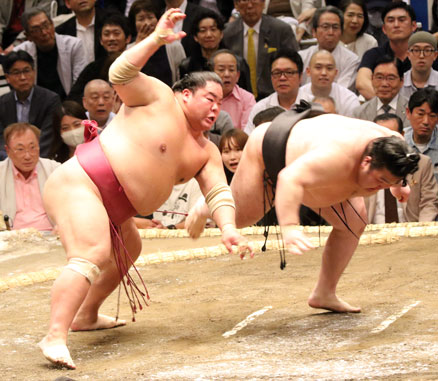
Photo by Michihiro Taguchi — shot ringside.
In sumo, Daieisho is a pushing-and-thrusting specialist out of Oitekaze stable, run by the former Daishoyama. A product of the powerhouse Saitama Sakae High School sumo club, he climbed steadily through the ranks before breaking through to the top division — and went on to lift his first yusho.
A sumo boy from Saitama Sakae
As his shikona suggests, Daieisho came up through the sumo club at Saitama Sakae High School, a name that today supplies a steady stream of wrestlers to the professional ranks. He had been wrestling since elementary school — a sumo boy through and through, much like Endo. When he turned pro, he entered Oitekaze stable, led by the former Daishoyama. His early ring names changed as he rose: Takanishi in the maezumo preliminary bouts, and Daishoei down in jonokuchi.
A fast climb to juryo
His ascent was smooth. He took the jonokuchi championship in March 2012, and just six tournaments on from jonokuchi he had reached makushita. From the September 2012 basho — his second tournament in sandanme — he adopted the name he wrestles under today, Daieisho. He stumbled in makushita with back-to-back losing records and slipped back to sandanme, but won the division there and bounced straight back up. Only a year after that return, he secured promotion to juryo. Counting from jonokuchi, the climb took 14 tournaments — a quick rise by any measure. His combined record through the makushita ranks and below stood at 67 wins and 31 losses.
Struggling to stick in makuuchi
Juryo proved tougher. It took him seven tournaments to reach makuuchi, and with three losing records along the way, the grind showed. The real hardship, though, came after he got there: he could not hold his place in the top division. Twice he dropped back to juryo — the first time for two tournaments, and after his second promotion he lasted only four tournaments in makuuchi. He had reached new juryo back in July 2014, but it was only from his third trip up to makuuchi that he finally settled.
Testing himself against the top rankers
That third promotion came at the March 2017 basho, where he posted 11 wins. The following May tournament brought his first taste of the joi — the upper ranks. Facing three yokozuna and two ozeki, he lost every one of those bouts and finished 4–11, a chastening result. His next crack at the top came a year later, in May 2018. He beat ozeki Goeido that time, but a 5–10 record showed he still could not keep pace up there.
Finding his footing at the top
Daieisho began to establish himself near the top of the banzuke from the March 2019 tournament. In both March and May he came up just short at 7–8, though in March he toppled two ozeki, Takayasu and Goeido. From the July basho he started posting winning records there, stringing together three straight kachikoshi. Across 2019 he went 47–43, with a 2–5 mark against yokozuna and 5–6 against ozeki. That September he claimed a kinboshi, upsetting yokozuna Kakuryu. Standing 165 kilograms and built around his pushing-and-thrusting game, he carried real momentum into a new year — and a new rank of komusubi, earned for the January banzuke after handing yusho winner Hakuho his only defeat at the previous November tournament, a run that brought him the Outstanding Performance prize.
Inside the championship run
Tracking his sumo from the second week of his title run — scored not on the result but on how fully he imposed his own game — shows a wrestler steadily taking control:
- Day 8 vs Kagayaki — Daieisho charged in thrusting, but Kagayaki countered and drove him to the edge. He spun out and won by reversal with a tottari arm bar — a narrow, dangerous escape.
- Day 9 vs Takarafuji — His thrusting attack failed to move Takarafuji, who rode it out and pulled him down. His first loss of the run.
- Day 10 vs Hokutofuji — He drove Hokutofuji to the straw and kept after him for a clean thrust-out.
- Day 11 vs Onosho — He won the tachiai and pushed Onosho back, but a thrust-down sent his own momentum flying out of the ring. He won the sumo and lost the bout — his second loss.
- Day 12 vs Meisei — A back-and-forth thrusting exchange that went to a monoii conference, decided in Daieisho’s favor.
- Day 13 vs Ryuden — He thrust Ryuden up and carried him straight out, staying level with Shodai at the front of the yusho race on two losses.
- Day 14 vs Tamawashi — A bullet-like charge and relentless thrusting set up a pull-down. With Shodai losing, Daieisho moved into the sole lead.
- Senshuraku vs Okinoumi — A win meant the title. He hit hard and thrust Okinoumi out in a straight line, sealing his first yusho.
From Day 8 onward his sumo was worth 33 points on that scale, and 67.5 across the full 15 days — the equivalent of 90 out of 100. He took the championship with a genuinely high score.
Frequently asked questions
Q. Where did Daieisho learn sumo?
He wrestled from elementary school and came up through the sumo club at Saitama Sakae High School before turning pro with Oitekaze stable.
Q. What is Daieisho’s style?
A pushing-and-thrusting specialist. At 165 kilograms, he builds his sumo around a hard charge and relentless thrusts.
Q. How did Daieisho win his first yusho?
He took the sole lead late in the tournament and clinched the title on the final day, thrusting Okinoumi out in a straight line for his first championship.
Photos by Michihiro Taguchi, shot ringside.