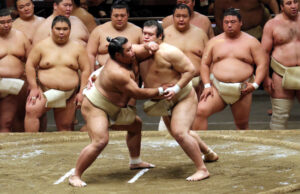
To watch a grand sumo tournament in Japan, choose the tournament first, then a seat and an official ticket channel. Tokyo hosts the January, May and September tournaments; Osaka, Nagoya and Fukuoka host March, July and November. Each lasts fifteen days. Check availability before committing to a trip: an old guide mentioning a queue for same-day tickets is not evidence that those tickets will be sold at your tournament.
Start with the city and the dates
The Japan Sumo Association’s official tournament calendar lists the venue, first and final days, general on-sale date and banzuke announcement. Read the row for your year: the month stays familiar, but the exact dates move. Our tournament calendar guide brings those dates together with an explanation of the competition.
A Tokyo trip outside January, May or September will not coincide with a Tokyo grand tournament. The guide to sumo between tournaments distinguishes museum visits, regional tours, training visits and commercial shows. They offer different experiences; a demonstration is not a ranked tournament bout.
Choose a seat you can use comfortably
Masu-seki are Japanese-style floor boxes. Isu-seki are chair seats. Compare the total you must pay, the stated capacity and the seating position on the particular tournament’s sales page. A price for a whole box is not a price for one person. Four-person boxes are common, but do not assume every box has the same capacity or every venue has the same grades.
Ringside tamari-seki have additional access and use restrictions. Check the Association’s seat-use rules and our spectator guide before choosing this area.
Our ticket guide explains example prices and the presale process. Use the official checkout for the actual total, including fees, rather than treating a comparison table as a live offer.
Buy through the official route
Begin at the Association’s English How to Buy page and follow its ticket-service link. Check the chosen service’s language, registration, payment and ticket-delivery requirements before the sale opens. A Japanese presale or fan-club lottery may have a different process from the English general-sale service.
A presale application is a chance to buy, not a confirmed reservation. If general sale is sold out, look for the official resale service linked by the Association. Availability depends on tickets actually being returned. Do not build a travel plan around an assumed walk-up allocation or a promised resale seat.
There is a useful distinction between reported demand and your own chances. In his August 8, 2026 report, Michihiro Taguchi described fans finding the September ticket draw harder than the May draw. That is a report of their experience, not a published success rate. It explains why planning ahead matters without supplying odds we cannot verify.
Plan the day around what you want to see
Lower divisions appear before the top-division programme. The ring-entering ceremonies are part of the day, as well as the bouts themselves. Read the tournament’s daily programme and door time before choosing when to arrive; the schedule is not identical on every day.
For a first visit, identify your entrance and seat before the bouts you most want to watch. Leave time to find food or the toilets without standing in another spectator’s view. Our spectator guide separates official restrictions from practical courtesy.
If you cannot attend
Check the broadcaster or streaming service available in your country for coverage of the specific tournament. A highlights programme, selected live bouts and a complete live broadcast are different products. Availability, access conditions and charges depend on the provider and region. We do not describe all television coverage as free or promise every bout through one service.
Frequently Asked Questions
Can I turn up without buying a ticket?
Only plan on same-day sales if the current official notice confirms them. Do not assume unsold seats or a separate walk-up allocation will exist after advance sales sell out.
Does a box-seat price mean the cost per person?
Read the sales unit carefully. A whole-box price covers the specified box; the per-person cost depends on how many permitted places your group uses. Chair seats are a useful alternative to compare.
Sources and update
Calendar and ticket guidance: Japan Sumo Association, Grand Tournament Schedule and How to Buy. Ringside restrictions: seat-use rules (Japanese). Checked October 2, 2026. The linked Taguchi article supplies the attributed account of ticket demand. This is a planning guide, not a ticket seller.