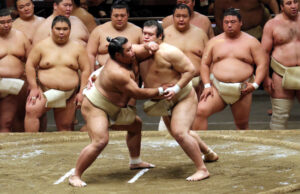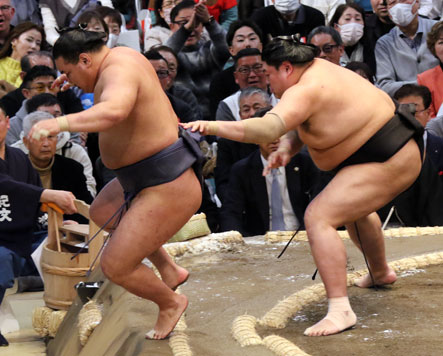
A kimarite is the officially named technique that wins a sumo bout, and there are 82 of them. The Japan Sumo Association recognizes 82 winning techniques, sorted into six official families, plus five recorded outcomes that are not techniques at all — cases where a wrestler goes out or goes down under his own momentum. This guide explains the six categories, a selection of moves to recognize, and the five non-technique outcomes. The complete illustrated list is linked below.
A kimarite names the action that decided a bout. The opening charge may be a push, yet the finish may be a throw; the recorded name describes that finish. Start by watching the last exchange, then compare it with the announced result. You do not need to memorize 82 names before you can follow a match.
The rules underneath are simple. A wrestler loses if any part of his body other than the soles of his feet touches the clay, or if he touches the ground outside the straw ring, the dohyo. Everything a kimarite describes is a path to one of those two endings. If you are new to the sport, the broader framework is laid out in our guide to the basic rules of sumo; this article zooms in on the finishing moves.
The 82 kimarite, by official category
The Japan Sumo Association sorts its 82 techniques into six named families, in a fixed order. Below that sit the five non-technique outcomes, which are recorded like kimarite but describe a wrestler beating himself rather than being beaten.
| Family | Japanese | How many | What it covers |
|---|---|---|---|
| Kihonwaza | 基本技 | 7 | Basic pushes, thrusts and force-outs, including their falling finishes. |
| Nagete | 投げ手 | 13 | Throws, using a grip on the belt or an arm. |
| Kakete | 掛け手 | 18 | Leg techniques: hooking, tripping and sweeping. |
| Sorite | 反り手 | 6 | Backward body drops, involving an arching motion underneath or around the opponent. |
| Hinerite | 捻り手 | 19 | Twists, breaking the opponent’s balance by turning the body. |
| Tokushuwaza | 特殊技 | 19 | Special techniques that fit none of the above, including the slap-down and the lift-out. |
| Total techniques | — | 82 | — |
| Hiwaza (non-techniques) | 非技 | 5 | Outcomes with no winning move: isamiashi, koshikudake, tsukite, tsukihiza, fumidashi. |
Those six official families are the record-keeper’s categories. For watching, a coarser split works better: pushing and thrusting, grappling and throwing, leg and tripping techniques, and the non-technique decisions. Get those four straight and the rest is detail.
Pushing and thrusting
Oshidashi and tsukidashi both send the opponent out without the belt-gripping finish of yorikiri. For oshidashi, watch the hands applying pressure to the chest or under the arms. For tsukidashi, look for repeated thrusts. The visual question is how the wrestler is being moved, rather than simply whether he goes backward.
Grappling and throwing
Once both men have hold of the mawashi, the heavy cotton belt, the bout becomes a wrestling match and the throws come into play. The two you will hear named most often are uwatenage and shitatenage, the overarm and underarm throws. Uwatenage uses a grip reaching over the opponent’s arm to the back of his belt, then turns him to the clay; shitatenage works from underneath, the arm threaded inside, a throw of leverage and timing rather than raw strength. The family also includes kotenage, the arm-lock throw, where a wrestler clamps the opponent’s arm and swings him down without gripping the belt at all.
Leg and tripping techniques
For leg techniques, watch which side of the opponent’s leg is being hooked. Sotogake hooks from the outside; uchigake from the inside. Kekaeshi sweeps the opponent’s ankle from the inside. A replay is useful here: the upper bodies can hide the footwork that decided the bout.
Non-technique decisions
The five non-technique outcomes describe a loss without an opponent’s decisive winning technique. In isamiashi, the attacking wrestler drives forward but steps outside first. Fumidashi records a wrestler stepping out without being forced out by the opponent. Do not use “stepping backward” as the definition of isamiashi: the key is the attacker overrunning the edge.
Watch the finish. The named technique describes the decisive action, which may differ from the attack at the start.
Four viewing cues. Pushing and thrusting, grappling and throwing, leg and tripping techniques, and the non-technique decisions where a wrestler defeats himself.
The judges have the final word. The gyoji calls an instant winner, but the ringside shimpan can overrule him through a mono-ii conference, and a too-close bout can be rerun as a torinaoshi.
The five non-technique outcomes: watch the losing wrestler
These names describe what went wrong for the loser. Follow the official links for the Japanese definitions and illustrations.
| Outcome | Japanese | What to look for |
|---|---|---|
| isamiashi | 勇み足 | The attacker carries the attack too far and steps out first. |
| koshikudake | 腰砕け | The wrestler loses balance and falls at the hips without an opponent’s technique causing it. |
| tsukite | つき手 | A hand touches the ground without an opponent’s technique causing the fall. |
| tsukihiza | つきひざ | A knee touches the ground without an opponent’s technique causing the fall. |
| fumidashi | 踏み出し | The wrestler steps outside without being forced out by the opponent. |
The kimarite you will actually hear
Of the 82, a small group does most of the work. These are the names that recur day after day, with the ones described above collected in one place.
| Kimarite | Japanese | Family | What it looks like |
|---|---|---|---|
| yorikiri | 寄り切り | Kihonwaza | Frontal force-out. A belt grip, chest to chest, walking the opponent out over the bales. |
| oshidashi | 押し出し | Kihonwaza | Push-out. Continuous pressure with hands or body until he crosses the straw. |
| tsukidashi | 突き出し | Kihonwaza | Thrust-out. A volley of open-palm strikes to chest and throat, battering him backward. |
| uwatenage | 上手投げ | Nagete | Overarm throw, gripping over the opponent’s arm to the back of his belt. |
| shitatenage | 下手投げ | Nagete | Underarm throw using a belt grip reached inside the opponent’s arm. |
| kotenage | 小手投げ | Nagete | Arm-lock throw. Clamps the opponent’s arm and swings him down without a belt grip. |
| sotogake | 外掛け | Kakete | Hooks a leg around the outside of the opponent’s leg to topple him. |
| uchigake | 内掛け | Kakete | The same hook, applied from the inside. |
| kekaeshi | 蹴返し | Kakete | A quick kick to the inside of the ankle as his weight shifts onto it. |
| tsukiotoshi | 突き落とし | Hinerite | Thrust-down. A twisting push to the side that drops him on the spot. |
| hatakikomi | 叩き込み | Tokushuwaza | Slap-down. Sidestep an over-committed charge and slap the shoulder so his own momentum finishes him. |
| tsuridashi | 吊り出し | Tokushuwaza | Lift-out. Hoisting the opponent clean off the clay by the belt and carrying him out. |
What the Most Common Techniques Look Like
Yorikiri is a frontal force-out: the wrestler stays in close contact and drives the opponent over the boundary. Compare it with oshidashi, where the hands press against the body. In the Japan Sumo Association’s displayed ranking from January 2013 through Day 13 of September 2026, oshidashi comes first and yorikiri second. That is a ranking for the association’s stated dataset, not a claim about every division or every period.
Then there are the techniques that make highlight reels. Hatakikomi, the slap-down, punishes an over-committed charge: the defender sidesteps and slaps the opponent’s shoulder or back so his own momentum sends him down. Tsuridashi, the lift-out, is pure power, a wrestler hoisting his opponent clean off the ground by the belt and carrying him out. The throws, uwatenage and shitatenage and their relatives, supply the moments when a bout that looked lost is reversed in a single turn of the hips.
Part of the pleasure of following sumo at the top of the banzuke ranking is watching how elite wrestlers favor different styles. A grand champion, or yokozuna, is expected to win with command and composure rather than scrambling tricks, and the kimarite that recur in a champion’s record reveal a great deal about how he fights.
Who Decides the Winner: The Gyoji and the Shimpan
A sumo bout can be over in a heartbeat, and someone has to rule on it instantly. That someone is the gyoji, the referee in the elaborate robes who stands on the dohyo throughout. The moment the bout ends, he must point his war fan, the gunbai, toward the wrestler he judges to have won. He is never allowed to call a draw; one side must be declared.
The gyoji is not the final authority, though. Around the ring sit the shimpan, ringside judges and former wrestlers who watch from floor level. If they believe the gyoji has erred, or the finish was too close to call with confidence, they raise their hands and step onto the dohyo for a conference called a mono-ii, literally a discussion. Talking it through, sometimes consulting video review, they reach one of three outcomes: uphold the gyoji’s decision, reverse it and award the bout to the other wrestler, or, if the two seem to have hit the clay or stepped out at the same instant, order the bout fought again. That rematch is the torinaoshi.
A mono-ii is one of the quietly dramatic rituals of sumo. The arena hushes, the wrestlers wait, and the judges deliberate in the center of the ring before announcing the verdict to the crowd. Knowing what is happening turns a confusing pause into a piece of theatre. To make the most of these moments, our guide on how to watch sumo walks through what to look for during a broadcast.
Why Kimarite Matter to How You Watch
Kimarite are more than trivia. They are the language the sport uses to describe itself, encoding a whole hierarchy of difficulty and style. A wrestler known for clean force-outs fights a different sport from a technician who lives off throws, and the record of how each man wins is, in effect, his signature. You do not need to memorize the full list to enjoy this. Start with the handful that decide most bouts, learn the two throws everyone names, and notice when something rarer flashes by. Once the announcer’s call lands on a technique you recognize, you are no longer watching two men collide. You are watching a contest you can read.
Frequently Asked Questions
How many kimarite are there?
Eighty-two, on the official list maintained by the Japan Sumo Association, sorted into six families: 7 basics, 13 throws, 18 leg techniques, 6 backward body drops, 19 twists and 19 special techniques. Five further outcomes are recorded but are not techniques at all. Only a fraction of the 82 appear with any regularity, and many can go a whole tournament without being seen.
What is the most common kimarite?
In the Japan Sumo Association’s ranking from January 2013 through Day 13 of September 2026, oshidashi ranks first and yorikiri second. Rankings depend on the period and the bouts included. For a beginner, both are useful starting points: oshidashi is a push-out; yorikiri is a frontal force-out with close body contact.
Can a sumo bout end in a draw?
In a close finish in modern professional sumo, the gyoji first points his fan to one side. If the finish is genuinely too close to separate, the ringside judges can order a rematch, the torinaoshi, and the wrestlers fight again rather than sharing the result.
What is a mono-ii?
A mono-ii is the conference the ringside judges hold when they want to review the gyoji’s decision. They step onto the dohyo, discuss the finish, sometimes consult video, and then either uphold the call, reverse it, or order the bout to be fought again. The verdict is announced to the crowd before the next bout begins.
What is the difference between isamiashi and fumidashi?
Isamiashi is an attacking wrestler stepping out first while driving the opponent toward the boundary. Fumidashi is stepping out without the opponent’s force causing it. Both are among the five non-technique outcomes, so the result credits a win without naming a winning push or throw.
Where to go next
The technique is announced at the end of a bout that begins with the tachiai, the synchronized charge, after the staring-down ritual of the shikiri. The referee’s role and the judges’ review are set out in our guide to the gyoji and shimpan — and what the referee shouts while the bout is still running is explained in hakkeyoi and nokotta. Most of the throws start from a grip on the mawashi. For every other word you will hear, see the sumo glossary.
Sources
Definitions and category counts: Japan Sumo Association, complete kimarite list. The five non-technique definitions are linked in their table above. The most-common comparison uses the association’s displayed ranking for January 2013 through Day 13 of September 2026, checked September 26, 2026. The viewing cues are The Sumo’s explanation of how to read these definitions during a broadcast.
Correction, September 26, 2026: We corrected the direction and meaning of isamiashi, separated it from fumidashi, and replaced unsupported frequency claims with a dated official ranking.