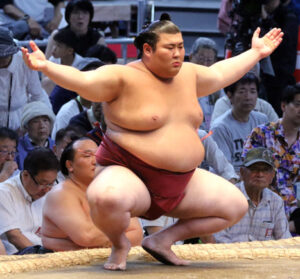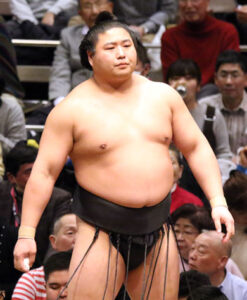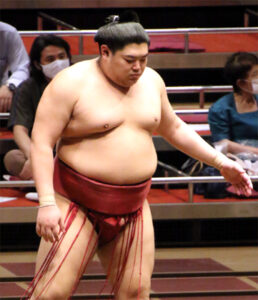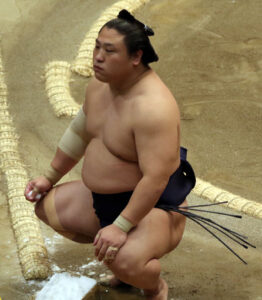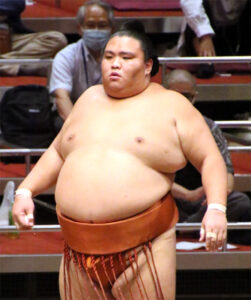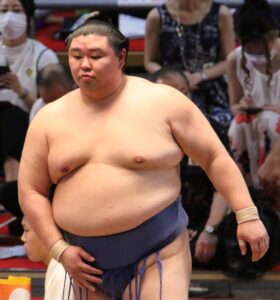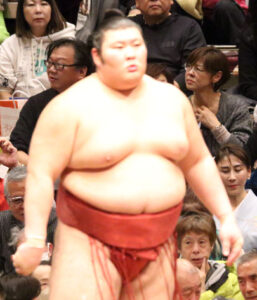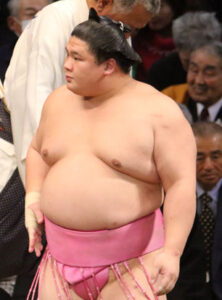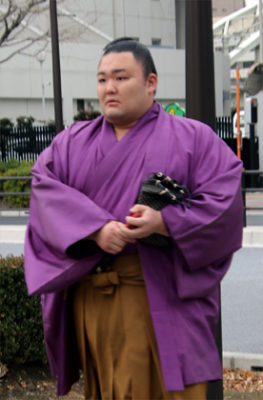
Photo by Michihiro Taguchi.
In sumo, Asanoyama is a former ozeki from Takasago stable who fell further than any ozeki of the modern era and climbed back twice. He was promoted to the rank in 2020 and held it for seven tournaments. He did not lose it to a losing record: a suspension kept him off the ring for seven tournaments and the ranking sheet carried him down to sandanme, the third division from the bottom. He returned to the top division in 2023, fell to sandanme again through injury, and returned again. He is 32, was ranked maegashira 10 at Nagoya 2026, and still has the one championship he won in May 2019.
Where he stands now — October 2026
The account further down this page — the promotion, the style, the window at the top — was written in 2020, in the weeks after he reached the rank. It did not go the way it reads. This section is what happened next.
| Rank | East maegashira 6, September 2026 (Aki) banzuke |
| Stable | Takasago |
| Age | 32 (born March 1, 1994, Toyama) |
| Size | 188 cm, 172 kg |
| Highest rank | Ozeki, July 2020 – July 2021 |
| Championships | 1 — May 2019 |
| Last three tournaments | May 2026, maegashira 10, 7–5 and withdrew · July 2026, maegashira 10, 9–6 · September 2026, maegashira 6, 10–5 |
He did not lose the rank in the ring
Asanoyama held ozeki for seven tournaments. He did not lose it to two losing records, which is the only way the rulebook takes the rank away. He lost it to a suspension.
During the period when the Japan Sumo Association had told everyone in the sport not to go out, he went out — and then had others back up an account that was not true. He was pulled from a tournament mid-way and then suspended for six more. Seven tournaments away from the ring in all. A wrestler’s rank falls when he does not wrestle, and by the time he was allowed back he was in sandanme, the third division from the bottom, four divisions below the salaried ranks.
Taguchi’s view of the sanction, written in 2025 with five years of hindsight, is not the conventional one. He calls the punishment severe — and points out that a salaried wrestler caught going out to gamble drew a one-tournament suspension. His conclusion: there is no consistent standard behind these decisions, and the sloppiness is the Association’s, not the wrestler’s. He does not excuse the false account. He objects to a scale of penalties that nobody can state in advance.
Two climbs back from sandanme
He made it back to the top division in May 2023 and went 12–3 in that first tournament back — the sort of return that suggests the rank was never really the issue. He got as high as komusubi. Then his knee went, and this time it was injury rather than discipline: a full withdrawal, then more, and the ranking sheet carried him all the way back down to sandanme a second time.
By November 2025 he was at juryo 4, one good tournament from the top division again. Taguchi did the arithmetic at the time and it was mostly about age. The first climb ended with him back in makuuchi at 29. A second return would land him there at 31, turning 32 in the March after — and at that age, he wrote, getting as far as komusubi or sekiwake would be a good outcome. There would be no third promotion to ozeki.
He got back. He was ranked maegashira 12 for the March 2026 tournament, and he has held a place in the top half of the maegashira ranks since, going 9–6 at maegashira 10 in July 2026.
What is left
Taguchi’s tally of Asanoyama’s life after the demotion, taken at the end of January 2024: 42 wins, 20 losses and 13 days missed in the top division, 0–1 against yokozuna and 2–5 against ozeki. Three of his first five tournaments back involved withdrawing or joining late. The body, not the ranking sheet, is what decides this.
He has one championship: May 2019, the tournament that Donald Trump attended and at which the visiting president handed him a trophy. Taguchi wants him to get one more, and says so plainly — a wrestler drops into a hole this deep from a punishment that harsh, and you find yourself hoping for one last piece of glory. His route, on Taguchi’s reading, is the one Kotoshoho took in July 2025: catch the top ranks in a gap and go through it.
Promotion to ozeki
Among the current makuuchi division, Asanoyama stood out as the one rikishi capable of aiming for ozeki. His promotion to the rank was made official at the banzuke-editing meeting and an extraordinary board meeting — the birth of a new ozeki. At the proclamation ceremony, he delivered his statement: that he would not disgrace the name of ozeki, that he would love sumo, fulfil justice as a rikishi, and work hard with everything he had.
A style built on pressure and forward drive
Asanoyama wrestles with a right-hand inside grip, the migi-yotsu style. The grip calls to mind past greats such as Futabayama and Tamanoumi, but those men fought from the hips. Asanoyama is different: he wins through pressure and forward movement. The pressure he generates is considerable, and it is the source of his strength. For a time he struggled against thrusting-and-pushing power wrestlers, but that pressure is exactly what let him overcome the problem.
The challenge: contending for a yusho
So what is Asanoyama’s task now? Having become an ozeki, he must fight for the championship. His best result at the upper ranks so far has been 11 wins, which leaves him far from a yusho. Until now, even when yokozuna Hakuho and Kakuryu sat out, the ozeki still could not win — and the hope is that Asanoyama will not become that kind of ozeki. Whether the yokozuna are absent or competing, he is wanted in the yusho race.
No ozeki has taken a championship since Kisenosato at the January 2017 basho. Maegashira, komusubi and sekiwake have all produced yusho winners, yet the ozeki who reign above them have not — and that erodes the very value of the rank. The hope is that Asanoyama can break this state of affairs.
Not getting comfortable at the rank
An ozeki is not demoted to sekiwake unless he posts losing records in two consecutive basho. Yet how many senior ozeki have leaned on that rule and piled up single-digit win totals? Under the 15-day system, the only top-ranked ozeki with more 10-win-or-better tournaments than tournaments of nine wins or fewer is Kotokaze. If Asanoyama lets the rule make him complacent, he risks following the same path.
A Kindai man, following his seniors
Asanoyama comes from Kinki University. Among his seniors in student sumo, Yutakayama — earlier known as Uchida — carried the potential to reach yokozuna, and Wajima did become yokozuna. Asanoyama is currently 26. Yutakayama reached ozeki at 25, and Wajima at 24; Wajima was then promoted to yokozuna after just four basho as an ozeki. On that count, Asanoyama is a step behind.
A window at the top
When Yutakayama rose to ozeki, the wall of Taiho stood in the way. When Wajima became yokozuna, the senior yokozuna Kitanofuji and Kotozakura had already entered their decline. Now Hakuho and Kakuryu are in the twilight of their careers — and that is precisely why Asanoyama has a chance to reach the top. Asanoyama has also already beaten Kakuryu.
Now that Asanoyama has been promoted to ozeki, other rikishi will look at him differently. How he answers that — what kind of sumo he shows in response — is the question. The May basho is one to watch.
Asanoyama photographs
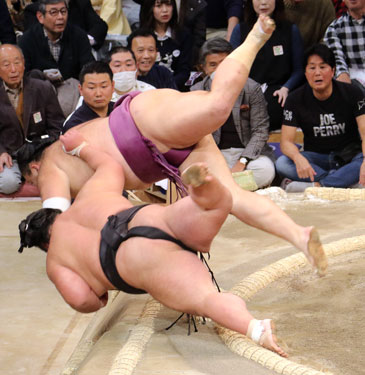
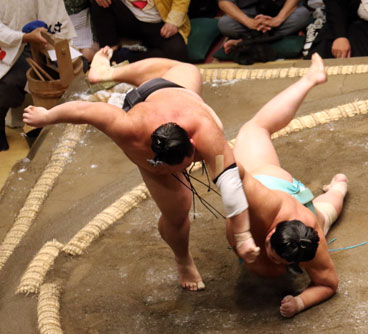
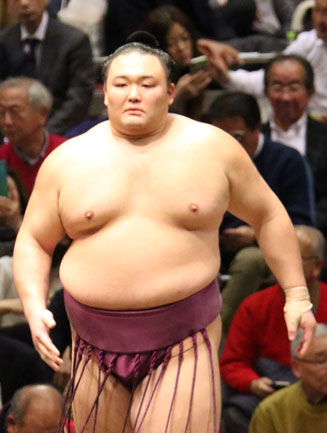
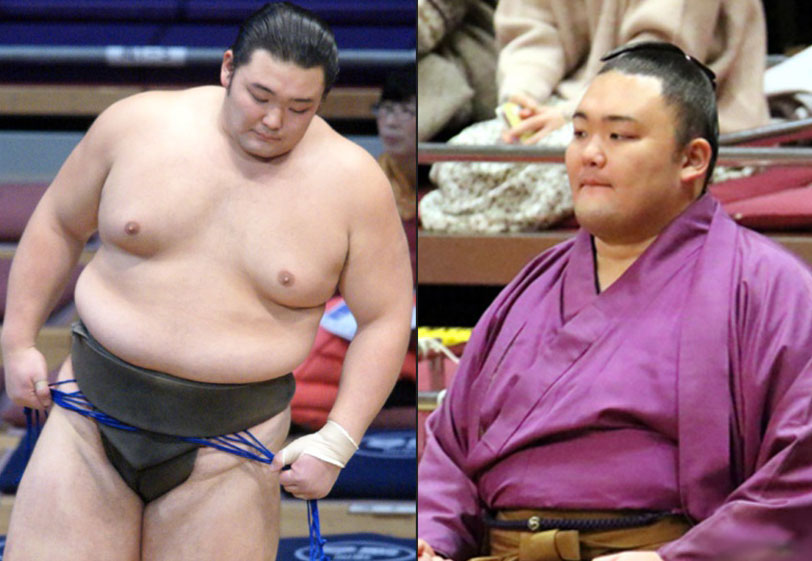
Michihiro Taguchi has photographed Asanoyama since his makushita days, when he still wrestled under his own surname, Ishibashi. The set below covers the climb back: the throws, the mid-tournament returns, and one frame of the young Ishibashi next to the wrestler he became.
Asanoyama: the official record
| Field | Asanoyama |
|---|---|
| Ring name | Asanoyama Hiroki |
| Birth name | Ishibashi Hiroki |
| Ring names used | Ishibashi, then Asanoyama |
| Stable | Takasago |
| Height and weight | 188.0 cm, 172.0 kg |
| Highest rank | Ozeki |
| Rank, September 2026 (Aki) banzuke | East maegashira 6 |
| Career record | 439 wins, 219 losses, 159 days absent, over 63 tournaments |
| Top-division record | 287 wins, 182 losses, 101 days absent, over 38 tournaments |
| Championships and prizes | 1 top-division championship, 1 juryo championship, 1 makushita and 2 sandanme titles; 2 Outstanding Performance prizes, 3 Fighting Spirit prizes, 1 Technique prize, 1 gold star |
| Most-used winning moves | yorikiri, force out, 47%; oshidashi, push out, 18%; uwatenage, overarm throw, 7% |
Frequently asked questions
Q. What happened to Asanoyama?
He was suspended for six tournaments in 2021 for breaking the Association’s COVID-19 rules and then giving a false account of it. The suspension, not a run of losses, is what carried him from ozeki down to sandanme, the third division from the bottom. He has climbed back to the top division twice since.
Q. What rank is Asanoyama now?
East maegashira 6 on the September 2026 (Aki) banzuke, up from maegashira 10 after going 9–6 at Nagoya. His highest rank remains ozeki, which he held from July 2020 to July 2021.
Q. How does Asanoyama usually win?
On the belt, going forward. The Association’s breakdown of his last six tournaments puts yorikiri (force out) at 47 per cent of his wins — the highest share of any of the wrestlers profiled here — with oshidashi at 18 per cent.
Q. What rank did Asanoyama reach?
Ozeki. His promotion was formally decided at the rankings-editing meeting and an extraordinary board meeting of the association.
Q. What is Asanoyama’s wrestling style?
A right-hand inside grip (migi-yotsu), but rather than fighting from the hips he wins through considerable pressure and forward drive.
Q. What is the main challenge for Asanoyama as an ozeki?
Contending for a yusho. His best result at the upper ranks has been 11 wins, and no ozeki has won a championship since Kisenosato in January 2017.
Reporting note: this article draws on Michihiro Taguchi’s tournament reporting and original statistical work published in Dohyo no Mokugekisha — his reading of the second comeback (November 4, 2025) and his tally of the former ozeki still wrestling (February 14, 2024). Rank, age, measurements and stable were rechecked against the Japan Sumo Association’s wrestler profiles on August 2, 2026, and per-tournament results against the Association’s published tournament sheets on August 5, 2026. Age, measurements, career totals and the September 2026 results were checked again against the Association’s wrestler profile on October 15, 2026. Official bout-by-bout records are available from the January 2013 tournament onward.
Updated August 5, 2026.
Read next: the ozeki rank explained · kadoban: the rule that costs an ozeki his rank · Mitakeumi · what happens when a wrestler sits out