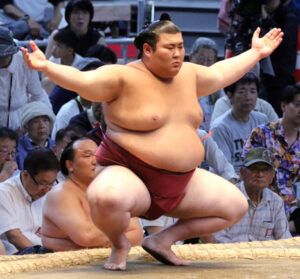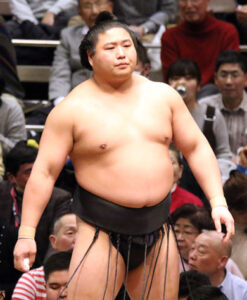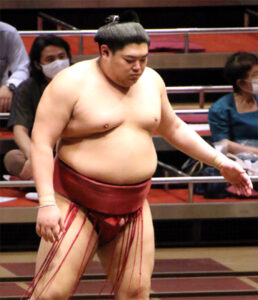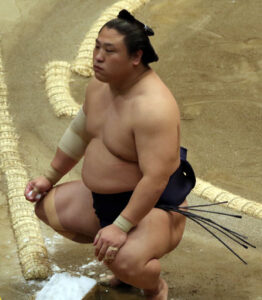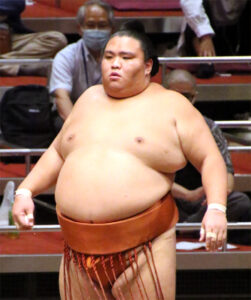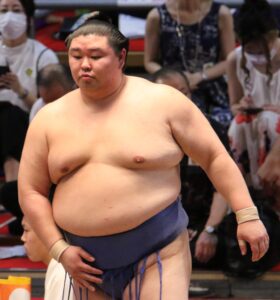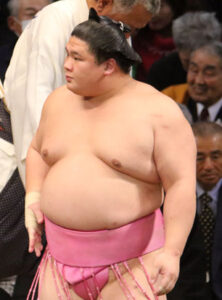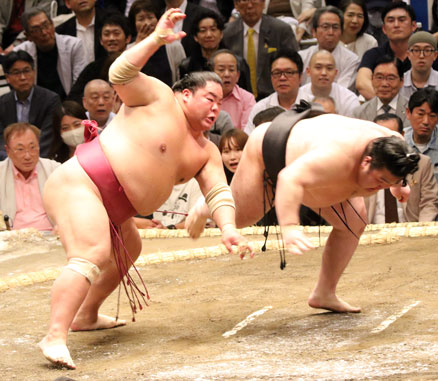
Photo by Michihiro Taguchi.
In sumo, Daieisho is a pushing-and-thrusting specialist out of Oitekaze stable, run by the former Daishoyama. A product of the powerhouse Saitama Sakae High School sumo club, he climbed steadily through the ranks, won the January 2021 championship outright, and then spent five years as the most reliable wrestler in the ranks directly below the top: eleven tournaments at sekiwake, ten at komusubi, and a winning record across the lot. Michihiro Taguchi calls him the strongest wrestler below yokozuna and ozeki. He is 32, and was ranked maegashira 4 at Nagoya 2026.
Where he stands now — October 2026
| Rank | West komusubi, September 2026 (Aki) banzuke |
| Stable | Oitekaze |
| Age | 32 (born November 10, 1993, Asaka, Saitama) |
| Size | 182 cm, 163 kg |
| Highest rank | Sekiwake |
| Championships | 1 — January 2021 |
| Last three tournaments | May 2026, maegashira 4, 7–8 · July 2026, maegashira 4, 10–5 · September 2026, komusubi, 5–10 |
The best wrestler who is not a yokozuna or an ozeki
Daieisho never became an ozeki. He is, on Taguchi’s assessment, the strongest man who never did.
The case rests on volume rather than peaks. In February 2025 Taguchi counted the top-division wrestlers whose highest rank was sekiwake and found only eight of them — a smaller group than most readers expect, because most careers stop at maegashira and the good ones keep going to ozeki. Within that group Daieisho stood apart: eleven tournaments at sekiwake with a winning 90–73 and two days missed, and another ten at komusubi. Taguchi’s verdict was one sentence — Daieisho is the strongest wrestler below the top two ranks.
The record he was chasing is the run of consecutive tournaments at sekiwake or komusubi. By June 2025 he had six in a row:
| Rank | Result |
|---|---|
| Komusubi | 8–7 |
| Komusubi | 8–7 |
| Sekiwake | 8–7 |
| Sekiwake | 11–4 |
| Sekiwake | 9–6 |
| Sekiwake | 10–5 |
Taguchi’s read at the time was structural, and worth repeating because it explains the whole rank: a streak like this is easier to extend when there are only three men above you. With three yokozuna and four ozeki on the sheet, a sekiwake has to beat all of them to hold his place. And because a losing 7–8 at sekiwake only drops a man to komusubi, the streak survives a bad tournament — it is broken by two of them, or by promotion to ozeki, which stops it automatically.
He did not get promoted, and the streak did break. He has been at maegashira 4 for the last three tournaments — 7–8, 7–8, then 10–5.
Ten wins at maegashira 4, and nobody to beat
The July 2026 tournament is the clearest picture of where Daieisho now sits. He won ten bouts from maegashira 4 and was never matched against a single one of the men who ended up fighting for the title.
Taguchi ends every tournament review with a list he calls the phantom bouts — the matchups the schedulers never made and everyone wanted. After Nagoya 2026 he named five among the wrestlers in the upper ranks who had finished with winning records, and four of the five had Daieisho in one corner: against the ozeki Kirishima, against the ozeki Kotozakura, against the sekiwake Aonishiki who won the tournament, and against Fujinokawa. A wrestler four places down the maegashira ranks does not get those bouts, however well he is going. Ten wins bought him a better rank for September and nothing else.
He is not out of the top ranks’ reach entirely. Across Hoshoryu‘s nine tournaments as a yokozuna, Daieisho is one of only four wrestlers to have split with him at two wins apiece.
A sumo boy from Saitama Sakae
As his shikona suggests, Daieisho came up through the sumo club at Saitama Sakae High School, a name that today supplies a steady stream of wrestlers to the professional ranks. He had been wrestling since elementary school — a sumo boy through and through, much like Endo. When he turned pro, he entered Oitekaze stable, led by the former Daishoyama. His early ring names changed as he rose: Takanishi in the maezumo preliminary bouts, and Daishoei down in jonokuchi.
A fast climb to juryo
His ascent was smooth. He took the jonokuchi championship in March 2012, and just six tournaments on from jonokuchi he had reached makushita. From the September 2012 basho — his second tournament in sandanme — he adopted the name he wrestles under today, Daieisho. He stumbled in makushita with back-to-back losing records and slipped back to sandanme, but won the division there and bounced straight back up. Only a year after that return, he secured promotion to juryo. Counting from jonokuchi, the climb took 14 tournaments — a quick rise by any measure. His combined record through the makushita ranks and below stood at 67 wins and 31 losses.
Struggling to stick in makuuchi
Juryo proved tougher. It took him seven tournaments to reach makuuchi, and with three losing records along the way, the grind showed. The real hardship, though, came after he got there: he could not hold his place in the top division. Twice he dropped back to juryo — the first time for two tournaments, and after his second promotion he lasted only four tournaments in makuuchi. He had reached new juryo back in July 2014, but it was only from his third trip up to makuuchi that he finally settled.
Testing himself against the top rankers
That third promotion came at the March 2017 basho, where he posted 11 wins. The following May tournament brought his first taste of the joi — the upper ranks. Facing three yokozuna and two ozeki, he lost every one of those bouts and finished 4–11, a chastening result. His next crack at the top came a year later, in May 2018. He beat ozeki Goeido that time, but a 5–10 record showed he still could not keep pace up there.
Finding his footing at the top
Daieisho began to establish himself near the top of the banzuke from the March 2019 tournament. In both March and May he came up just short at 7–8, though in March he toppled two ozeki, Takayasu and Goeido. From the July basho he started posting winning records there, stringing together three straight kachikoshi. Across 2019 he went 47–43, with a 2–5 mark against yokozuna and 5–6 against ozeki. That September he claimed a kinboshi, upsetting yokozuna Kakuryu. Standing 165 kilograms and built around his pushing-and-thrusting game, he carried real momentum into a new year — and a new rank of komusubi, earned for the January banzuke after handing yusho winner Hakuho his only defeat at the previous November tournament, a run that brought him the Outstanding Performance prize.
Inside the championship run
Tracking his sumo from the second week of his title run — scored not on the result but on how fully he imposed his own game — shows a wrestler steadily taking control:
- Day 8 vs Kagayaki — Daieisho charged in thrusting, but Kagayaki countered and drove him to the edge. He spun out and won by reversal with a tottari arm bar — a narrow, dangerous escape.
- Day 9 vs Takarafuji — His thrusting attack failed to move Takarafuji, who rode it out and pulled him down. His first loss of the run.
- Day 10 vs Hokutofuji — He drove Hokutofuji to the straw and kept after him for a clean thrust-out.
- Day 11 vs Onosho — He won the tachiai and pushed Onosho back, but a thrust-down sent his own momentum flying out of the ring. He won the sumo and lost the bout — his second loss.
- Day 12 vs Meisei — A back-and-forth thrusting exchange that went to a monoii conference, decided in Daieisho’s favor.
- Day 13 vs Ryuden — He thrust Ryuden up and carried him straight out, staying level with Shodai at the front of the yusho race on two losses.
- Day 14 vs Tamawashi — A bullet-like charge and relentless thrusting set up a pull-down. With Shodai losing, Daieisho moved into the sole lead.
- Senshuraku vs Okinoumi — A win meant the title. He hit hard and thrust Okinoumi out in a straight line, sealing his first yusho.
From Day 8 onward his sumo was worth 33 points on that scale, and 67.5 across the full 15 days — the equivalent of 90 out of 100. He took the championship with a genuinely high score.
Frequently asked questions
Q. Where did Daieisho learn sumo?
He wrestled from elementary school and came up through the sumo club at Saitama Sakae High School before turning pro with Oitekaze stable.
Q. What is Daieisho’s style?
A pushing-and-thrusting specialist. At 165 kilograms, he builds his sumo around a hard charge and relentless thrusts.
Q. How did Daieisho win his first yusho?
He took the sole lead late in the tournament and clinched the title on the final day, thrusting Okinoumi out in a straight line for his first championship.
Reporting note: this article draws on Michihiro Taguchi’s tournament reporting and original statistical work published in Dohyo no Mokugekisha — his count of the current wrestlers whose highest rank is sekiwake (February 18, 2025), his piece on the consecutive titled-rank record (June 23, 2025) and his review of the Nagoya 2026 tournament (July 28, 2026). Rank, age, measurements and stable were rechecked against the Japan Sumo Association’s wrestler profiles on August 2, 2026, and per-tournament results against the Association’s published tournament sheets on August 5, 2026. Age, measurements, career totals and the September 2026 results were checked again against the Association’s wrestler profile on October 15, 2026. Official bout-by-bout records are available from the January 2013 tournament onward.
Updated August 5, 2026.
Read next: sekiwake and komusubi explained · Abi · Hoshoryu, the 74th yokozuna · how a winning record moves you up the banzuke