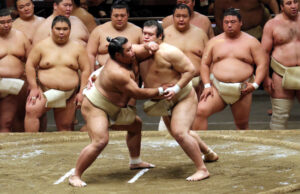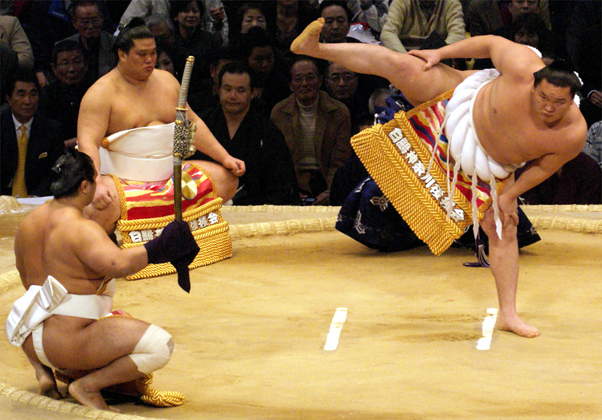
The dohyo is sumo’s ring: a clay platform 6.7 metres square and 60 centimetres high, with a fighting circle just over 4.55 metres across. The circle is marked by rice-straw bales half-buried in the clay, the surface is dusted with sand, and a Shinto roof hangs above it. It is built by hand for every tournament, blessed in a ceremony the day before the bouts start, and treated as sacred ground.
The dohyo is a clay ring. It is a raised platform of packed clay topped with a layer of sand, with the boundary marked by half-buried rice-straw bales.
The fighting circle is 15 shaku across. That is about 4.55 metres. The ring was enlarged from 13 shaku, roughly 3.94 metres, in April 1931.
The ring is a circle, not a square. Early sumo had square rings too, but a wrestler driven into a corner had nowhere to escape, which is part of why the circle won out.
It is consecrated before the bouts. The day before a tournament opens, the ring is blessed in a Shinto ceremony, the dohyo-matsuri, conducted solemnly before the wrestling begins.
It is treated as sacred ground. A hanging roof and four colored tassels frame it from above, and by long tradition women do not step onto it.
What the dohyo is
The dohyo is the ring on which sumo is contested. It is a raised platform built from packed clay and topped with a thin layer of sand. The fighting area is a circle marked by tawara — rice-straw bales, partly buried in the clay — and that ring of bales is the boundary the wrestlers are trying to force each other beyond. Driving an opponent out past it is one of the two ways to win, alongside making him touch down inside the ring; see the rules of sumo for how a bout is decided.
The inner fighting circle measures 15 shaku in diameter, about 4 metres 55 centimetres. That circle is smaller than it looks from the stands, and its size shapes how sumo is fought. A wider ring works against pushing-and-thrusting and forcing-out styles, because it gives a retreating wrestler more room to recover before his feet reach the bales.
Two short lines, the shikiri-sen, are drawn in the middle of the ring. The wrestlers crouch behind these lines to face off and begin. The gap between them is 70 centimetres today. Everything that makes sumo recognizable — the salt, the stamping, the charge — happens on this small circle of clay.
The straw bales themselves are not laid flat as a line but buried into the clay, so a wrestler at the edge can brace his feet against them and hold his ground. A boundary drawn only as a painted line would not let him do that. Being forced out of the ring is an instant loss — a feature unique to sumo. Judo and wrestling limit the competition area but have no instant out-of-bounds defeat, and a boxing ring is closed off with ropes so the fighters cannot leave it at all.
How big is the dohyo
Two numbers matter and people mix them up. The clay platform is one size; the circle the wrestlers actually fight inside is another, and smaller.
| Measurement | Size | Note |
|---|---|---|
| The clay platform | 6.7 m square | The raised block the whole ring sits on |
| Height of the platform | 60 cm | Which is why a wrestler thrown off it falls a long way |
| The fighting circle | a little over 4.55 m across | 15 shaku. This is the boundary that decides bouts |
| Gap between the starting lines | 70 cm | The two shikiri-sen the wrestlers crouch behind. Set at 60 cm until May 1970 |
| Circle before April 1931 | about 3.94 m | 13 shaku, used through the Edo, Meiji and Taisho periods |
The inner circle of today’s dohyo is 15 shaku across, about 4 metres 55 centimetres. Through the Edo, Meiji and Taisho periods the ring had been 13 shaku, roughly 3 metres 94 centimetres — noticeably smaller than the one wrestlers fight in now.
The ring was widened from 13 to 15 shaku in April 1931. The trigger was a tenran-zumo, sumo viewed by the Emperor, held on 29 April, the Emperor’s birthday, so that he could watch fuller exchanges in the ring. The change caught the wrestlers off guard: the 13-shaku ring their bodies had learned was suddenly two shaku wider. At that 23-bout exhibition, 11 bouts were decided inside the ring rather than by forcing an opponent out, which showed how a larger circle blunts pushing and forcing-out techniques. The 15-shaku ring was used in regular tournament play for the first time at the 1931 summer tournament, won by the komusubi Musashiyama.
The parts of the dohyo, and what the ring is made of
The measurements above are only half of what people ask about the dohyo. The other half is what it is actually made of, what the parts are called, and what happens to it between tournaments. The Japan Sumo Association answers all of that in its own English introduction to the sport, and its wording is quoted directly below.
| Part of the ring | What the Japan Sumo Association says |
|---|---|
| Where the name comes from | The ring “takes its name from the straw rice bags that mark out its parts” |
| The straw bales (tawara) | “The greater portion of each bale is firmly buried in the earth” |
| What the platform is built from | “constructed of a special kind of clay” |
| The fighting surface | “The hard surface is covered with a thin layer of sand” |
| The roof overhead | “suspended from the ceiling by cables is a roof resembling that of a Shinto shrine” |
| The four tassels | “four giant tassels hanging from each corner to signify the seasons of the year” |
| How often it is rebuilt | “partially rebuilt for every tournament” |
| What rebuilding involves | “20 cm of soil is taken off the top, new soil is added, and then the surface is leveled” |
| Why the bales decide bouts | A rikishi “loses by putting one toe or his heel over the straw bales that mark the circle” |
How the ring reached its modern form
Ancient and medieval Japan had no dohyo at all. The ring is said to have grown out of kanjin-zumo — sumo staged to raise funds for building and repairing shrines and temples — and it can be made out in sumo woodblock prints from around 1673 to 1683. The earliest rings were simply bales packed with earth and laid on the ground. Square rings existed too, but a wrestler driven into a corner of a square had nowhere to escape, which is part of why the circle won out.
The bales were first buried into the ground during the Kyoho era, between 1716 and 1736, and over time became thinner. At that stage the ring was 13 shaku across. By the Tenmei era, 1781 to 1789, a double-ring dohyo had appeared: 16 bales formed the inner circle and 20 the outer, 36 in all, so it was known as the “36-bale dohyo.” That double ring was reduced to a single ring when the diameter was changed to 15 shaku in April 1931.
The starting lines came later than the ring itself. The shikiri-sen and a time limit for the face-off were introduced in 1928, alongside the start of radio broadcasting; before that there was no shikiri-sen and wrestlers sometimes squared up head-to-head. The two lines were first set 60 centimetres apart, then widened to 70 centimetres at the May 1970 tournament — the spacing still used today. One more change did not last: after the war, at the November 1945 tournament, the ring was briefly made 16 shaku, but the wrestlers’ association objected and it returned to 15 shaku after a single tournament.
Who builds the ring, and how often
The dohyo is not permanent equipment that gets rolled out of storage. It is rebuilt, by hand, for every tournament. The Japan Sumo Association describes the process plainly: 20 centimetres of soil is taken off the top, new soil is added, and the surface is levelled again.
The people who do it are the yobidashi, the ring attendants, who also sweep and smooth the clay between bouts so that every pair of wrestlers meets the same surface. It is the least visible physical labour in the sport and the most constant: the ring you see on television on day fifteen has been repaired between every single bout since day one.
The dohyo-matsuri: blessing the ring
A finished dohyo is not ready for sumo until it has been consecrated. The day before a tournament opens, the ring is blessed in a Shinto ceremony called the dohyo-matsuri, conducted solemnly and in silence — quiet is the rule throughout.
The ceremony is normally one that wrestlers ranked sanyaku and above attend. At the September 2023 tournament it was opened to the public for spectators to watch, though on that occasion the sanyaku-and-above wrestlers did not take part.
The roof and the four tassels
Above the ring hangs a roof, the tsuriyane, suspended from the ceiling of the hall by wire rather than held up by pillars. Until the autumn tournament of 1952 the canopy was supported by four pillars at the corners, but they blocked the spectators’ view of the wrestling and were done away with, leaving the roof to hang from above.
When the pillars went, four large tassels in four colors — green, red, white and black — were hung from the roof in their place, a remnant of the four corner posts. Today those colors also name the four corners of the ring, the green-, red-, white- and black-tassel sides, which is how a wrestler’s position on the dohyo is often described.
A sacred space and its customs
Because the dohyo is treated as holy ground, a number of customs surround it. Before a bout, wrestlers toss salt onto the clay — one of the most recognizable rituals in the sport, explained in the guide to the salt and the pre-bout ceremony. By long-standing tradition, women do not step onto the dohyo itself; the custom applies to the raised ring, not to the seating around it.
That tradition has met friction in modern life. Women have been unable to present the championship trophy to a winning wrestler on the ring, and a retiring wrestler’s hair-cutting ceremony has been performed by women only below the ring rather than on it. The custom drew wide attention at a regional tour in Maizuru, where the city’s mayor collapsed on the dohyo; women among those who rushed up to help began chest compressions, and the announcing gyoji repeatedly called for them to leave the ring. The chairman of the association, Hakkaku, later thanked the women, called the announcement inappropriate in a life-threatening situation, and apologised.
The grandest moment the ring hosts is the ring-entering ceremony, when a yokozuna performs his dohyo-iri in full ceremonial dress, flanked by attendants. If you are watching live, the dohyo and its hanging roof are the first things you notice when you walk into the hall; see how to watch sumo for what else to look for on the day.
Frequently asked questions
How big is the sumo ring?
The clay platform is 6.7 metres square and 60 centimetres high. The fighting circle inside it is 15 shaku in diameter, a little over 4.55 metres — that circle, not the platform, is the boundary that decides bouts. It was enlarged from 13 shaku, roughly 3 metres 94 centimetres, in April 1931.
What is the dohyo made of?
It is built from a particular packed clay and topped with a thin layer of sand. The fighting circle is marked by tawara, rice-straw bales that are partly buried in the clay so a wrestler at the edge can brace his feet against them and hold his ground.
Is the dohyo rebuilt for every tournament?
Yes. Twenty centimetres of soil is taken off the top, new soil is added, and the surface is levelled again before each tournament. The yobidashi, sumo’s ring attendants, do the work, and they also sweep and smooth the clay between bouts across all fifteen days.
Why do women not step onto the dohyo?
The ring is treated as sacred ground, and by long-standing tradition women do not step onto it. The custom applies to the raised ring itself, not to the hall or the seats around it. It has met friction in modern life, most visibly at a regional tour in Maizuru where women who rushed up to give first aid were repeatedly asked to leave the ring.
What are the four colored tassels above the ring?
Four tassels — green, red, white and black — hang from the roof above the ring. They were added when the four corner pillars that once held up the canopy were removed in 1952, and they stand in for those posts. The same four colors are used to name the four corners of the ring.
Why is being pushed out of the ring a loss?
Because sumo has only two ways to lose, and leaving the circle is one of them: touch the clay with anything but the soles of your feet, or put a foot outside the bales. The instant out-of-bounds defeat is close to unique in combat sport — judo and wrestling limit the area but do not end a contest at its edge, and a boxing ring is roped off so fighters cannot leave at all.
For the words you will hear while all this is happening, see our glossary of sumo terms and the guide to what the referee shouts.
Sources
The platform dimensions (6.7 m square, 60 cm high), the inner circle of a little over 4.55 m, the clay-and-sand construction and the rebuilding of the ring for each tournament are from the Japan Sumo Association’s official English introduction, Sumo (sumo.or.jp). Retrieved August 3, 2026.
Photo by Michihiro Taguchi.