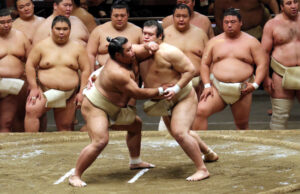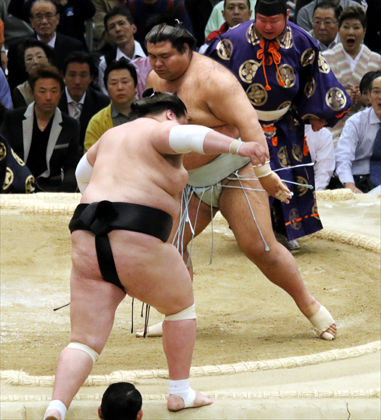
The mawashi is the thick, heavy belt a sumo wrestler wears in the ring, and it is far more than clothing. Wound tightly around the waist and between the legs, it is the only thing a wrestler wears in competition, and it doubles as the single most important handhold in the sport. Almost every throw, lift, and drive begins with a grip on the opponent’s mawashi. Lose your hold and you lose control; lose the belt itself and, under sumo’s rules, you lose the match outright. This guide explains what the mawashi is made of, how it is wound and tied, the grips that decide bouts, and the rules and lore that surround it.
The belt is the contest. Most sumo techniques begin with a grip on the opponent’s mawashi, so the fight for the belt at the opening clash often decides who wins.
Pressure comes first. The essence of sumo is applying pressure, not simply knocking the opponent down; only once pressure is on do throws, thrust-downs, and twists become effective.
Grips have names that matter. The outside grip (uwate) gives leverage to throw, the inside grip (shitate) drives forward, the double-inside grip (morozashi) is decisive, and the front grip (maemitsu) controls balance.
Lose the belt, lose the bout. A wrestler whose mawashi comes fully undone and leaves him exposed is disqualified outright.
What the mawashi is, and what it is made of
At its simplest, the mawashi is a long band of thick fabric wound several times around the body to form a snug belt at the waist, with a length passing between the legs and tucked in at the back. In formal competition it is the wrestler’s only garment, worn with nothing beneath it. The cloth is stiff and dense rather than soft, because it has to survive being yanked, twisted, and hauled on by a very heavy opponent.
The Japan Sumo Association publishes the specification for the competition belt in its own English introduction to the sport.
| Specification | Figure |
|---|---|
| Material | Heavy silk |
| Length | About 9 metres |
| Width of the cloth | About 80 centimetres |
| Folded | In six, before winding |
| Turns around the waist | Four to seven, depending on the wrestler’s girth |
| Worn underneath | Nothing |
| Front cords (sagari) | Silk, stiffened with glue, purely ornamental |
The association goes further than describing the object. It says the mawashi may be considered to have determined the whole form of sumo, and gives the reason in a number: of the sport’s 82 winning techniques, many are achieved by manoeuvring an opponent with a grip on the belt. Nothing else a wrestler wears has that kind of hold over how the sport is played. The rest of the wardrobe — the ceremonial apron, the rope, the topknot, the officials’ dress — is covered in our guide to what sumo wrestlers wear.
Not every belt is the same, and the difference tracks rank closely. The two top divisions, whose wrestlers hold the salaried status known as sekitori, are entitled to a competition mawashi made of silk, traditionally in a dark, dignified colour. Wrestlers in the lower divisions compete in a plainer cotton belt, usually black or a deep indigo. There is also the everyday training belt, the keiko-mawashi, worn in the practice stable; for the top men this is a sturdier, less precious belt kept apart from the silk one reserved for tournament days. To a newcomer the belts look interchangeable, but inside the sport the cloth, the colour, and the upkeep all signal where a man stands.
How it is wound and tied
Putting on a mawashi is a two-person job. The band is roughly 45 centimetres wide, folded into quarters, and then wound around the body while its folded width is varied along the way. Because the band is so long, an assistant is needed to hold the rolled-up mawashi while the wrestler dresses. These are details outsiders rarely appreciate; as our contributor, a former wrestler, puts it, they are things one does not really grasp unless one has actually wrestled.
The two figures on this page for the width of the cloth do not agree, and we have left both as they were given. The association’s published specification is 80 centimetres folded in six; the account below, from a former wrestler describing the belt as he handled it, is roughly 45 centimetres folded in four. Both describe the same principle — a band whose folded width is changed as it goes around — and we have not tried to reconcile the numbers.
The knot is tied at the back. The front end is first set at chest height and passed between the legs from a doubled state, then folded into eighths at the buttocks and brought around the right hip at quarter-width. After one wind the chest-height end is let hang in front; the wrestler rotates his body to wind the belt and adjust its tightness. Finally the hanging front portion is folded sideways and wound over, and the eighth-folded section at the buttocks and right hip is threaded from the bottom, pulled up, passed through, and knotted, so the knot ends up tied at half the width of the waist wind. The aim is a belt that sits low and tight: tight enough that it will not slide or unravel when an opponent buries a fist in it and pulls, yet loose enough that the wrestler can still bend, twist, and brace.
Across the front of the belt hangs a row of stiffened cords called sagari. The association is unambiguous about what they are: silk, stiffened with glue, and ornamental. It also states that they sometimes come off during a match and can be discarded, which is why nobody stops a bout to collect them when they scatter across the clay. The glue is what keeps the fringe fanned out instead of hanging limp. The belt that matters for the contest is the woven band itself, not the fringe in front of it.
The grip: why the belt decides bouts
Sumo is won by forcing an opponent out of the ring or down to the clay, and the surest way to do either is to take command of his belt. But the deeper principle is pressure. The essence of sumo is not so much knocking the opponent over as applying pressure to him; only once that pressure is on do throws, thrust-downs, and twists actually start to work. A wrestler with a strong grip can steer his opponent like a lever, marching him backward over the straw bales or hoisting and dumping him. This is why the opening clash, the tachiai, so often becomes an instant scramble for the belt: the man who wins the grip battle usually dictates what follows. For more on how a bout is decided, see our guide to the rules of sumo.
Inside and outside grips
Grips are named by where the arm sits relative to the opponent’s. An uwate is an outside grip, taken with the arm passing over the opponent’s arm to seize the belt; a shitate is an inside grip, with the arm threaded underneath. The outside grip is generally the more prized because it gives better leverage for throwing, while the inside grip is the workmanlike hold from which a wrestler drives forward. A coveted position is morozashi, both arms inside, which pins the opponent’s arms wide and leaves him little to fight back with. There is also the maemitsu, a grip on the front of the belt, which lets a wrestler control the centre of his opponent’s balance and is useful for pulling a taller man down.
Forcing an opponent out, the family of techniques known as yori, comes in several shapes: driving forward without letting the opponent take an outside grip, securing morozashi and pushing him back, or simply charging fast from the tachiai. Among the great forcing-out men, the yokozuna Higashifuji was known for his surging yori, while the yokozuna Kashiwado, in a phrase that has stuck, “took the front belt and ran.” The front grip is a recognised winning hold in its own right, not just a setup.
Morozashi is so strong that defending against it is its own skill. The standard counter is to keep the armpits clamped tight so the opponent cannot work both arms inside in the first place. Once he is in, a larger wrestler can answer with kime-dashi, an arm-lock force-out that clamps down on the opponent’s elbows to seal his movement and walk him out; Mitoizumi and Kushimaumi were noted for it. When the defence fails, the result is decisive. At the 2024 March tournament on Day 4, Meisei secured morozashi against the yokozuna Terunofuji and forced him straight out, handing the yokozuna the loss.
Styles divide along these lines. Some wrestlers are belt-fighters who want to lock up and grapple, while others are pushing-and-thrusting specialists who try to win before any grip is taken at all. The grip a wrestler favours, and the side he likes to take it on, becomes a signature that opponents study and try to deny. Watching for that battle is one of the quiet pleasures of the sport, and our guide on how to watch sumo walks through what to look for. The full catalogue of winning moves is set out in our guide to kimarite.
The rules of the belt
For all its physicality, the mawashi sits inside a clear set of rules. The belt is treated as part of the wrestler, so a legal grip means taking hold of the woven band itself. Grabbing the hair, jabbing the eyes or throat, or seizing the part of the belt that directly covers the groin are among the actions that are not allowed.
A mawashi can also come loose in the middle of a bout, and not only because it was tied carelessly. A belt is most vulnerable where it is a single layer: when an opponent grips that single-layer section near the knot, the hold can work loose. So can a knot that was left too short to begin with. When that happens the referee stops the bout to have the belt retied, a pause known as mawashi-matta. In one January tournament, on Day 4, the bout between Tokitenku and Sadanofuji had to be halted for the belt to be retied twice. That is a different matter from the belt failing completely.
The most striking rule concerns exactly that failure. Because the mawashi is the wrestler’s only covering, a competitor whose belt comes completely undone during a bout, leaving him exposed, is disqualified and loses. It almost never happens, precisely because the belt is wound so tightly. But the principle stands: a wrestler is responsible for keeping his belt on, and losing it costs him the match as surely as stepping out of the ring.
The keshō-mawashi and the ring-entering ceremony
The belt fans see during the pageantry is a different object entirely. The keshō-mawashi is an ornamental apron, worn over the front, that wrestlers ranked juryo and above put on for the dohyō-iri, the ring-entering ceremony that precedes the day’s bouts. The association describes the aprons as silk, richly embroidered, hemmed with gold fringe, and costing upwards of approximately one million yen. They are meant purely for display; no one grapples in one. Once the ceremony ends, the wrestlers shed the aprons and compete in the plain fighting belt.
Who is allowed one, who actually pays for it, and how the ceremony took its present shape are all covered separately in our guide to the keshō-mawashi. The grandest version belongs to the sport’s highest rank: a yokozuna performs his own solo ring-entering ceremony wearing a braided hemp rope, the tsuna, of 11 to 15 kilograms over the apron.
Colour, superstition, and the lore of the belt
Although competition belts have long leaned toward dark, traditional tones, brighter colours have become a more familiar sight in the top division in recent decades. The belt becomes part of how a fighter is recognised, and with it comes a thread of superstition that runs deep in sumo. A wrestler enjoying a strong run of victories will often refuse to wash his competition mawashi, believing that scrubbing it would rinse away his luck along with the grime. To outsiders it looks like a stained belt; to the wrestler it is a winning streak made visible, not to be tampered with until the run finally ends.
Frequently Asked Questions
What is a sumo wrestler’s belt called?
It is called the mawashi. The same word covers both the plain belt worn in competition and the sturdier version worn for daily training, the keiko-mawashi. The ornamental apron worn for ceremonies is a separate item, the keshō-mawashi.
How is a mawashi tied and worn?
The mawashi starts as a band roughly 45 centimetres wide, folded into quarters and wound several times around the body, with its folded width varied as it goes. It is a two-person task, because the band is long enough that an assistant has to hold the rolled-up belt while the wrestler dresses. The knot is tied at the back, at half the width of the waist wind, after the front end has been passed between the legs and the rear section folded into eighths, threaded up, and pulled through.
Why does the grip on the belt decide so many bouts?
Because sumo is built on pressure rather than just knocking an opponent down, and a grip on the belt is what lets a wrestler apply it. Once he has hold of the mawashi he can drive his opponent backward or set up a throw; only with that pressure on do throws, thrust-downs, and twists become effective. The outside grip (uwate) gives leverage to throw, the inside grip (shitate) drives forward, double-inside (morozashi) is the strongest grappling position, and a front-belt grip (maemitsu) controls the opponent’s balance.
Can you really lose a sumo match if your belt falls off?
Yes. Because the mawashi is a wrestler’s only covering, a competitor whose belt comes completely undone and exposes him is disqualified and loses the bout. It is exceedingly rare, since the belt is wound very tightly. A belt that merely works loose is different: the referee will stop to retie it, a pause called mawashi-matta, as happened twice in one January Day 4 bout between Tokitenku and Sadanofuji.
Why do some wrestlers’ belts look dirty?
It is usually deliberate. A common superstition holds that washing a competition mawashi during a winning streak rinses the luck out of it, so a wrestler on a good run will leave the belt unwashed until his fortunes turn. The grime is treated less as neglect than as a record of victories not to be disturbed.
How long and how wide is a mawashi?
The Japan Sumo Association gives the competition belt as heavy silk about 9 metres long and 80 centimetres wide, folded in six and wound around the waist four to seven times depending on the wrestler’s girth. A former wrestler’s account of handling the belt puts the width at roughly 45 centimetres folded in four; we present both figures as given rather than reconciling them.
What are the cords hanging from the front of the belt?
They are called sagari. The association describes them as silk stiffened with glue and purely ornamental, and states that they sometimes come off during a match and can be discarded. They play no part in the grappling and no rule attaches to them.
Sources
The specification of the competition belt, the description of the sagari, the count of 82 winning techniques, and the materials and price of the keshō-mawashi come from the Japan Sumo Association’s official English introduction, Sumo (sumo.or.jp/pdf/en/sumo_introduction.pdf). The winding sequence, the position of the knot, the causes of a belt working loose, and the Tokitenku–Sadanofuji mawashi-matta come from the archive of Michihiro Taguchi at Dohyo no Mokugekisha (dohyounomokugekisya.net), “まわしの結び目“. Retrieved August 3, 2026. Where the two sources give different figures for the width of the cloth, both are reproduced as published.
Photo by Michihiro Taguchi.