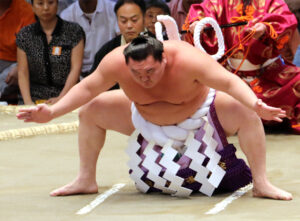
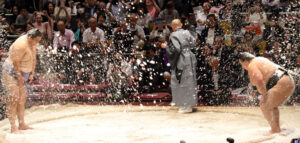
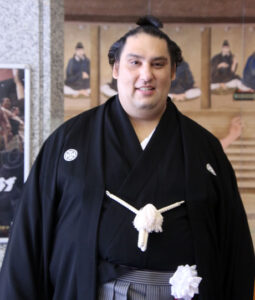
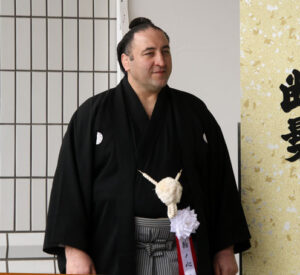
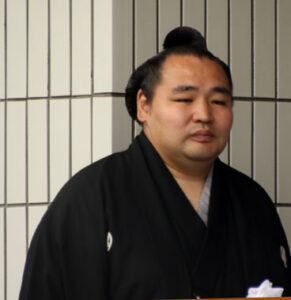
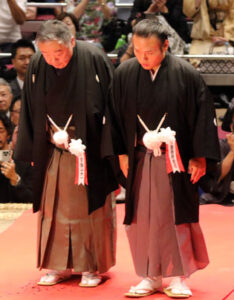
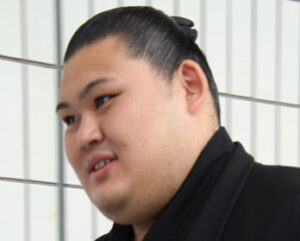
This was the retirement ceremony of the former yokozuna Terunofuji, held at the Ryogoku Kokugikan in early 2026. After his last dohyo-iri (ring-entering ceremony), his master made the final cut to the topknot, formally closing a career and marking his succession to the Isegahama elder name.
The day belonged to one man. For the former yokozuna Terunofuji, the ceremony at the Ryogoku Kokugikan carried a double weight: it marked both his retirement from the ring and his step into the Isegahama elder name. What follows is the reporting of Michihiro Taguchi, the writer-photographer who covers sumo for The Sumo.
The scene and the queues
Doors opened at 10:00, and the program began at 11:00. Long before that, by 9:30, a line had already wrapped around the building. Ticket holders for the first floor and the second floor were queued separately; those with second-floor seats entered on the second floor, then made their way down to the first if they wished.
There was an absence that anyone familiar with these occasions would have felt at once. Usually, ranked wrestlers — the sekitori — line the entrance to greet arriving guests, and the man of the day often appears outside to welcome them in person. This time, no sekitori stood at the doors, and Terunofuji himself was not seen greeting guests outside. The morning had a quieter, more inward shape than custom suggests.
The final dohyo-iri
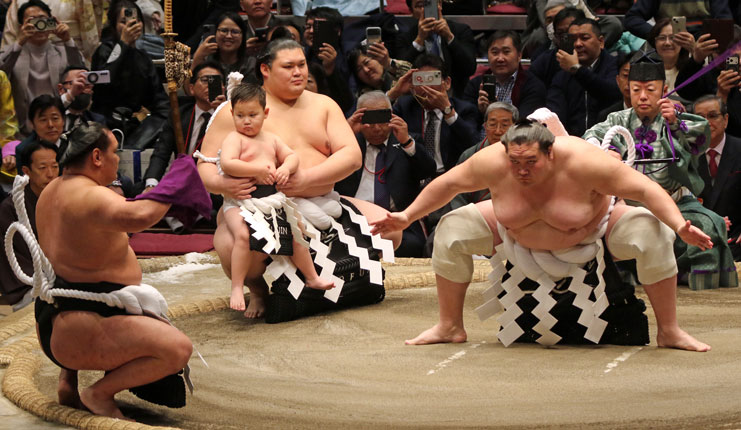
Then came the moment built into every yokozuna’s farewell: the final dohyo-iri, the ring-entering ceremony performed in the full regalia of the rank. His tsuyuharai (herald) was Onosato, and his tachimochi (sword-bearer) was Hoshoryu — two of the era’s leading names framing him on the dohyo.
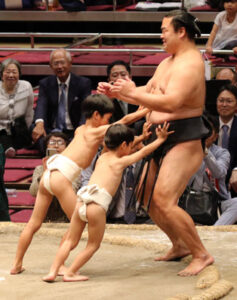
Terunofuji walked out carrying his young child in his arms. For the ring-entering itself, he handed the child to Onosato, then turned to the ritual one last time. It was a small, human gesture folded into a formal rite, and it set the tone for everything that came after.
The topknot-cutting and who took part
The danpatsu-shiki (the topknot-cutting retirement ceremony) followed. A second break from custom announced itself immediately. These ceremonies normally open with a greeting from the supporters’ association chairman; this time there was none. They began cutting the topknot straight away, one snip at a time, in the long procession of guests that gives the rite its drama.
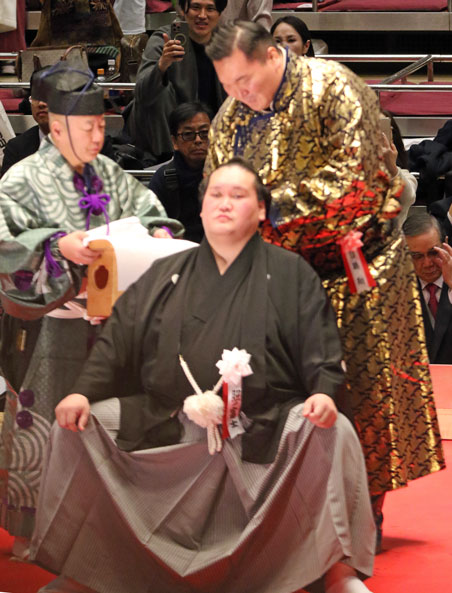
Among those who came forward, figures from the wider world of sport stood out — names from pro baseball, boxing and judo each taking their snip. The former yokozuna Wakanohana, the third to hold the name, took a snip as well. Throughout it all, Terunofuji kept facing forward, still and composed as the scissors passed from hand to hand.
The Mongolian contingent took their snips together, as a group. Hakuho — who by the usual alphabetical order would have come in a different slot — cut here instead, joining his countrymen and dressed in traditional Mongolian attire. Hakuho moving out of sequence to stand with the Mongolian wrestlers gave the moment its own quiet symbolism.
A women’s section was included in the order — itself worth noting in a sport whose ceremonies usually keep women off the dohyo. The judoka Uta Abe was present. Then Terunofuji’s family came forward: his younger sister, his older sister, his mother-in-law, his mother and his wife each took a snip, the line of women closest to him marking the change in his life.
The master’s final cut and the farewell
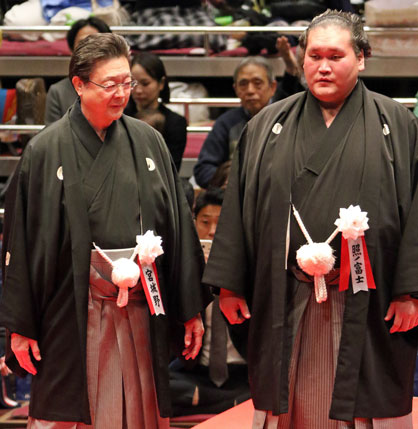
Last came the association. Elders and ranked wrestlers of the Isegahama stable stepped up, joined by the same-group elder Asakayama, the wrestler Aonishiki, and the Rikishi-kai (wrestlers’ association) chairman Hoshoryu. The tomebasami — the final cut, the one that severs the last of the knot — was made by his master, the former yokozuna Asahifuji. His family then presented flowers.
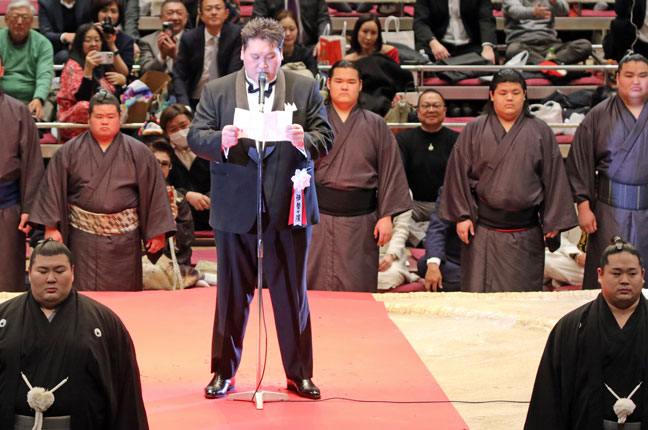
After the final grooming, Terunofuji stood with his disciples and gave his greetings. It was around 4 p.m. — the ceremony had ended earlier than expected, drawing to its close while the afternoon light still held.
Key Takeaways
- The ceremony marked both Terunofuji’s retirement and his succession to the Isegahama elder name, held at the Ryogoku Kokugikan in early 2026.
- For his final dohyo-iri, Onosato served as herald (tsuyuharai) and Hoshoryu as sword-bearer (tachimochi); Terunofuji carried his young child out and handed the child to Onosato for the ring-entering.
- The topknot-cutting drew sports figures from baseball, boxing and judo, the former yokozuna Wakanohana, and the Mongolian contingent — with Hakuho cutting among them in traditional Mongolian attire.
- The final cut (tomebasami) was made by his master, the former yokozuna Asahifuji.
- Terunofuji gave his closing greetings with his disciples around 4 p.m., ending earlier than expected.
Frequently Asked Questions
Who performed the roles in Terunofuji’s final dohyo-iri?
Onosato served as his herald (tsuyuharai) and Hoshoryu as his sword-bearer (tachimochi). Terunofuji walked out carrying his young child and handed the child to Onosato for the ring-entering itself.
Who made the final cut to the topknot?
The final cut, the tomebasami, was made by his master, the former yokozuna Asahifuji. His family then presented flowers.
What was unusual about this ceremony?
No ranked wrestlers (sekitori) lined the entrance, and Terunofuji was not seen greeting guests outside. There was also no opening greeting from the supporters’ association chairman; the topknot-cutting began straight away. A women’s section was included in the order.
When did the ceremony end?
After the final grooming, Terunofuji stood with his disciples to give his greetings at around 4 p.m., ending earlier than expected.