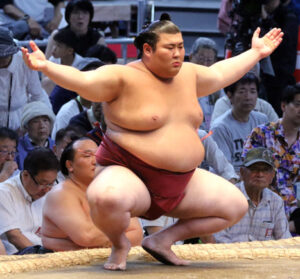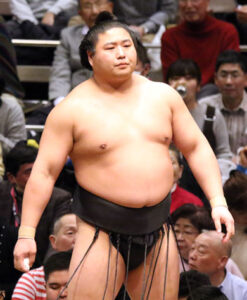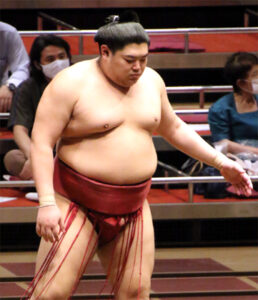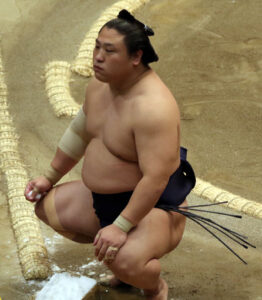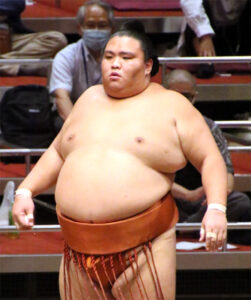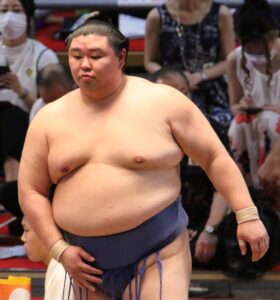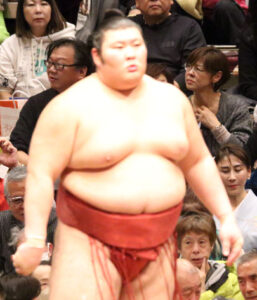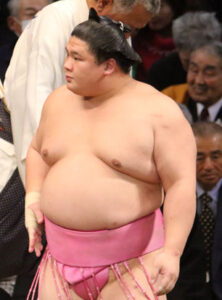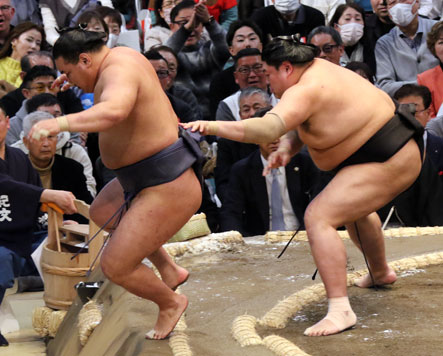
Photo by Michihiro Taguchi.
Hoshoryu is the 74th yokozuna in sumo history and the sixth born in Mongolia. He fights for Tatsunami stable, and he is a nephew of the former yokozuna Asashoryu. He was promoted after winning the January 2025 tournament and made his debut at the rank that March. Ten tournaments later he has still not won a championship as a yokozuna, and he has missed all or part of five of those ten, including the whole of September 2026. He is ranked West yokozuna on the September 2026 (Aki) banzuke, issued August 31, 2026.
Hoshoryu at a glance
| Rank | Yokozuna (74th). West yokozuna, September 2026 (Aki) banzuke |
| Stable | Tatsunami |
| Born | May 22, 1999, Ulaanbaatar, Mongolia (age 27) |
| Size | 188 cm, 148 kg |
| Style | Right-hand inside grip; force-out and throw |
| First tournament | January 2018 |
| Championships | 2 — July 2023 (as sekiwake), January 2025 (as ozeki). None as yokozuna |
| Record as yokozuna | 71–35, 44 days missed, over ten tournaments (March 2025 – September 2026) |
How he became yokozuna
Hoshoryu won the January 2025 tournament at 12–3 as an ozeki. He came into the final day on three losses and had to overwhelm Kotozakura in the closing bout to reach a three-way playoff, then win it. He beat Kinbozan first — force-out, after swinging him round off an underarm grip — and then Oho, who resisted and was carried down. Two bouts: the shortest a three-man playoff can be.
The Association promoted him days later. He became the 74th yokozuna and the sixth from Mongolia, and at his acceptance ceremony he pledged to train in a spirit of concentrated fighting will so as not to disgrace the name of yokozuna. He had spent nine tournaments at ozeki. He turned 25 the previous May and stood at the rank for the March 2025 tournament — younger at his yokozuna debut than Harumafuji and Kakuryu were at 28, or Terunofuji at 29, but three years older than his uncle Asashoryu and Hakuho, who both got there at 22.
Taguchi was at the tournament, and he did not agree with the promotion
Michihiro Taguchi has covered nearly every tournament from the venue since 2013. He wrote his objection on the night of the championship, before the Association had voted, and he has not withdrawn it: “He won the title, but yokozuna is a separate question. I cannot agree.” Three days later he ran a piece under the headline A manufactured yokozuna.
His argument is arithmetic, not taste. Over the five tournaments leading into the promotion, Hoshoryu won 10, 9, 8, 13 and 12 bouts. Read as the Association reads them, that is 33 wins across the last three, 42 across the last four, 52 across the last five — averages of 11.0, 10.5 and 10.4 wins a tournament. One of those five was a 13-win tournament. One was a losing-adjacent 8–7.
Set that beside wrestlers the same committee passed over:
| Wrestler | Run under consideration (◎ = championship) | Committee’s decision on that run |
|---|---|---|
| Tamanishiki | ◎9–2, ◎9–2, ◎10–1 (four-tournament era) | Passed over |
| Chiyonoyama | 8–5, 12–3, ◎13–2, ◎12–3 (three-tournament era) | Passed over |
| Konishiki | 12–3, 11–4, ◎13–2, 12–3, ◎13–2 | Passed over |
| Hoshoryu | 10–5, 9–6, 8–7, 13–2, ◎12–3 | Promoted |
Taguchi’s conclusion: “A yokozuna is not something you manufacture. He is a wrestler of such obvious superiority that you find yourself thinking, please, go ahead and become one.” He points the blame past Hoshoryu and at the Yokozuna Deliberation Council, which he says has produced weak yokozuna before and has never once offered an account of it.
Ten tournaments of results have since arrived. They are below. Readers can decide for themselves whether the objection has aged well.
Ten tournaments as yokozuna
| Tournament | Result | Note |
|---|---|---|
| March 2025 | 5–5, 5 days missed | Debut at the rank; withdrew |
| May 2025 | 12–3 | |
| July 2025 | 1–4, 10 days missed | Withdrew |
| September 2025 | 13–2 | Best result at the rank |
| November 2025 | 12–3 | |
| January 2026 | 10–5 | |
| March 2026 | 11–4 | |
| May 2026 | 0–2, 13 days missed | Withdrew |
| July 2026 | 7–7, 1 day missed | Withdrew after losing to Atamifuji |
| September 2026 | 0–0, 15 days missed | Sat out the full tournament |
| Total | 71–35, 44 days missed | Winning rate .670 |
Three things stand out. Five of the ten tournaments were cut short or missed entirely. May, July and September 2026 came one after another: May and July were the first time he had missed two tournaments in a row, and he then sat out all of September. And 71–35 works out to roughly ten wins for every fifteen bouts he has actually fought — the number Taguchi had said was not a yokozuna number before the promotion, arrived at from the other side.
The record he is now setting: no championship as yokozuna
Hoshoryu has not won a tournament since the one that promoted him. Ten tournaments at the rank, no Emperor’s Cup. That is already past Kakuryu, who went eight without one and then won his ninth, and it puts Hoshoryu on a list nobody wants to join.
| Yokozuna | Tournaments at the rank before a first championship |
|---|---|
| Terukuni | 18th |
| Chiyonoyama | 13th |
| Asashio | 12th |
| Kashiwado | 12th |
| Kakuryu | 9th |
| Hoshoryu | 11th and counting |
There is a symmetry to it that Taguchi noticed and that is hard to unsee. The senior yokozuna whose promotion record most resembles Hoshoryu’s — 33 wins over three tournaments — is Kashiwado. Kashiwado did not win as a yokozuna until his twelfth tournament at the rank, and the four tournaments immediately before that championship were consecutive withdrawals.
Who beats him
A yokozuna is not allowed to have a bogey opponent. Hoshoryu has several, and the worst of them is a wrestler five years younger than him.
| Opponent | Hoshoryu’s record as yokozuna |
|---|---|
| Aonishiki | 1–6, including a championship playoff. Lost the first five in a row |
| Kirishima | 1–4 |
| Fujinokawa | 0–3 |
| Hakunofuji, Yoshinofuji, Atamifuji, Daieisho | 2–2 each |
Aonishiki is the problem. He and Hoshoryu usually end up in a belt grip, and it is Aonishiki who ends up in the better position. Taguchi’s read is that Hoshoryu’s way out is to take the front of the belt and drive, rather than settle into the grip and let Aonishiki build his own position.
He is also 0–2 in championship playoffs as a yokozuna, beaten by Onosato and by Aonishiki. That is a small sample, and it still matters: playoff losses are how a yokozuna’s reputation gets decided in a sport with no other tiebreaker.
Two numbers that measure a yokozuna
Taguchi tracks two rates for every yokozuna, and they are the two that answer the question a promotion is supposed to settle: does he turn up, and does he beat the wrestlers he is supposed to beat?
- Withdrawal rate, 24 percent. The share of scheduled days at the rank he did not wrestle, counting forfeit losses as absences. Onosato, over a shorter span, is at 27 percent.
- Kinboshi concession rate, 27 percent. The share of his bouts against rank-and-file maegashira that he loses — which is exactly the rate at which he hands out gold stars. Onosato’s is 30 percent.
Both rates are Taguchi’s own counts, published July 28 and August 3, 2026, on the counting rule stated above. Neither is a flattering number, and Taguchi’s verdict on the pair of them was blunt: neither man has the underlying strength of a yokozuna. Kitanoumi’s line is the one he keeps returning to — the mission of a yokozuna is to win the championship.
Where he came from
The sections below were written earlier in his career, when he was climbing toward the top division. They are kept as filed.
From wrestling mat to the dohyo
Hoshoryu drew attention from the start as a nephew of Asashoryu — he is the second son of the former yokozuna’s eldest brother. His foundation was in wrestling. He originally came to Japan as a wrestling exchange student, but the sport of sumo captivated him. His athleticism carried over to the ring, and on the expectation of finishing high school he entered Tatsunami stable, run by the former Kyokuho.
The lower divisions
His early progress was smooth. He cleared each division in a single tournament to reach makushita, and along the way he took the jonidan championship. In the maezumo and jonokuchi of the January 2018 basho he lost to Naya, a sign that at the very beginning he still had ground to make up.
In the tournament he debuted in makushita, he went 3–3 and then beat Naya in their meeting. Once he reached the single-digit ranks of makushita, things were no longer easy. Carrying a light frame, his best result there was 4–3, and he also posted a losing 3–4. It took him ten tournaments to climb from jonokuchi into juryo — one more than his uncle Asashoryu had needed, but a fast rise all the same. His record across those divisions was 49 wins and 21 losses. By comparison, Asashoryu had gone 53–10 and had won championships in jonidan, sandanme and makushita.
Bouts with Ura and the rising generation
In makushita, Hoshoryu faced a crop of talented contemporaries, including Ura, Kotokamatani — later known as Kotonowaka — and Kotetsugake, who would go on to wrestle as Kotoshoho.
New to juryo
The struggle continued in juryo. In his first tournament there he went 7–8 and only just held his place in the division. Records of 8–7 followed. Then, ranked sixth in juryo for the July basho, he posted 10–5 to secure his promotion to makuuchi. He took part in a six-way championship playoff but narrowly missed out on the title. Asashoryu had cleared juryo in just two tournaments; Hoshoryu’s record in the division was 20 wins and 15 losses, so once again his uncle had the edge.
Style, as it looked on his arrival in the top division
Hoshoryu is young, just 21, with plenty of promise. He weighs 131 kilograms. His strengths are a right-hand inside grip, the force-out and the throw, and he occasionally shows off leg techniques. For reference, Asashoryu won nine bouts on his makuuchi debut, and his first turn at komusubi and his first special prize came in his third tournament in the top division. How far Hoshoryu can go is the open question as a new chapter of his career begins.
Update: he is now 27 and the Association lists him at 150 kilograms. The grip, the force-out and the throw are still the sumo he wins with.
What to watch next
A yokozuna cannot be demoted, which is the whole difficulty. There is no mechanism to correct a promotion, only retirement. Hoshoryu is 27, which is young enough that a run of three strong tournaments would settle the argument in his favour and make this page read very differently. Taguchi’s position is that it has to start with the bogey opponents: drag Aonishiki and Kirishima into the training ring and beat them there first, because a yokozuna who has wrestlers he cannot beat is not doing the job.
Frequently asked questions
Q. Is Hoshoryu still a yokozuna?
Yes. He is the 74th yokozuna, ranked West yokozuna on the September 2026 (Aki) banzuke, issued August 31, 2026. A yokozuna is never demoted for a losing record; the only way out of the rank is retirement.
Q. How many championships has Hoshoryu won?
Two, neither as a yokozuna: July 2023 as a sekiwake and January 2025 as an ozeki. The January 2025 title is what earned him the promotion.
Q. Why has Hoshoryu not won a title as yokozuna?
Injury and matchups. He has missed all or part of five of his ten tournaments at the rank, and he loses to specific opponents — 1–6 against Aonishiki and 1–4 against Kirishima. Ten wins a tournament does not win Emperor’s Cups.
Q. How is Hoshoryu related to Asashoryu?
He is a nephew of the former yokozuna Asashoryu — specifically the second son of Asashoryu’s eldest brother. Asashoryu was the first Mongolian yokozuna; Hoshoryu is the sixth.
Q. What stable does Hoshoryu belong to?
Tatsunami stable, run by the former Kyokuho, which he joined on the expectation of finishing high school.
Q. What is Hoshoryu’s wrestling style?
He favours a right-hand inside grip, winning by force-out and by throw, and will occasionally mix in leg techniques.
Reporting note: this article draws on Michihiro Taguchi’s tournament reporting and original statistical work published in Dohyo no Mokugekisha, in particular his pieces of January 26 and 29, 2025, May 3, 2026, and July 28, July 29 and August 3, 2026. Ranks, measurements and per-tournament results were rechecked against the Japan Sumo Association on August 3, 2026, and the September 2026 result and his weight on October 14, 2026. Official bout-by-bout records are available from the January 2013 tournament onward; figures for earlier eras are Taguchi’s own records.
Updated October 14, 2026.
Read next: how Hoshoryu won his first title and sealed ozeki · what the rules actually require for yokozuna promotion · the rank of yokozuna explained · Onosato, the 75th yokozuna