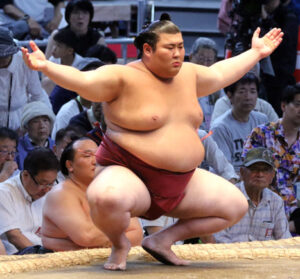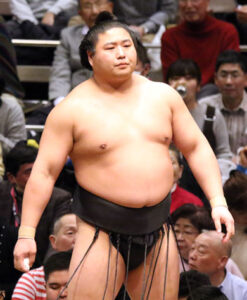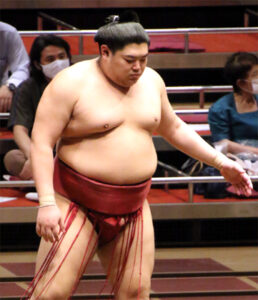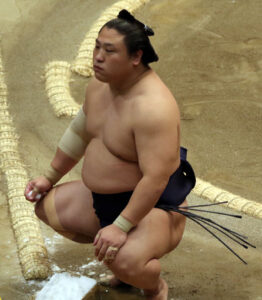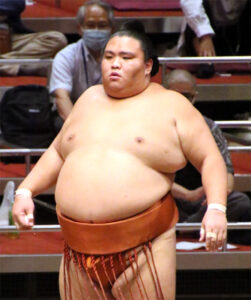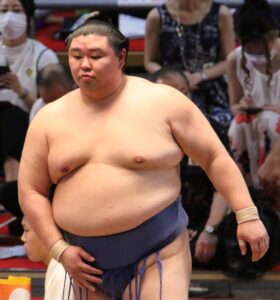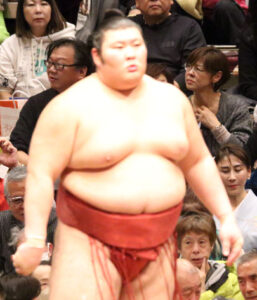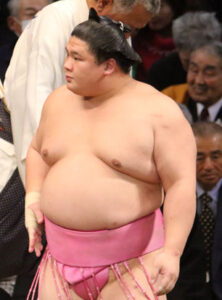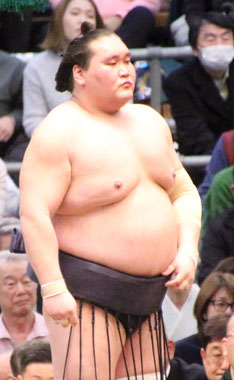
Photo by Michihiro Taguchi.
Terunofuji was the 73rd yokozuna, and his career is the greatest comeback modern sumo has produced: an ozeki who fell to jonidan, the second-lowest division, and climbed all the way back to the top of the sport. He won ten championships, six of them as a yokozuna. He also missed 151 days at the rank — more than half the days he was scheduled to wrestle — and he retired mid-tournament in January 2025. He now runs Isegahama stable as the elder Isegahama.
Terunofuji at a glance
| Highest rank | Yokozuna, the 73rd |
| At the rank | September 2021 – January 2025, 21 tournaments |
| Born | Ulaanbaatar, Mongolia |
| Championships | 10 in all; 6 as yokozuna, including one perfect 15–0 |
| Record as yokozuna | 114–40, 151 days missed. Winning rate .740 |
| Now | The elder Isegahama, running Isegahama stable |
A comeback made official
On March 31, 2021, the banzuke ranking committee and an extraordinary board meeting formally confirmed Terunofuji’s restoration to ozeki. The Japan Sumo Association dispatched two messengers — Takashima (the former Daimonyama) and Asakayama (the former Kaio) — to the Isegahama stable in Koto Ward. Receiving them, Terunofuji delivered the customary greeting: “I humbly accept.” It marked his first return to ozeki since the September 2017 basho.
The long fall to jonidan
The road back was long. After dropping out of the ozeki rank, Terunofuji slid almost overnight into juryo — an unusual sight, since former ozeki rarely wrestle that far down. Yet the descent did not stop there. Four straight tournaments sitting out from makushita pushed his rank all the way down to jonidan. At that point, hardly anyone could have pictured an ozeki comeback. Fighting injury and illness at the same time made it even harder to imagine. Words like “perseverance” or “battling adversity” feel too small for the ordeal he went through, and a return to ozeki after falling to jonidan may well never happen again.
The strongest man in makuuchi
The ozeki ranks already held Takakeisho, Asanoyama and Shodai. But among them only Takakeisho had taken a championship as ozeki, and just once. From the July 2020 tournament through the March 2021 tournament, their records told the story:
- Takakeisho — 45 wins, 22 losses, 8 absences
- Shodai — 45 wins, 20 losses, 10 absences
- Asanoyama — 44 wins, 19 losses, 12 absences
Over the same span Terunofuji went 57–16 with just 2 absences. That gap put him well ahead of the sitting ozeki — strong enough to be called the best in makuuchi.
Strengths and the work that remained
Technically, his standout sumo came when he seized both front mawashi grips and drove his opponent straight out — a style he put on display against Mitakeumi and Shodai. On the other side of the ledger, at that point he held a poor record against Takayasu and had lost back-to-back bouts to Onosho. Those were the matchups he still needed to overcome.
The four sections above were written when the comeback to ozeki was confirmed, in the spring of 2021. He was promoted to yokozuna four months later. What follows is the rest of it.
Twenty-one tournaments as yokozuna, and what they were worth
Terunofuji was promoted after the July 2021 tournament and stood at the rank for the September basho. He won the championship in that first tournament as a yokozuna — one of only seven men to do so since the official championship system began in 1926. He held the rank for twenty-one tournaments and won six of them.
When he retired, Taguchi ran the totals against the three other yokozuna who also finished with ten career championships. The comparison is unflattering in one column and flattering in another, and both matter.
| Yokozuna | Tournaments at the rank | Championships as yokozuna | Championship rate | Record | Winning rate | Days missed as share of days scheduled |
|---|---|---|---|---|---|---|
| Terunofuji | 21 | 6 | 29% | 114–40, 151 missed | .740 | 51% |
| Tochinishiki | 28 | 6 | 21% | 292–84, 44 missed | .777 | 12% |
| Wakanohana I | 25 | 8 | 32% | 254–66, 69 missed, 1 draw | .793 | 20% |
| Kitanofuji | 27 | 7 | 26% | 247–84, 62 missed | .746 | 17% |
Read the columns in order and the career comes apart into two different men. On championships he belongs with the seniors: 29 percent, one perfect 15–0 tournament, two runs of back-to-back titles. On availability he is nowhere near them — 51 percent of his scheduled days at the rank went unwrestled, against 12 to 20 percent for the other three, and his longest run of consecutive tournaments completed as a yokozuna was three. Taguchi’s reading is that the two facts are one fact: this was a career fought against his own knees and his own health, and the championship rate is what he managed while that was going on.
The end, January 2025
He entered the January 2025 tournament, went 2–3 and retired during it. That fixed the numbers above at their final values.
The retirement ceremony, January 2026
The event’s full title was the Terunofuji Retirement and Isegahama Succession Grand Sumo — a retirement and a promotion in the same afternoon. Doors at ten, curtain at eleven. Taguchi arrived at the Kokugikan at half past nine and there was already a long line; the ground-floor and second-floor ticket holders were queued separately, with the upper tier let in from the second floor.
No wrestlers stood in the entrance hall, and Terunofuji himself was not outside greeting guests. Among the undercard, the Isegahama stable ran a knockout tournament for its makushita-and-below wrestlers, which the new recruit Asahifuji won outright.
Then the last ring-entering ceremony, with the yokozuna Onosato as dew-sweeper and the yokozuna Hoshoryu carrying the sword. He came in holding his small child, and handed the child to Onosato when it was time to perform.
The haircut normally opens with an address from the head of the supporters’ association. This one did not. They simply started cutting. Athletes from outside sumo were conspicuous among the guests — baseball, boxing, judo. The former third Wakanohana cut. Terunofuji faced the front throughout. Hakuho, whose surname put him in the alphabetical run, took his turn there instead, in Mongolian dress. A women’s section had been set aside: the judoka Uta Abe, then Terunofuji’s sister, his elder sister, his mother-in-law, his mother, and the stable’s mistress. Then the Association’s own — the elders and salaried wrestlers of Isegahama stable, the faction elder Asakayama, the wrestler Aonishiki, and Hoshoryu in his capacity as head of the wrestlers’ association. His master Miyagino, the former yokozuna Asahifuji, made the final cut. Flowers from the family. It was over shortly after four, earlier than expected.
He is now the elder Isegahama, and the Association’s register lists him running the stable he fought out of.
Frequently asked questions
Q. When did Terunofuji retire?
During the January 2025 tournament, after a 2–3 start. He had held the yokozuna rank for twenty-one tournaments.
Q. How many championships did Terunofuji win?
Ten in all, six of them as a yokozuna, including one perfect 15–0 tournament. His championship rate as a yokozuna was 29 percent — better than Tochinishiki’s and Kitanofuji’s, both of whom also finished with ten.
Q. What is Terunofuji doing now?
He is the elder Isegahama and runs Isegahama stable. His retirement ceremony in January 2026 was formally a joint retirement and succession event.
Q. What stable did Terunofuji belong to?
Isegahama stable, in Koto Ward — the stable he now runs. His master was Miyagino, the former yokozuna Asahifuji.
Q. How far did Terunofuji fall before returning to ozeki?
All the way down to the jonidan division, after dropping from ozeki to juryo and then sitting out four straight tournaments from makushita. He is the only wrestler to have made that climb back.
Q. How much of his time as yokozuna did Terunofuji miss?
151 days, plus six forfeit losses — 51 percent of the days he was scheduled to wrestle at the rank, by Taguchi’s count. The comparable figure for the other three ten-time champions is 12 to 20 percent.
Reporting note: this article draws on Michihiro Taguchi’s tournament reporting and original statistical work published in Dohyo no Mokugekisha, in particular his account of the ozeki comeback (April 2021), his tally of Terunofuji’s yokozuna career (January 30, 2025) and his report from the retirement ceremony (January 31, 2026). Rank order, championship total and elder name were rechecked against the Japan Sumo Association in July 2026.
Updated August 5, 2026.
Read next: inside Terunofuji’s retirement ceremony · the rank of yokozuna explained · what happens when a wrestler sits out · Kisenosato, the 72nd yokozuna