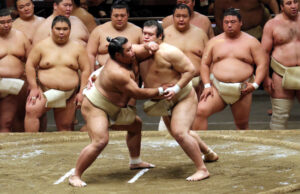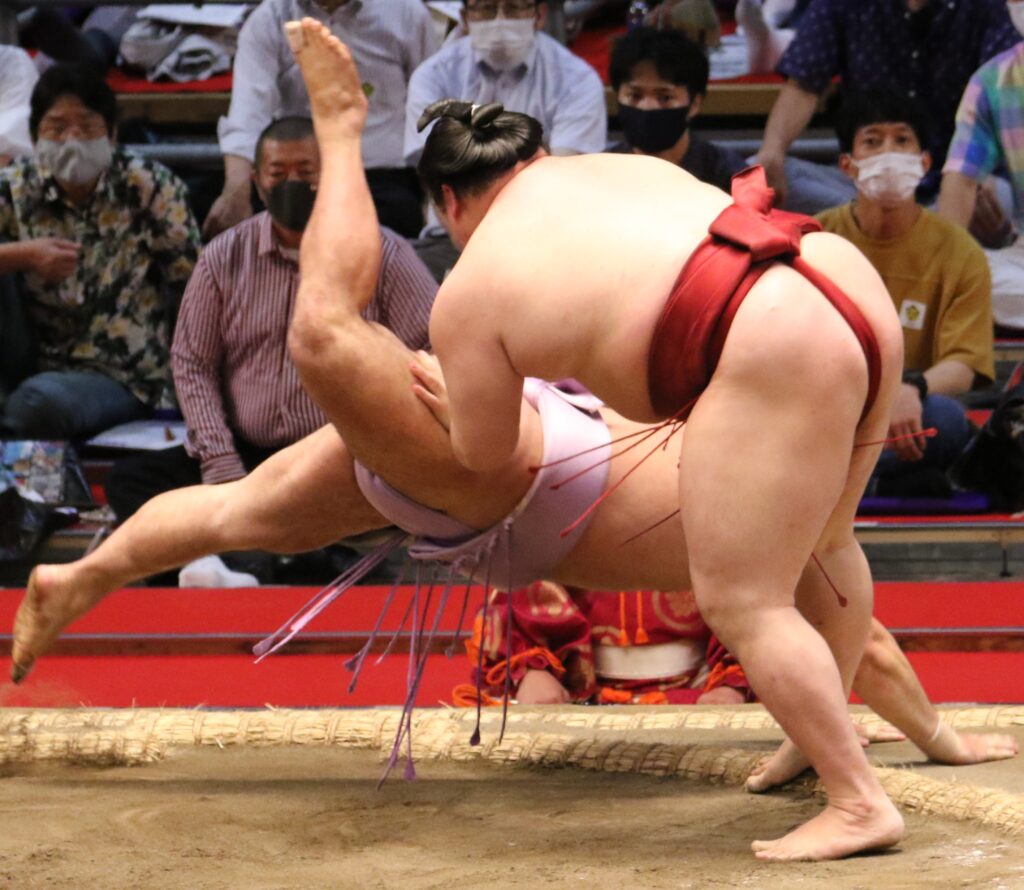
Kachikoshi means a majority-winning record and makekoshi means a majority-losing record over a single tournament. In sumo’s top two divisions, where wrestlers fight 15 bouts, 8 wins earns kachikoshi and 8 losses brings makekoshi. Kachikoshi pushes a wrestler up the banzuke ranking; makekoshi pushes him down.
Kachikoshi is a winning record, makekoshi is a losing one. Each is decided over a single tournament, with no draws to muddy the count.
The threshold depends on the division. Eight wins clinches kachikoshi in the top two divisions (15 bouts); four wins does it in the four lower divisions (7 bouts).
A record moves you on the banzuke, but not by a fixed amount. The size of the move scales with how strong or weak the record is and with the field around you.
Ozeki feel the rule hardest. One makekoshi makes an ozeki kadoban; two in a row drops him to sekiwake, though a 10-win return restores the rank at once.
Yokozuna are the exception. They are never demoted for a losing record; the expectation is retirement when they can no longer perform at the top.
Every sumo tournament ends in a reckoning. After 15 days of bouts, each wrestler walks away with a record, and that record decides which way his name moves on the next ranking sheet. Two words run the whole system: kachikoshi (kachi-koshi, a majority-winning record) and makekoshi (make-koshi, a majority-losing record).
What kachikoshi and makekoshi actually mean
A wrestler posts kachikoshi when he wins more bouts than he loses in a single tournament. He posts makekoshi when he loses more than he wins. There is no draw to muddy the count, so one outcome or the other locks in the moment he crosses the majority line.
The exact number depends on how many bouts a wrestler fights, and that varies by division:
- Top two divisions (makuuchi and juryo): wrestlers fight 15 bouts. So 8 wins = kachikoshi, and 8 losses = makekoshi.
- The four lower divisions: wrestlers fight 7 bouts per tournament. So 4 wins = kachikoshi.
Reach the winning number and the rest of the schedule can’t take it away — kachikoshi is banked. The same holds in reverse for makekoshi.
How a record moves you on the banzuke
The banzuke is sumo’s master ranking sheet, redrawn before every tournament. Kachikoshi generally moves a wrestler up the banzuke. Makekoshi generally moves him down.
How far is the open question. There is no fixed table that says “one win equals one rank.” The size of the move scales with two things:
- How strong or weak the record is. A stronger winning record lifts a wrestler more than a record that barely clears the line, and a heavy losing record sinks him further than a makekoshi by a single bout.
- The field around him. Promotions depend on who else won, who lost, and which spots open up above and below him. The same record can mean a bigger jump in a thin field than in a crowded one.
So the direction is reliable; the exact distance is a judgment the ranking committee makes tournament by tournament. For the full mechanics of how the sheet is assembled, the banzuke guide goes deeper.
Ozeki: where a losing record bites hardest
The clearest place to watch this system work is at ozeki (the second-highest rank). Unlike yokozuna, an ozeki can be demoted — and the kachikoshi/makekoshi rule governs exactly how.
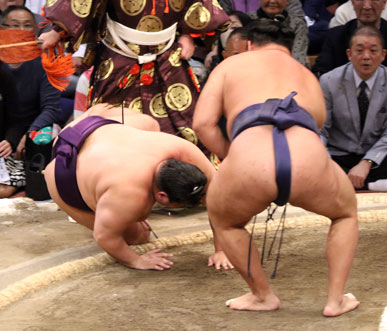
When an ozeki posts makekoshi, he becomes kadoban (kado-ban, roughly “on the threshold”). He is not demoted yet, but he is on notice: he must post kachikoshi the next tournament or drop down. In the framing reported by sumo writer Michihiro Taguchi, two consecutive makekoshi means demotion to sekiwake (the rank just below ozeki).
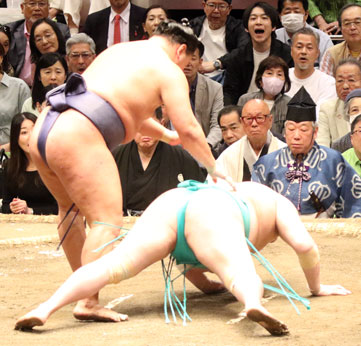
There is a safety net. A freshly demoted ozeki who wins 10 or more bouts in the very next tournament returns to ozeki immediately. This special rule has been in effect since the July 1969 tournament. So a demotion isn’t always a long fall — a single dominant return can undo it.
Yokozuna: the rule that doesn’t apply
At the top sits the yokozuna (grand champion), and here the logic flips. A yokozuna is never demoted for a losing record. The rank is permanent once earned.
The pressure takes a different shape. Because a yokozuna can’t fall down the banzuke, the expectation is that he retires when he can no longer perform at the top level. There is no quiet slide back to a lower rank — the only honorable exit is to step away. (For how a wrestler reaches that rank in the first place, see yokozuna promotion.)
Quick comparison
| Rank | Effect of makekoshi |
|---|---|
| Lower-division and most makuuchi wrestlers | Move down the banzuke; size depends on record and field |
| Ozeki | First makekoshi → kadoban; second consecutive makekoshi → demotion to sekiwake |
| Yokozuna | No demotion; expectation is retirement when no longer competitive |
Why it matters when you watch
Once you know the kachikoshi line, the late days of a tournament read completely differently. A wrestler one win short of a winning record on the final day is fighting for his whole next ranking in a single bout. An ozeki who is kadoban is wrestling under a deadline. The win-loss column isn’t just a scoreboard — it’s the engine that reshuffles the entire sport every tournament. If you’re still learning how bouts are won and lost, start with the sumo rules overview.
For one rank the arithmetic carries more weight than for anyone else. Two losing records in a row cost an ozeki his rank, and the tournament in between has a name of its own — see kadoban.
Frequently asked questions
What is kachikoshi in sumo?
Kachikoshi is a majority-winning record in a single tournament. In the top two divisions, where wrestlers fight 15 bouts, it takes 8 wins. In the four lower divisions, where wrestlers fight 7 bouts, it takes 4 wins. Kachikoshi generally moves a wrestler up the banzuke ranking.
What is makekoshi?
Makekoshi is a majority-losing record in a tournament. In the top two divisions that means 8 losses; in the lower divisions it means losing more than half of 7 bouts. Makekoshi generally moves a wrestler down the banzuke. The further the losing record, the bigger the drop tends to be.
How many wins do you need for kachikoshi?
It depends on the division. In makuuchi and juryo, wrestlers fight 15 bouts, so 8 wins secures kachikoshi. In the four lower divisions, wrestlers fight 7 bouts per tournament, so 4 wins secures it. Once you reach the number, it can’t be taken away that tournament.
Can an ozeki be demoted?
Yes. Unlike a yokozuna, an ozeki can fall in rank. A makekoshi makes him kadoban, meaning he must post kachikoshi the next tournament or be demoted to sekiwake. But a demoted ozeki who wins 10 or more bouts in the very next tournament returns to ozeki immediately — a rule in place since the July 1969 tournament.
Can a yokozuna be demoted for losing?
No. A yokozuna is never demoted for a losing record. The rank is permanent once earned. Instead of dropping down the banzuke, a yokozuna is expected to retire when he can no longer perform at the top level.
How much does one tournament move a wrestler up or down the banzuke?
There is no fixed number of ranks per win. Kachikoshi moves a wrestler up and makekoshi moves him down, but the size of the move scales with how strong or weak the record is and with the field around him. The same record can mean a bigger jump in some tournaments than in others.