Promotion to yokozuna, the highest rank in professional sumo, is reserved for an ozeki who has dominated the top division — by convention, winning two tournaments in a row or putting together a comparable record — and who carries the dignity the rank demands. The Yokozuna Deliberation Council reviews the case and recommends the promotion; the Japan Sumo Association makes the final decision. Unlike every rank below it, yokozuna is permanent: a grand champion can never be demoted. This guide explains the requirements, who decides, and why the standard is a custom rather than a fixed rule.
Only an ozeki can be promoted to yokozuna — no rank below it can skip the line.
The benchmark of two straight championships is a convention run by the Yokozuna Deliberation Council, not a written rule. The standard is “two consecutive yusho, or a comparable record.”
The original standard was hinkaku rikiryo batsugun — dignity and ability of the highest order — and the two-yusho line came afterward.
Several yokozuna were promoted with a single championship, and one with none, showing how the “comparable record” clause has actually been used.
Yokozuna is permanent and brings the tsuna rope and a solo dohyo-iri.
Most fans can name the famous grand champions, but far fewer can explain how a sumo wrestler actually reaches the rank. There is no automatic trigger, no points table that flips a switch. Promotion to yokozuna sits at the intersection of hard results and something harder to measure — and that combination is what makes the path so rarely walked.
The starting point: you must already be an ozeki
The first rule is non-negotiable. Only a wrestler already holding the rank of ozeki can be promoted to yokozuna. A sekiwake or komusubi having the tournament of his life cannot leapfrog the second-highest rank, no matter how spectacular the run. He has to reach ozeki first, then build his case from there.
That single requirement shapes everything else. Yokozuna candidates are not surprises; they are ozeki who have already proven they belong near the top and are now being measured against a much steeper bar.
Because the ozeki rank is the gate, the promotions to it are the step every yokozuna candidate has to clear first. The association publishes the same set of career markers each time, which makes the climb easy to line up side by side. Every wrestler below was a sekiwake on the day the decision was announced.
| Rikishi | Ozeki promotion announced | Rank held before promotion | First tournament | Juryo debut | Makuuchi debut | Sanyaku debut |
|---|---|---|---|---|---|---|
| Mitakeumi | January 26, 2022 | Sekiwake | March, 2015 | July, 2015 | November, 2015 | November, 2016 |
| Kirishima | May 31, 2023 | Sekiwake | May, 2015 | March, 2019 | January, 2020 | November, 2021 |
| Hoshoryu | July 26, 2023 | Sekiwake | January, 2018 | November, 2019 | September, 2020 | March, 2022 |
| Kotonowaka | January 31, 2024 | Sekiwake | November, 2015 | July, 2019 | March, 2020 | January, 2023 |
| Onosato | September 25, 2024 | Sekiwake | May, 2023 | September, 2023 | January, 2024 | May, 2024 |
| Aonishiki | November 26, 2025 | Sekiwake | September, 2023 | November, 2024 | March, 2025 | September, 2025 |
The two-in-a-row benchmark — and what “or the equivalent” means
The standard everyone cites is winning two top-division championships in a row as an ozeki. But this is a convention, not a codified rule. The de facto line is “two straight yusho, or a comparable record,” and it is run by the Yokozuna Deliberation Council as a custom rather than a written numerical regulation. Think of it less as a switch and more as a benchmark — a shorthand for “this wrestler has clearly been the best in sumo for a sustained stretch.”
Why “the equivalent” matters — and who has used it
The phrase that always accompanies the two-tournament standard is “or a comparable record,” and it is not decorative. Several wrestlers reached yokozuna on a single championship: Kagamisato, Yoshibayama, Kashiwado, the second Wakanohana, Mienoumi, Onokuni, and — among recent grand champions — Kakuryu and Kisenosato. Futahaguro went further still, promoted without a single championship to his name. The flexible wording exists precisely so the decision-makers can weigh the full body of recent work rather than be boxed in by one line.
That flexibility has caused friction inside the Council itself. When the first Wakanohana came up for promotion, his results were not back-to-back titles, and the case deadlocked: the Council figure Funahashi Seiichi refused to break the panel’s own two-consecutive-yusho principle. Wakanohana was promoted in the end — but the standoff showed how much weight the convention carries even when it bends.
There is a built-in danger to the two-yusho convention, too. In the modern six-tournament year it isolates just two basho out of six, treats a 15-0 perfect championship and a 12-3 championship as equivalent, and can hand promotion to a wrestler riding momentum alone. Even grand champions who did win two straight — Kotozakura, Asahifuji, and the third Wakanohana among them — are cited as cases where the standard was applied mechanically.
Each grand honbasho runs fifteen days, so a candidate’s case is built tournament by tournament, in public, with no hiding place. The recent stretch — usually the last two tournaments — carries the most weight, which is why momentum matters so much. A wrestler who looks unstoppable across consecutive basho puts himself squarely in the conversation; one who fades, even after a strong start, sees the case cool just as fast.
Who actually decides: the Yokozuna Deliberation Council and the Sumo Association
Strong results open the door, but they do not promote anyone on their own. The body that weighs a candidate’s case is the Yokozuna Deliberation Council, known in Japanese as the Yokozuna Shingiinkai. It is an advisory panel made up of figures from outside the wrestling ranks, and its job is to look at a candidate dispassionately and decide whether to recommend promotion.
The formal process moves in steps. The judging department nominates a wrestler, and the chairman refers the case to the Yokozuna Deliberation Council for review. Only after the Council approves does the Association make the final decision, through its ranking-compilation meeting and board of directors. Final authority rests with the Japan Sumo Association, the sport’s governing body. The multi-step structure is deliberate: it keeps the most consequential promotion in the sport from resting on any one person’s enthusiasm and forces a candidate to satisfy more than a single judge.
Why the Council exists at all
The Yokozuna Deliberation Council was established in 1950. That spring, all three reigning yokozuna withdrew early from the tournament and drew heavy public criticism. The Association first floated a “yokozuna demotion” rule — drop a grand champion to ozeki after two consecutive losing tournaments — but the public rejected it firmly, on the grounds that a yokozuna is not a mere champion and should retire rather than be demoted. The Association withdrew the demotion plan and set up the Council instead. The principle of “two consecutive championships” was first applied from the first Wakanohana onward; the first yokozuna promoted after the Council’s creation was Chiyonoyama.
This is also where the difference between the two top ranks becomes concrete. An ozeki promotion is closely tied to a wrestler’s win totals across a defined window. A yokozuna promotion runs through a separate panel whose mandate is broader — and that broader mandate is the whole point of the next requirement.
The steps above are easier to follow against the two most recent promotions. In both cases the association announced the decision itself, and in both cases the wrestler was already an ozeki when it came.
| Yokozuna | Place in the yokozuna line | Promotion announced | Rank held before promotion | Stable | Birthplace |
|---|---|---|---|---|---|
| Hoshoryu | 74th yokozuna in history | January 29, 2025 | Ozeki | Tatsunami | Mongolia |
| Onosato | 75th yokozuna in history | May 28, 2025 | Ozeki | Nishonoseki | Ishikawa |
Hinkaku: the dignity that sets a yokozuna apart
The full traditional standard is hinkaku rikiryo batsugun — dignity and ability of the highest order — and the two-consecutive-yusho line was originally preceded by this clause. The dignity-and-ability standard alone was once meant to be enough; over time it has nearly fallen out of use, a near-dead phrase, while the two-yusho shorthand took center stage. The original order was the reverse of how the rule is usually told today.
Hinkaku does not demand sainthood. It refers to a wrestler’s conduct on the dohyo — including the resolve never to engage in match-fixing — and his dedication to the sport. It is not formally defined by the Association, which is part of why it gives the decision-makers room to judge a candidate as a whole rather than by numbers alone.
This expectation is why a wrestler can post the results and still be made to wait. The rank carries no demotion clause, so once the title is granted there is no taking it back if conduct later falls short. That permanence raises the stakes on the decision and explains why dignity is weighed alongside wins. The Council is not only asking whether a wrestler can win; it is asking whether he can carry the rank for years without diminishing it.
What promotion brings: no demotion, the rope, and the dohyo-iri
Reaching yokozuna changes a wrestler’s standing in ways no other promotion does. The headline is permanence: a yokozuna can never be demoted. Every other rank in sumo can be lost with a losing record, but the grand champion holds his title for the rest of his career. The trade-off is that a yokozuna who can no longer perform at the level the rank demands is expected to retire rather than slide down the banzuke.
The tsuna and the ring-entering ceremony
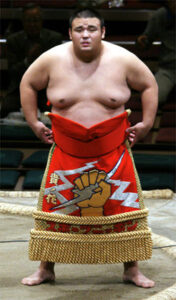
The most visible marker of the rank is the tsuna, the thick white rope worn around the waist — the literal source of the word “yokozuna,” meaning “horizontal rope.” Only a grand champion wears it, and he wears it to perform his own dohyo-iri, the ring-entering ceremony. While lower-division wrestlers enter the ring as a group, the yokozuna performs a solo ceremony in front of the crowd before the day’s top bouts.
The rope predates the rank. Yokozuna began not as a rank but as a ground-purification ritual: a leading wrestler performed a ground-stamping rite wearing a sacred rope, the shimenawa, and that rope came to be called the tsuna, or yokozuna. The solo ring-entering ceremony wearing the rope was first performed in the eleventh month of 1789, by Tanikaze and Onogawa — who were then ranked sekiwake. Yokozuna, in other words, was originally neither a rank nor a title automatically handed to a strong ozeki.
That ceremony is the public expression of everything the promotion stands for. The rope, the solo entrance, the stylized movements — together they announce that this is the man who carries the sport. It is a long way from the daily grind of building a record at ozeki, and that distance is exactly why so few ever make the walk.
Frequently Asked Questions
What are the requirements to become a yokozuna?
A candidate must already be an ozeki and must have dominated the top division — by convention, winning two tournaments in a row or producing a comparable record — while showing the dignity the rank demands. The Yokozuna Deliberation Council recommends the promotion and the Japan Sumo Association approves it. The two-yusho line is a custom, not a written rule.
Can a sekiwake or komusubi be promoted straight to yokozuna?
No. Promotion to yokozuna is open only to a wrestler already holding the rank of ozeki. A sekiwake or komusubi, however well he performs, has to reach ozeki first before a yokozuna case can even be considered.
Is winning two tournaments in a row an absolute requirement?
No. Two consecutive championships is the customary benchmark, but the standard is expressed as two straight titles “or a comparable record.” Several yokozuna were in fact promoted on a single championship — among them Kagamisato, Kashiwado, Onokuni, Kakuryu, and Kisenosato — and Futahaguro was promoted with none, which shows how the flexible wording has been used in practice.
Why was the Yokozuna Deliberation Council created?
It was set up in 1950 after all three reigning yokozuna withdrew early from that spring’s tournament and drew heavy criticism. The Association first proposed demoting underperforming yokozuna, but the public rejected the idea — holding that a grand champion should retire rather than be demoted — so the Association created the Council to advise on promotions instead.
Can a yokozuna ever be demoted?
No. Yokozuna is the only rank in sumo that cannot be lost through poor results. A grand champion holds the title for the rest of his career. The expectation, though, is that a yokozuna who can no longer compete at the level the rank demands will retire rather than continue.
What is hinkaku, and why does it matter for promotion?
Hinkaku means dignity — a wrestler’s conduct on the dohyo, including the resolve never to fix a match, and his dedication to sumo. It is the older half of the standard, originally phrased as “dignity and ability of the highest order.” Because a yokozuna represents the whole sport and can never be demoted, the decision-makers weigh hinkaku alongside results, and a candidate who meets the statistical bar but not the dignity expectation can be made to wait.