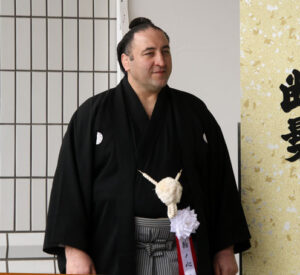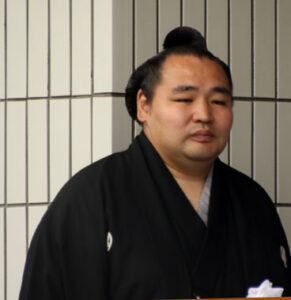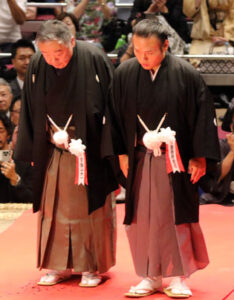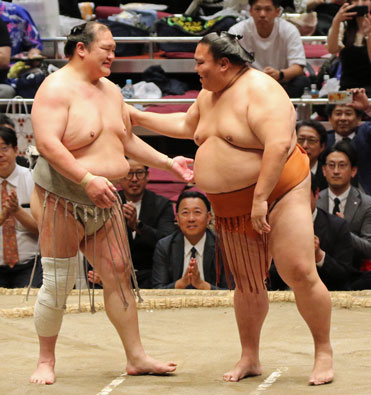
Hokutofuji’s retirement ceremony at the Ryogoku Kokugikan marked both his formal farewell to the dohyo and his succession to the elder name Oyama. The day brought his final ring-entering ceremony alongside his young son, a winning last bout against Mitakeumi, and a hair-cutting ritual in which roughly 300 people each took a snip — closing with words of a sumo life held without a single regret.
A farewell, and a new name
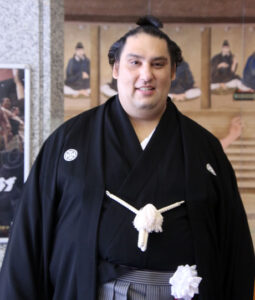
The occasion was billed in full as the retirement ceremony of Hokutofuji and the celebration of his succession to the elder, or toshiyori, name Oyama. Two titles for one man, the wrestler stepping aside and the elder stepping forward, joined into a single afternoon under the great roof of the Kokugikan in Tokyo.
You felt the weight of it before you ever reached your seat. A queue had formed from early morning, well ahead of the 10:30 a.m. opening, the line stretching along the building while people waited to be let in. Admission came in stages, first-floor and second-floor ticket holders ushered through separately rather than all at once — a way of managing the crowd that has become a recent habit at events like this. By the time the doors finally gave way, the anticipation had been building for hours.
At 11:30 the program opened the only way a sumo day should, with the furedaiko, the announcing drums whose rhythm carries the message that the action is about to begin. If you have ever wondered how the rituals fit together, our guide to watching sumo walks through the shape of a day like this one.
Two moments that held the room
A father and son at the center
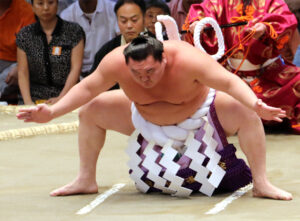
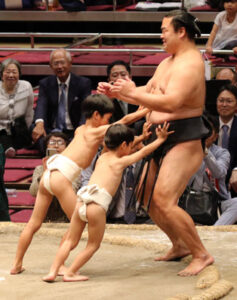
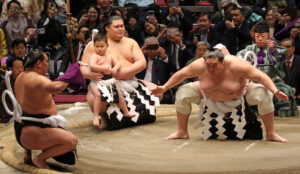
Of everything the afternoon offered, two moments stood apart. The first was Hokutofuji’s final dohyo-iri, his last ring-entering ceremony. He did not make the circle alone. His young son went with him, the two of them moving around the ring together before coming to a stop at the very center. There is a particular hush that settles over a hall when a small child stands where giants have stood, and it settled here.
One last bout against Mitakeumi
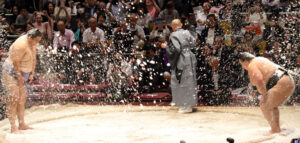
The second came in the ring itself. For his final bout Hokutofuji faced Mitakeumi, and it was no soft exhibition. The two went at it with spirit, and when it was over Hokutofuji had won. What lingered afterward was not the result but the exchange between them — two men who acknowledged each other’s effort, the kind of mutual respect that a career is supposed to leave behind.
The danpatsu-shiki, snip by snip
Then came the hair-cutting. The ceremony in which a retiring wrestler has his topknot removed is called the danpatsu-shiki, and it is the heart of any retirement day — long, deliberate, and built entirely around the people who shaped a career. Chairman Suzuki Muneo opened with greetings. After that, the line began to move.
About 300 people were scheduled to take a turn, each making a single ceremonial snip at the knot. The second to step forward was the singer Matsuyama Chiharu. As the guests came and went, Hokutofuji turned in sequence to face each part of the hall — front, or shomen, then east, then the far side known as the mukou-shomen, then west, and finally front again — so that every direction of the arena had its moment with him. There was no women’s slot on this day.
The figures from the Sumo Association came last, as they do. Both yokozuna took their turn; the seniors and juniors of Saitama Sakae high school and of Nittai, the Nippon Sport Science University, filed through; and the wrestlers and elders of the Takasago ichimon and the Hakkaku stable followed. Onosato was among those who took a snip. You can read more about the sport’s highest rank in our explainer on the yokozuna.
One small detail spoke to the standing of the man. Of the wrestlers who had sat out the May tournament, all took part in the ceremony except Asanoyama.
A climb without a single step back
It is worth pausing on what Hokutofuji actually did on his way up, because it is rarer than the crowd may have realized. He reached the top division, makuuchi, without ever posting a losing record on the climb. Every tournament on the way up ended even or better. Not a single make-koshi to set him back.
To grasp how unusual that is, consider the names who did not manage it. Takanohana did not. Asashoryu did not. Hakuho — the most decorated of them all — did not either. Three of the greatest figures the sport has known stumbled at least once on the way up; Hokutofuji did not. It is the kind of record that does not win championships but does say something quiet and durable about consistency.
No regret, and a clean close
The final cut, the tome-basami, belonged to his stablemaster, Hakkaku. When it was done, Hakkaku turned and bowed to the four directions. Then Hokutofuji addressed the crowd. He told them he carried “not a single regret in my sumo life” — a line that lands differently coming from a man whose ledger really did read that way on the climb.
His family came forward with flowers, and the ceremony closed without a hitch. What the day meant was written across all of it: the son at the center of the ring, the win over Mitakeumi, the 300 hands that came to cut, the bow to the four directions. A wrestler became an elder named Oyama, and he left the way the record suggested he might — squarely, completely, and with nothing owed.
The day combined two milestones: Hokutofuji’s retirement and his succession to the elder name Oyama, held at the Ryogoku Kokugikan.
His final dohyo-iri with his young son and his winning last bout against Mitakeumi framed a danpatsu-shiki in which about 300 people each took a snip.
He reached the top division without a single losing record on the way — a feat Takanohana, Asashoryu, and Hakuho never achieved — and bowed out with “not a single regret.”
Frequently Asked Questions
What elder name did Hokutofuji take?
He succeeded to the toshiyori (elder) name Oyama. The event was officially both his retirement ceremony and the celebration of that succession.
Who made the final cut of his topknot?
His stablemaster, Hakkaku, made the final cut, known as the tome-basami, and then bowed to the four directions. About 300 people in total were scheduled to each take a ceremonial snip before that.
What record set Hokutofuji apart?
He reached the top division, makuuchi, without ever posting a losing record on the way up — something even Takanohana, Asashoryu, and Hakuho did not achieve.