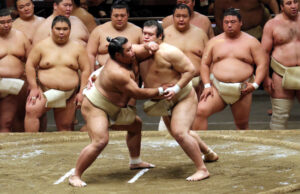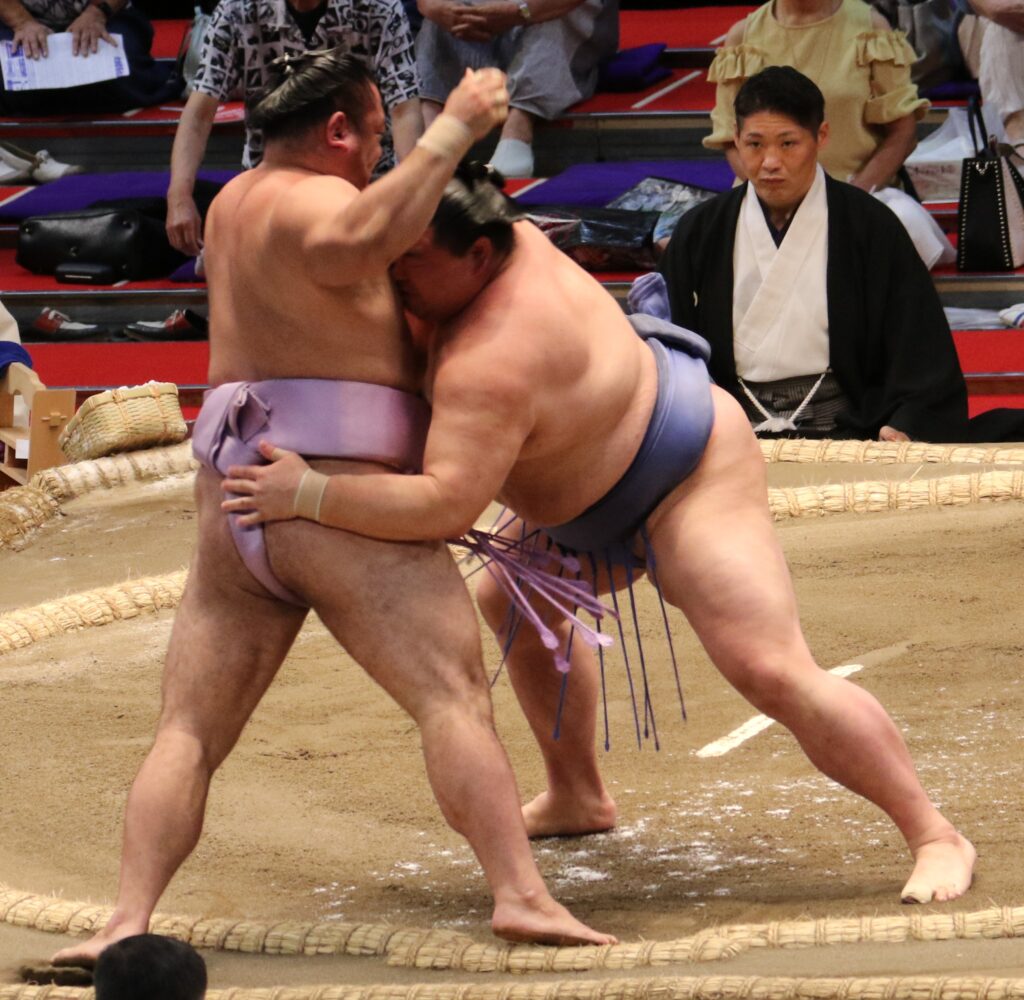
Kensho (kensho-kin) is sponsor-funded prize money attached to individual top-division sumo bouts. Each banner is worth 70,000 yen; the Japan Sumo Association takes a 10,000 yen fee, leaving the winning wrestler 60,000 yen. The loser gets nothing, and only makuuchi bouts carry it.
Per-bout, not per-tournament. Kensho is sponsor money tied to one specific matchup, paid out the moment that single bout ends.
Winner takes all. The wrestler who wins collects the full prize; the loser receives nothing, with no split or consolation share.
70,000 yen per banner, 60,000 to the wrestler. Each banner’s face value is 70,000 yen, and after the Japan Sumo Association’s 10,000 yen fee the winner keeps 60,000 yen per banner.
Top division only. Kensho appears solely on makuuchi bouts, clustering around yokozuna, ozeki, and other popular wrestlers.
The banner parade is the tell. A long line of kensho-maku circling the ring signals a big bout and money riding on the result.
When sponsor banners start circling the ring before a sumo bout, that parade is the signal that real money is riding on the result. That money is kensho (kensho-kin), per-bout prize money put up by corporate sponsors. The wrestler who wins the bout takes it. The loser walks away with nothing.
What kensho actually is
Kensho is sponsorship money tied to a single bout, not to a tournament or a season. A company buys one or more banners for a specific matchup, and the cash attached to those banners goes to whoever wins. There is no split and no consolation share. Win, and you collect; lose, and you get zero.
This makes kensho different from the yusho, the tournament championship, which carries its own separate prizes. Kensho rewards a single result on a single day.
How much money is on the line
Each banner has a fixed face value, but the wrestler does not pocket the whole amount.
| Item | Amount |
|---|---|
| Face value per banner | 70,000 yen |
| Japan Sumo Association handling fee | 10,000 yen |
| Wrestler’s portion per banner | 60,000 yen |
These figures follow Michihiro Taguchi’s reporting on sumo money. The exact handling and the number of banners on any given bout can change over time, so treat the per-banner math as the rule rather than a fixed total. The more banners a bout attracts, the larger the winner’s haul, but the per-banner split stays the same.
Which bouts carry kensho
Kensho appears only on makuuchi (top-division) bouts. Lower divisions do not get it. Within makuuchi, the banners cluster around the matches fans most want to see: bouts involving a yokozuna (grand champion) or ozeki (champion), and any sumo wrestler popular enough to draw a crowd.
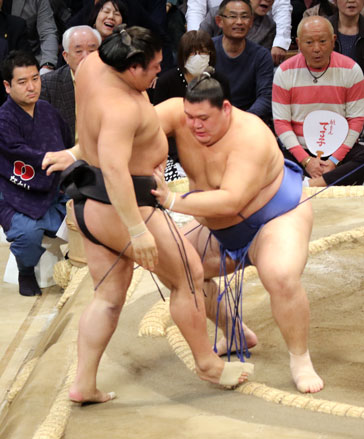
That is why the headline bouts late in the day’s schedule often have the longest banner parades, while a quieter mid-card matchup may have few or none. Sponsors put their money where the attention is.
The banner parade and the handover
Before a sponsored bout, attendants carry the kensho-maku — the kensho banners, each printed with a sponsor’s name — in a slow circle around the ring. This parade is the visible signal that the bout carries prize money, and the number of banners hints at how big the matchup is.
After the bout, the winner receives the prize on the ring itself, before stepping down. The gyoji (referee) hands the money to the victor in envelopes.
Where kensho fits in a tournament day
Across a honbasho (official 15-day tournament), the day builds from junior bouts up to the makuuchi finale. Kensho rides only on that top tier, so the banner parades grow more frequent as the afternoon climbs the banzuke (ranking sheet) toward the marquee names.
Why kensho matters to fans
For a newcomer, kensho is one of the easiest pieces of sumo to read. You do not need to know the wrestlers to sense the stakes: a long line of banners means a big bout, a tense crowd, and money changing hands the moment the match ends. It turns an abstract ranking system into something you can watch and count in real time.
Frequently asked questions
Does the loser of a sumo bout get any kensho money?
No. Kensho is winner-take-all. The wrestler who wins the bout receives the full prize attached to it, and the loser receives nothing. There is no split or consolation share.
How much is one kensho banner worth?
Each banner has a face value of 70,000 yen. The Japan Sumo Association takes a 10,000 yen handling fee, so the winning wrestler’s portion is 60,000 yen per banner. The number of banners on a bout can vary.
Why do banners get carried around the ring before a match?
Those are the kensho-maku, banners printed with each sponsor’s name. Parading them around the ring is the visible signal that the bout carries prize money. The more banners, the bigger the matchup.
Which sumo bouts have kensho?
Only makuuchi (top-division) bouts. Lower divisions do not carry it. Within the top division, bouts involving a yokozuna or ozeki and other popular wrestlers attract the most banners.
How does the winner receive the kensho money?
The gyoji (referee) hands the prize to the winner on the ring, before the wrestler steps down. The money is given in envelopes.
Is kensho the same as the tournament championship prize?
No. Kensho is per-bout sponsor money decided by a single match. The yusho is the tournament championship, won over the full schedule and carrying its own separate prizes. They are two different things.