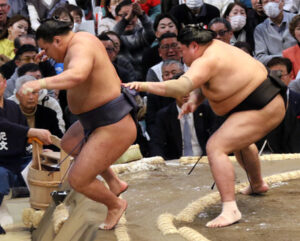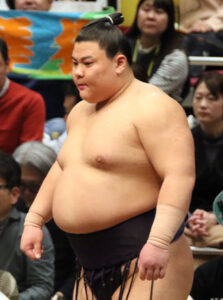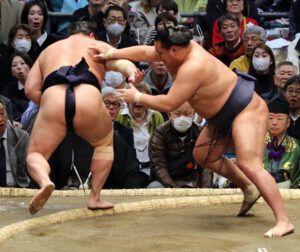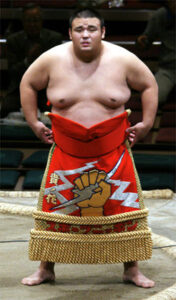
In sumo, sekiwake and komusubi are the two junior titled ranks of the top division, sitting directly below ozeki and above the rank-and-file maegashira. Of the two, sekiwake is the higher: the order from the top runs yokozuna, ozeki, sekiwake, then komusubi. Together with the ozeki they make up the san’yaku, the titled fighting ranks below the grand champion. This guide explains what each rank is, which outranks which, why their schedule is the hardest in the sport, and how a sekiwake turns strong results into an ozeki promotion.
Sekiwake is higher than komusubi. The order from the top is yokozuna, ozeki, sekiwake, komusubi, then the maegashira rank-and-file.
Both are san’yaku. The titled fighting ranks below the yokozuna are ozeki, sekiwake and komusubi; sekiwake and komusubi are the two junior ones.
Komusubi is usually the first title. For most wrestlers, komusubi is the first titled rank they ever reach — and reaching it can take years.
They are the gateway to ozeki. Strong runs at sekiwake — customarily three strong tournaments, often quoted as around 30 wins — are what build an ozeki case.
No safety net. Unlike an ozeki, who gets a kadoban reprieve, a sekiwake or komusubi who posts a losing record simply drops down the banzuke.
What sekiwake and komusubi are
Professional sumo ranks its wrestlers on a single list, the banzuke, and the top division — makuuchi — is led by a handful of named ranks. Below the yokozuna and the ozeki come the two junior titled ranks: sekiwake and komusubi. They stand above the maegashira, the numbered rank-and-file who make up most of the division. A wrestler who reaches sekiwake or komusubi has stepped out of the pack and into the san’yaku, the group of titled fighting ranks, marking him as one of the strongest competitors of the moment. The banzuke usually carries at least one sekiwake and one komusubi on each side, East and West, and occasionally more when results demand it.
For a wrestler who has just reached the top division, the first promotion goal is exactly this — to break into the san’yaku at komusubi or sekiwake. In one tournament that the sumo writer Michihiro Taguchi surveyed, 23 of the 42 makuuchi wrestlers — about 55 percent — had reached sekiwake or komusubi at some point in their careers, which shows both how central these ranks are and how far they sit above the rank-and-file.
Which is higher — sekiwake or komusubi?
Sekiwake is the senior of the two. Reading the top of the banzuke downward, the order is yokozuna, ozeki, sekiwake, then komusubi, and below them the maegashira. Komusubi is therefore the lowest of the titled ranks — and for many wrestlers it is the first one they ever reach, the doorway into the san’yaku. Sekiwake sits one step closer to the top and is the rank from which an ozeki bid is normally launched. The gap between them is small in name but meaningful in practice: a strong komusubi who keeps winning moves up to sekiwake, and a sekiwake who sustains it puts himself in line for ozeki.
Getting there at all is hard. Taguchi has documented just how long the climb into the san’yaku can take: Endo needed 28 tournaments from his top-division debut before he first reached komusubi, and Tamawashi did not make komusubi until his 38th tournament, more than six years in, at the age of 30. Both reached the top division years before they reached its lowest titled rank.
The toughest schedule in sumo
Holding a san’yaku rank is punishing because of who these wrestlers have to face. In the opening days of each tournament, the sekiwake and komusubi are matched against the yokozuna and ozeki at the top of the banzuke. A newly promoted komusubi can find himself drawn against a yokozuna on the very first day — when Onosato held the top rank, for instance, a West komusubi was lined up to meet him on day one. That schedule is why the junior san’yaku ranks change hands so often: a wrestler can earn komusubi with a fine tournament, then surrender it after a hard run against the best, dropping back into the maegashira before climbing again.
And unlike the ozeki, who is cushioned when he stumbles, a sekiwake or komusubi has no protection. An ozeki who posts two losing tournaments in a row falls only as far as sekiwake, and can climb straight back by winning ten or more bouts in the very next tournament — the kadoban reprieve, in force since the July 1969 tournament. Sekiwake and komusubi have no such cushion. A single losing record sends them straight back down the list.
The road to ozeki
For an ambitious wrestler, sekiwake is the launchpad. Promotion to ozeki has no rigid formula, but it is customarily described as a run of three strong tournaments at sekiwake — roughly eleven wins in each of three straight basho. The figure quoted by sumo elders is around 30 wins over those three tournaments: the former yokozuna Tochinishiki, as elder Kasugano, noted that even Wajima earned his promotion on 30 wins across an 11–10–9 stretch. That is why a wrestler who reaches sekiwake and keeps producing is watched so closely — each strong tournament builds his case.
The fastest route of all is to win the tournament outright as a sekiwake, which is rare but decisive. Since the championship system began in 1926 there have been 31 occasions when a sekiwake took the title; on 23 of them the wrestler was promoted to ozeki the very next tournament — about 74 percent — while only 8 times did the title not bring an immediate promotion. The ladder, in order, runs komusubi to sekiwake to ozeki, and finally — for the very few — to yokozuna. See how an ozeki is promoted and how a yokozuna is promoted for the steps above.
There is a deeper line in the sport about why these two ranks sit where they do. As one veteran put it to Taguchi, sekiwake and komusubi are ranks any wrestler can reach with enough effort — but reaching ozeki and beyond takes something extra that effort alone does not supply. That is the dividing line the junior san’yaku ranks mark: the proving grounds a wrestler can earn his way onto, and the gateway he then has to force open.
Frequently asked questions
Q. Which is higher, sekiwake or komusubi?
Sekiwake. The order from the top is yokozuna, ozeki, sekiwake, then komusubi.
Q. What rank is below komusubi?
The maegashira, the rank-and-file of the top division. A komusubi who posts a losing record usually drops into the maegashira ranks.
Q. What is san’yaku?
The titled fighting ranks below the yokozuna — ozeki, sekiwake and komusubi. Sekiwake and komusubi are the two junior san’yaku ranks.
Q. How does a sekiwake become an ozeki?
By stringing together strong tournaments — customarily three strong basho at sekiwake, often quoted as around 30 wins. Winning the title outright as a sekiwake almost always brings promotion the next tournament. See how an ozeki is promoted.
Q. Is it hard to reach komusubi?
Very. It took Endo 28 tournaments from his top-division debut to first reach komusubi, and Tamawashi 38 tournaments, at the age of 30.
Photo by Michihiro Taguchi.