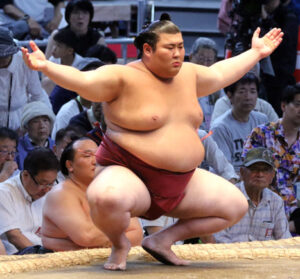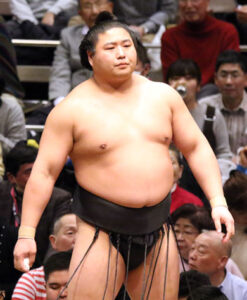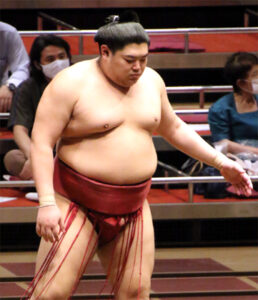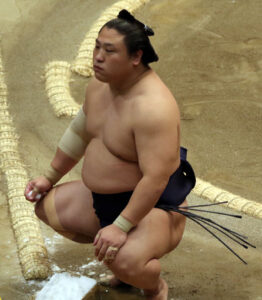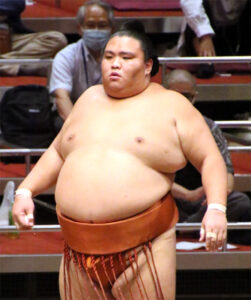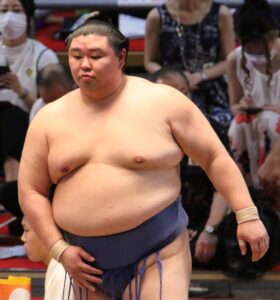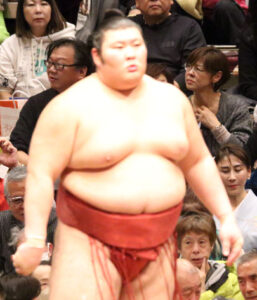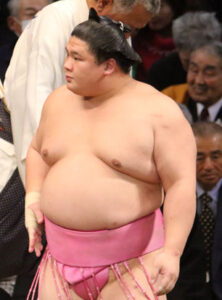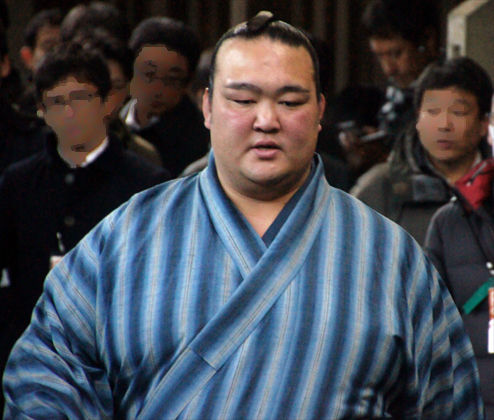
Photo by Michihiro Taguchi.
Kisenosato was the 72nd yokozuna and the first Japanese-born wrestler promoted to the rank in nineteen years. He won the championship in his first tournament as a yokozuna, in March 2017 — and never won another. Injury took the next two years: he withdrew from eight tournaments in a row, came back for one winning record, and retired on day five of the January 2019 tournament. He is now the stablemaster Nishonoseki, and the wrestler he raised, Onosato, became the 75th yokozuna in 2025.
The ozeki who rarely sat out
For most of his career, up through his years at ozeki, Kisenosato was a model of durability. He simply kept showing up. His only withdrawal in that whole stretch came on the final day of the January 2014 basho, when he sat out and took a forfeit loss. That single absence ended his run of consecutive tournament appearances — counted from his days back in jonokuchi — at 69 basho.
A reversal at the top
Promotion to yokozuna flipped the script. The wrestler who once never sat out became one who could not stay on the dohyo. His withdrawals as a yokozuna stretched to seven tournaments in a row, tying Takanohana for the worst such mark. Counting forfeit losses as absences, his yokozuna withdrawal rate climbed to 63.3 percent — the second worst on record.
The numbers pointed toward an even grimmer milestone. If he were to pull out of the July tournament as well, the rate would rise to 75.8 percent, passing Musashiyama’s 72 percent and leaving him with the worst yokozuna withdrawal rate of all.
A comeback that has to be as a yokozuna
Kisenosato began training again on June 5. The session was kept away from the press — not as some secret special camp, but, it seems, because he did not want to show a body that had gone soft. That detail captures the bind he was in. Futabayama was once described as being just a touch stronger than anyone he faced. The Kisenosato of this period was, against almost anyone, even at best.
That is what made the road so steep. His return could not be a comeback as an ozeki or a sekiwake. It had to be a comeback as a yokozuna — and at that level, half-hearted training would never be enough.
The four sections above were written in mid-2018, while he was still trying. What follows is what happened.
He did sit out July, and the record stands
He missed the July 2018 tournament in full — his eighth consecutive withdrawal. He came back in September and went 10–5, the only winning record he managed as a yokozuna after his first tournament at the rank. Two months later he opened November 0–5 and pulled out. He opened January 2019 0–4 and announced his retirement on the fifth day.
| Tournament | Result |
|---|---|
| March 2017 | 13–2 — championship, in his first tournament as yokozuna |
| May 2017 | 6–5, 4 days missed |
| July 2017 | 2–4, 9 days missed |
| September 2017 | Full withdrawal |
| November 2017 | 4–6, 5 days missed |
| January 2018 | 1–5, 9 days missed |
| March 2018 | Full withdrawal |
| May 2018 | Full withdrawal |
| July 2018 | Full withdrawal |
| September 2018 | 10–5 |
| November 2018 | 0–5, 10 days missed |
| January 2019 | 0–4 — retired on day five |
| Total | 36–36, 97 days missed, across 12 tournaments |
Thirty-six wins as a yokozuna. Ninety-seven days not wrestled. The two-year yokozuna career is the shortest kind of tragedy sumo produces, because the rank has no exit that is not retirement: a yokozuna cannot drop back to ozeki and grind out a living. He either wrestles at the top or he stops.
The championship that turned out to be the last one
Winning a tournament in your first outing as a yokozuna is rare enough that Taguchi went and counted it. From Tamanishiki through Terunofuji — the forty-two men promoted to the rank since the official championship system began in 1926 — seven won their debut tournament as a yokozuna.
| New yokozuna | Result |
|---|---|
| Futabayama | 13 wins — mid-way through his 69-bout winning streak |
| Azumafuji | 10–2, with one bout stopped for injury |
| Taiho | 13–2 |
| Takanosato | 15–0 — the only perfect new-yokozuna championship |
| Takanohana | 13–2 |
| Kisenosato | 13–2 — and his last championship |
| Terunofuji | 13–2 |
Kisenosato is the only man on that list for whom the debut championship was also the farewell. It is the cruellest possible shape for a career: the thing everyone had waited nineteen years for arrived, and then nothing came after it.
The retirement ceremony, September 2019
Taguchi went to the Kokugikan for the danpatsu-shiki, the ceremony where a retiring wrestler’s topknot is cut off. He had been tipped off that the queue was long. It was: it ran from the main gate, round past the south gate and on beyond that, and it took him about an hour to get inside. The programme handed out at the turnstile was A3, folded once — an unusually large format for a retirement ceremony, with a photograph of Kisenosato on the cover in the rope and carrying the sword.
He performed the ring-entering ceremony one last time. Not with serving yokozuna as attendants, as convention would have it, but with Takayasu and Shohozan — his own stablemate and a contemporary. Umegatani style. The red under-colour of the ceremonial apron hit the eye hard. The rise out of the crouch is the moment the whole thing is built around, and knowing it was the last time made the room hold its breath.
Two things broke with custom during the haircut itself. It is normal for the retiring wrestler to be turned to face front, east, the back of the hall and west in turn as guests take their snips. Kisenosato did not turn. He faced front, and stayed there, for the whole ceremony. And there were no women among those who cut — also not the usual arrangement.
Among those who did take the scissors: two seniors from his own stable, the former Rikizakura and the former Takanowaka; his father; the swimmer Takeshi Matsuda; the former third Wakanohana; and, from Mongolia, the former yokozuna Harumafuji — a man Kisenosato had traded some of the best bouts of his career with, now standing over him with a pair of shears. Toyonoshima, Kotoshogiku, Takayasu, Hakuho and Kakuryu cut. So did the elders Onogawa, Inagawa, Futagoyama, Shibatayama and Nishiiwa. Then the lights went down, a spotlight came up on him alone, and his stablemaster Tagonoura, the former Takanotsuru, made the final cut. Kisenosato bowed to the four sides. Later, during the top-division bouts, he was seen at the teahouses making his greetings with his hair combed out.
Nishonoseki: what he did next
He stayed in the sport as the elder Araiso, coaching under Tagonoura, and in 2021 he broke away to found his own stable. He built it in Ami, in Ibaraki prefecture, next to Ushiku where he grew up — not in the Ryogoku sumo district, as had been expected when he retired. He wanted the space. About 300 square metres of land, with two training rings rather than the usual one. He took four wrestlers with him and ran the stable out of temporary quarters in Tsukubamirai while it was built.
He later took the Nishonoseki name, and the Japan Sumo Association’s elder register lists him under it today. When Taguchi wrote about the new stable in 2021 he closed by wondering what kind of salaried wrestler might come out of it, and said it might take some years. It took four. Onosato came up through the stable and was promoted to yokozuna in 2025 — the 75th, and the first Japanese-born yokozuna since Kisenosato himself.
That is the line worth drawing under this page. Kisenosato’s own time at the top lasted twelve tournaments and produced one championship. The stable he built has already produced a yokozuna who has won five. Some careers do their real work after the topknot comes off.
Frequently asked questions
Q. When did Kisenosato retire?
On the fifth day of the January 2019 tournament, after opening 0–4. He had been a yokozuna for twelve tournaments, going 36–36 with 97 days missed.
Q. How many championships did Kisenosato win?
Two in total, and only one as a yokozuna — the March 2017 tournament, his first at the rank. It was also the last championship of his career.
Q. What is Kisenosato doing now?
He is the stablemaster Nishonoseki. He founded the stable in Ami, Ibaraki in 2021 as the elder Araiso and later took the Nishonoseki name. Its best-known wrestler is the yokozuna Onosato.
Q. What was Kisenosato like as an ozeki?
Remarkably durable. His only withdrawal up through his ozeki years came on the final day of the January 2014 basho, a forfeit loss that ended a streak of 69 consecutive tournament appearances dating back to jonokuchi.
Q. How many tournaments did Kisenosato miss as a yokozuna?
He withdrew from seven in a row and then an eighth, in July 2018. Counting forfeit losses as absences, his withdrawal rate as a yokozuna reached 63.3 percent as of mid-2018 — second worst on record at the time.
Q. Why was Kisenosato’s comeback considered so difficult?
Because a yokozuna can only return as a yokozuna. He could not drop back to wrestling like an ozeki or sekiwake, and at that point he was, against nearly anyone, even at best.
Reporting note: this article draws on Michihiro Taguchi’s tournament reporting published in Dohyo no Mokugekisha, in particular his account of the retirement ceremony (September 30, 2019), his piece on the founding of the stable (May 28, 2021) and his count of new-yokozuna championships (February 23, 2025). Tournament results were rechecked against the Japan Sumo Association on August 3, 2026, and the elder register on July 20, 2026. Official bout-by-bout records are available from the January 2013 tournament onward.
Updated August 5, 2026.
Read next: how yokozuna promotion actually works · what happens when a wrestler sits out a tournament · Terunofuji, the 73rd yokozuna · Takayasu, his stablemate