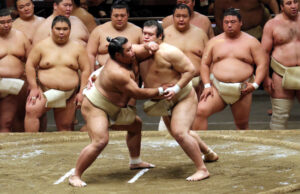
Watching sumo live in Japan is easier to plan than many first-time visitors expect, once you know the calendar, the seat types, and where to buy. This is a practical planning guide for anyone hoping to sit in the hall for a grand tournament: when the tournaments happen, how tickets are sold, what a full day inside looks like, and how to reach the venue. A little reading on sumo etiquette beforehand also helps you feel at home once you are in your seat.
When and where the tournaments happen
Sumo runs on a fixed yearly calendar that has held steady for decades. There are six grand tournaments, called honbasho, across the year, and each one runs for fifteen days. Knowing these dates is the first step in timing a trip.
Three of the six are held in Tokyo at the Ryogoku Kokugikan, in January, May, and September. The other three move around the country: Osaka in March, Nagoya in July, and Fukuoka in November. For a visitor planning to watch sumo in the capital, the January, May, and September tournaments are the ones to aim for, since those are the Tokyo basho held at Ryogoku.
The kinds of seats
The hall offers a few different ways to watch, and the experience changes depending on where you sit. Picking the seat type that suits you is worth doing before you buy.
Masu-seki are Japanese-style floor boxes; isu-seki are chair seats. Check the selected tournament’s plan for their position, capacity and sales unit. Do not assume a separate same-day allocation exists: rely on the current official sales notice before travelling without a ticket.
The association publishes its prices in English, and they are worth looking at before you decide, because the gap between the cheapest and the most expensive way to watch the same day of sumo is very wide.
| Seat type | Weekday | Weekend & holiday | Sold as |
|---|---|---|---|
| Masu Box B (box seat) | ¥40,000 | ¥42,000 | One box for four people |
| Masu Box C (box seat) | ¥34,000 | ¥38,000 | One box for four people |
| Chair Seat B (arena seat) | ¥5,000 | ¥5,500 | Per person |
| Chair Seat C (arena seat) | ¥3,500 | ¥4,000 | Per person |
These are examples from the Association’s English guide, not a complete price range for every venue. In the weekday Masu Box C example, ¥34,000 divided between four people is ¥8,500 each. A ¥3,500 Chair Seat C is about 41% of that per-person figure, not less than a quarter. This is our calculation from the listed examples; fees are additional. If your group does not use all the places in a box, compare the whole-box cost with buying individual chair seats.
How to get your tickets
Tickets go on sale ahead of each tournament, and popular days can sell out. Weekends and the final days tend to go fastest, so those are the ones to secure early if your schedule allows.
Begin with the Association’s official English ticket guidance and follow its sales link. Check registration, payment and delivery conditions for the channel you choose. Same-day sales, if announced, are not a guaranteed fallback after advance tickets sell out.
Timing matters more than most guides admit. General-sale dates differ by tournament, and the Association publishes them in its official calendar. Use the listed date rather than a fixed number of weeks before the opening day. For the Tokyo tournaments, advance sales opened on August 8, 2026 for the September 2026 tournament, and open on December 5, 2026 for January 2027 and April 10, 2027 for May 2027.
Treat those dates as the thing to diarise, because selling out is the norm rather than the exception. As of August 24, 2026, the association’s own English site listed the September 2026 tournament as sold out on every date, more than two weeks before the opening day. Booking fees are charged on top of the ticket price, and prices can differ by venue, so confirm the final figure at the official ticket site as you buy.
The presale lotteries: fan club first, then Ticket Oosumo
Before general sale opens, tickets are first offered through a series of presale lotteries. For the November 2026 tournament in Fukuoka, the Japan Sumo Association ran four of them in a fixed order: two rounds for members of its official fan club, then a lottery on its own ticket site, Ticket Oosumo, then one on the ticket agency Ticket Pia. General sale, first come, first served, came last.
| Round | Who can enter | Entry window | Results |
|---|---|---|---|
| 1. Fan club, first round | Yokozuna, Ozeki and Sekiwake members | Aug 14–17 | Aug 19 |
| 2. Fan club, second round | All paid members | Aug 21–24 | Aug 26 |
| 3. Ticket Oosumo presale | Ticket Oosumo (web) | Aug 28–31 | Sep 2 |
| 4. Ticket Pia presale | Ticket Pia (web) | Sep 4–7 | Sep 9 |
| 5. General sale | Anyone, first come, first served | From Sep 19, 10:00 | – |
The order matters because the rounds share one stock of seats. The fan club says its first round, its second round and then Ticket Oosumo draw from the same pool, and the association warns that any seat type that sells out during the presales is not offered at general sale at all. The fan club is also plain that a presale lottery only adds a chance to buy: it does not promise good seats, or any seat.
The official fan club
The association’s official fan club (its website, fanclub.sumo.or.jp, is in Japanese) has five paid tiers named after the sumo ranks. As of September 29, 2026, including tax: Makuuchi ¥550 a month; Komusubi ¥6,600 a year; Sekiwake ¥33,000 a year; Ozeki ¥110,000 a year, limited to 100 members; and Yokozuna ¥330,000 a year, limited to 30 (the club says it may open more places). Sekiwake and above can enter both fan club rounds; Komusubi and Makuuchi members can enter only the second. The free Juryo tier carries no presale entry.
To enter a fan club lottery you also need a free Ticket Oosumo account registered with the same email address as your fan club account. If the two do not match, the fan club warns, you may lose the draw or have a win cancelled.
Improving your odds
The fan club’s own guidance for the November 2026 presale named three ways to raise your chances. Pick a weekday, because weekends and holidays draw the most entries. Avoid the front seats, tamari (ringside), Masu Box S and A, and Chair Seat S, which are the most contested. And use all three preferences allowed for each seat category, across more than one category.
How hard is it to win?
The numbers are not public: neither the association nor the fan club publishes how many seats each lottery hands out or what share of entries win. What is on record is the pressure. The fan club notes that all six tournaments of 2024 sold out, with the Tokyo tournaments drawing especially heavy demand.
Michihiro Taguchi, who writes our sister site in Japanese, has heard it from fans directly. On August 8, 2026, before the September tournament, he wrote that fellow fans described a far tougher draw than for the May tournament: people who used to win tickets for two days through the fan club were now winning one, or none. After the tournament, on September 29, he wrote that several people had complained to him that fan club presale wins had fallen, and he asked for the number of winning tickets to be at least put back to where it was. Those are reports from fans, not official figures.
If it sells out: the official resale
Once a tournament sells out, the association points buyers to its fixed-price resale service on the official ticket site. Reselling tickets is prohibited under the association’s spectator terms, and the fan club warns that resellers may be refused entry or have their accounts suspended, so buy and swap only through the official channels.
What a day at the tournament looks like
Doors open in the morning and bouts run all day, so you can shape your visit around the parts you most want to see. The program starts with the lowest divisions and works upward, division by division, building toward the top division, makuuchi, in the late afternoon.
Before the makuuchi bouts come two ring-entering ceremonies: the top-division ring-entering ceremony, the makuuchi dohyo-iri, and then the yokozuna‘s own ring-entering ceremony. Many spectators time their arrival for these. The day builds to its close with the final bout, the musubi-no-ichiban, in the early evening. You can arrive early for a quieter hall and the lower divisions, or come later to catch the top-division action and the closing ceremonies.
Getting to the Kokugikan
The Ryogoku Kokugikan stands right by Ryogoku Station, which makes it simple to reach. You can get there on the JR Sobu Line and on the Toei Oedo Line, so it connects easily to the wider Tokyo rail network.
Arriving from Narita or Haneda airport, you can reach Ryogoku from central Tokyo by train. For current routes, connections, and fares, the rail operators and journey-planning tools will give you the up-to-date details for your travel day.
Planning a trip from overseas
If your goal is to watch sumo in Tokyo, build the trip around the three Ryogoku tournaments in January, May, and September. Those are the dates that put a grand tournament in the capital, so they give you the best chance of seeing sumo while you are in the city.
Because tickets can sell out, booking ahead through the official English-language channel is the safer plan, and check the official resale route if advance tickets have sold out. Do not assume tickets will be available at the venue. If you want to know which wrestlers will be in the spotlight, reading up on the rankings before you go helps you follow the day. To turn a tournament into a fuller day out, see the guide to Ryogoku, the sumo town, or how to pair sumo with Asakusa in one day.
Before you book
For the details that change from tournament to tournament, go straight to the official Japan Sumo Association site and the official ticket site. That is where to confirm exact prices, on-sale dates, and the day-by-day schedule for the tournament you want to attend.
Those official sources also carry the current rules for the hall, including what you may bring in your bag, whether you can leave and re-enter, and what is allowed for photography. Checking them shortly before you travel means you arrive with the right expectations and no surprises at the door.
Key Takeaways
- Six grand tournaments run each year, fifteen days each; the Tokyo ones at the Ryogoku Kokugikan fall in January, May, and September.
- Compare floor boxes and chair seats using the selected tournament’s seating plan. Do not assume same-day general admission is available.
- Buy through the official ticket site with its English option, and book on the on-sale date: the September 2026 tournament was sold out on every date by August 24, 2026.
- Before general sale, tickets are offered in presale lotteries: two fan club rounds, then Ticket Oosumo, then Ticket Pia. For the November 2026 tournament, general sale opened on September 19, 2026, and the number of lottery winners is not published.
- The B/C seat examples in the Association’s English guide list chair seats at ¥3,500–¥5,500 and four-person boxes at ¥34,000–¥42,000. These are selected examples, not the full range of seats or prices.
- A tournament day runs from the lower divisions in the morning up to the top division and the final bout in the early evening.
- Confirm prices, on-sale dates, the schedule, and bag and photography rules on the official Japan Sumo Association site and the official ticket site before you go.
Frequently Asked Questions
How do you buy sumo tickets from overseas?
Use the official ticket site, which has an English-language option, as your main route from abroad. Authorized outlets also sell tickets. Check availability before committing to travel; same-day sales must be confirmed in the current official notice. Check the official Japan Sumo Association site and the official ticket site for the current process.
Does joining the sumo fan club help you get tickets?
It gets you into the earliest lotteries. Paid members of the official fan club can enter its presale lotteries, which run before any other sale; Sekiwake members and above (¥33,000 a year and up, as of September 29, 2026) can enter the first round as well as the second. Membership does not guarantee a seat, you also need a free Ticket Oosumo account under the same email address, and the fan club’s website is in Japanese.
How hard is it to win a sumo ticket lottery?
The association and the fan club do not publish the number of winners or the odds. According to the fan club, every tournament in 2024 sold out, and its own advice is to choose weekdays, avoid the front seats and use all three preferences for each seat category.
How much do sumo tickets cost?
The Association’s English guide gives selected B/C examples: chair seats at ¥3,500–¥5,500 per person and four-person boxes at ¥34,000–¥42,000, depending on grade and day. These are not the full range of ticket prices. The figures were rechecked on October 2, 2026; fees are extra and venue prices vary. Consult the actual tournament sales page for a quote.
When are the Tokyo sumo tournaments?
The Tokyo grand tournaments take place in January, May, and September at the Ryogoku Kokugikan. Each one runs for fifteen days. If you want to see sumo in the capital, plan your visit around one of those three months.
What happens on a tournament day?
Doors open in the morning and bouts run all day. The program starts with the lowest divisions and works up to the top division, makuuchi, in the late afternoon. The top-division and yokozuna ring-entering ceremonies come before the makuuchi bouts, and the day ends with the final bout, the musubi-no-ichiban, in the early evening.
Sources
Ticket prices, on-sale dates and tournament dates on this page were taken from the Japan Sumo Association’s official English site on August 24, 2026: How to Buy for seat types and prices, and the Grand Tournament Schedule for dates and on-sale dates. Prices and availability change, and the association warns against unofficial ticket resellers, so buy through its official ticket service. The presale lottery order and dates, the fan club tiers and the fan club’s advice were taken on September 29, 2026 from the association’s ticket purchase page for the November 2026 tournament and the official fan club’s membership page, presale guide and November 2026 presale notice (all in Japanese). If your trip misses the tournament windows, see how to see sumo in Tokyo when no tournament is on.
Correction, October 2, 2026: removed unverified same-day-ticket advice; corrected the chair-to-box price comparison and the erroneous “fifteen hours” description. The lottery sources retain their September 29 check date.