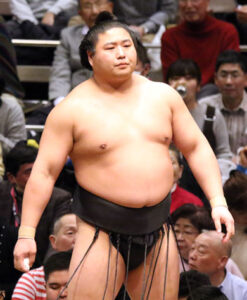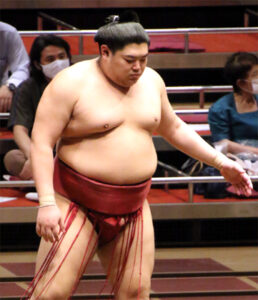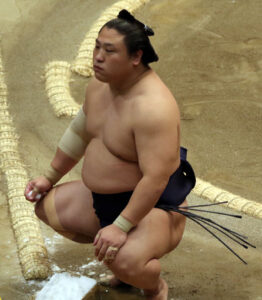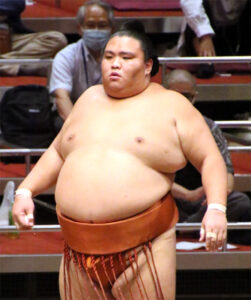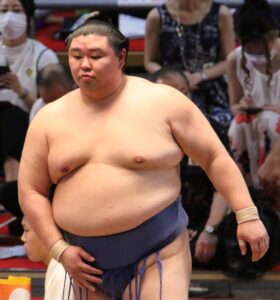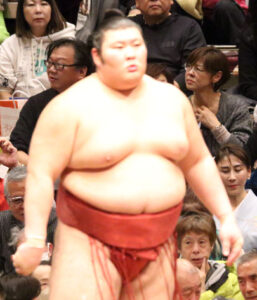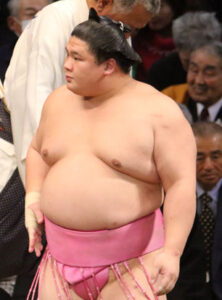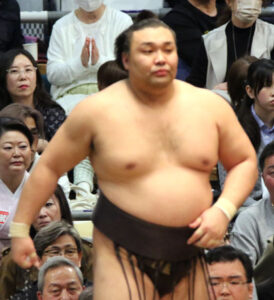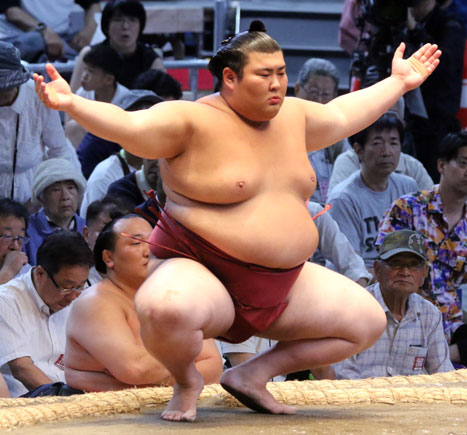
Photo by Michihiro Taguchi.
The 42 wrestlers in sumo’s top division averaged 159.8 kg (352 lb) in July 2026. The heaviest was Kazuma at 205 kg (452 lb), the lightest Fujinokawa at 123 kg (271 lb). Thirty of the 42 weighed 150 kg or more, five were over 180 kg, and only one cleared 200 kg. Average height was 184.7 cm (6ft 1in), so the typical top-division wrestler is a little over six feet tall and carries about 160 kg.
There are no weight classes in sumo. No upper limit either. A 123 kg wrestler and a 205 kg wrestler are ranked on the same banzuke and can be drawn against each other on any day.
The spread is 82 kg wide. The gap between the heaviest and lightest man in the top division is more than the whole body weight of a light-heavyweight boxer.
Heavier does not mean higher ranked. The heaviest man in the division was ranked Maegashira 15, second from the bottom. One yokozuna weighed 150 kg, less than the divisional average.
The sport got about 35 kg heavier in three decades, across the selected snapshots. The top-division average was 129 kg in 1984 and 164 kg by September 2018 on Michihiro Taguchi’s counts — and 159.8 kg in July 2026, slightly below the 2018 figure.
The July 2026 roster table below uses the Association’s listed weights, retrieved from official wrestler profiles on August 4, 2026. Weights change from tournament to tournament.
How much does the average sumo wrestler weigh?
159.8 kg (352 lb), if you mean the top division as it stood in July 2026. That is a mean of the 42 listed weights, and the median sits almost on top of it at 159.5 kg, so the number is not being dragged around by one or two outliers.
Sumo has 70 salaried wrestlers, the sekitori: 42 in the top division, makuuchi, and 28 in the second, juryo. Take both together and the average falls to 156.7 kg, because juryo averages 152.1 kg. This article’s dataset covers the two salaried divisions only; it does not estimate an average for the lower divisions.
| Group | Wrestlers | Average weight | Range |
|---|---|---|---|
| Makuuchi (top division) | 42 | 159.8 kg / 352 lb | 123–205 kg |
| Juryo (second division) | 28 | 152.1 kg / 335 lb | 107–183 kg |
| All sekitori | 70 | 156.7 kg / 345 lb | 107–205 kg |
| San’yaku only (yokozuna to komusubi) | 10 | 165.8 kg / 366 lb | 138–197 kg |
| Maegashira only | 32 | 157.9 kg / 348 lb | 123–205 kg |
The distribution is worth a second look, because “sumo wrestlers weigh about 160 kg” hides how few of them are actually near 160 kg.
| Weight band | Top-division wrestlers |
|---|---|
| 200 kg and above (441 lb+) | 1 |
| 180–199 kg (397–438 lb) | 4 |
| 170–179 kg (375–394 lb) | 8 |
| 160–169 kg (353–372 lb) | 8 |
| 150–159 kg (331–350 lb) | 9 |
| 140–149 kg (309–328 lb) | 7 |
| 130–139 kg (287–306 lb) | 3 |
| Under 130 kg (under 287 lb) | 2 |
Thirty of the 42 are 150 kg or heavier. The 130s have three men in them and everything under 130 kg has two. A wrestler who weighs what a heavyweight boxer weighs is not in this division at all.
Every top-division wrestler by weight, July 2026
All 42, heaviest first. Rank is the position each man held on the July 2026 banzuke; E and W mark the east and west sides. Wrestlers on the same weight share a position.
| # | Wrestler | Rank (July 2026) | Weight | lb | Height | Stable |
|---|---|---|---|---|---|---|
| 1 | Kazuma | Maegashira 15 (W) | 205 kg | 452 lb | 185 cm | Kise |
| 2 | Atamifuji | Sekiwake (E) | 197 kg | 434 lb | 187 cm | Isegahama |
| 3 | Onosato | Yokozuna (W) | 189 kg | 417 lb | 192 cm | Nishonoseki |
| 4 | Oho | Komusubi (W) | 185 kg | 408 lb | 192 cm | Otake |
| 5 | Fujiryoga | Maegashira 9 (E) | 181 kg | 399 lb | 180 cm | Fujishima |
| 6 | Kinbozan | Maegashira 14 (E) | 179 kg | 395 lb | 195 cm | Kise |
| 7 | Kotozakura | Ozeki (W) | 178 kg | 392 lb | 189 cm | Sadogatake |
| 8 | Shishi | Maegashira 14 (W) | 177 kg | 390 lb | 192 cm | Ikazuchi |
| 9 | Asanoyama | Maegashira 10 (E) | 175 kg | 386 lb | 188 cm | Takasago |
| 9 | Mitakeumi | Maegashira 11 (W) | 175 kg | 386 lb | 182 cm | Dewanoumi |
| 11 | Takanosho | Maegashira 1 (W) | 173 kg | 381 lb | 184 cm | Minatogawa |
| 11 | Takayasu | Maegashira 7 (W) | 173 kg | 381 lb | 188 cm | Tagonoura |
| 13 | Kotoshoho | Sekiwake (W) | 172 kg | 379 lb | 191 cm | Sadogatake |
| 14 | Shodai | Maegashira 6 (E) | 168 kg | 370 lb | 184 cm | Tokitsukaze |
| 15 | Abi | Maegashira 12 (W) | 167 kg | 368 lb | 188 cm | Shikoroyama |
| 16 | Oshoma | Maegashira 5 (W) | 166 kg | 366 lb | 190 cm | Naruto |
| 17 | Onokatsu | Maegashira 15 (E) | 165 kg | 364 lb | 185 cm | Onomatsu |
| 18 | Daiseizan | Maegashira 16 (E) | 164 kg | 362 lb | 192 cm | Arashio |
| 19 | Daieisho | Maegashira 4 (E) | 160 kg | 353 lb | 183 cm | Oitekaze |
| 19 | Ichiyamamoto | Maegashira 4 (W) | 160 kg | 353 lb | 190 cm | Hanaregoma |
| 19 | Roga | Maegashira 8 (W) | 160 kg | 353 lb | 184 cm | Futagoyama |
| 22 | Hakunofuji | Maegashira 3 (W) | 159 kg | 351 lb | 181 cm | Isegahama |
| 23 | Yoshinofuji | Komusubi (E) | 157 kg | 346 lb | 185 cm | Isegahama |
| 24 | Gonoyama | Maegashira 2 (E) | 156 kg | 344 lb | 178 cm | Takekuma |
| 25 | Nishikifuji | Maegashira 13 (E) | 155 kg | 342 lb | 184 cm | Isegahama |
| 26 | Asahakuryu | Maegashira 12 (E) | 152 kg | 335 lb | 185 cm | Takasago |
| 27 | Churanoumi | Maegashira 2 (W) | 151 kg | 333 lb | 178 cm | Kise |
| 28 | Fujiseiun | Maegashira 6 (W) | 150 kg | 331 lb | 185 cm | Fujishima |
| 28 | Kirishima | Ozeki (E) | 150 kg | 331 lb | 186 cm | Otowayama |
| 28 | Hoshoryu | Yokozuna (E) | 150 kg | 331 lb | 188 cm | Tatsunami |
| 31 | Takerufuji | Maegashira 13 (W) | 148 kg | 326 lb | 187 cm | Isegahama |
| 32 | Wakanosho | Maegashira 11 (E) | 145 kg | 320 lb | 178 cm | Minatogawa |
| 33 | Wakamotoharu | Maegashira 8 (E) | 143 kg | 315 lb | 187 cm | Arashio |
| 34 | Kotoeiho | Maegashira 7 (E) | 142 kg | 313 lb | 184 cm | Sadogatake |
| 34 | Aonishiki | Sekiwake (W) | 142 kg | 313 lb | 182 cm | Ajigawa |
| 36 | Hiradoumi | Maegashira 3 (E) | 141 kg | 311 lb | 178 cm | Sakaigawa |
| 37 | Chiyoshoma | Maegashira 10 (W) | 140 kg | 309 lb | 184 cm | Kokonoe |
| 38 | Ura | Maegashira 5 (E) | 139 kg | 306 lb | 176 cm | Kise |
| 39 | Wakatakakage | Sekiwake (E) | 138 kg | 304 lb | 183 cm | Arashio |
| 40 | Tobizaru | Maegashira 9 (W) | 135 kg | 298 lb | 173 cm | Oitekaze |
| 41 | Asakoryu | Maegashira 16 (W) | 125 kg | 276 lb | 178 cm | Takasago |
| 42 | Fujinokawa | Maegashira 1 (E) | 123 kg | 271 lb | 177 cm | Isenoumi |
Two things in that table cut against what people expect. The heaviest man in the division, Kazuma, was ranked Maegashira 15 West — second from the bottom of 42. And Hoshoryu, one of the two yokozuna, weighed 150 kg, nearly ten kilos below the divisional average and 47 kg less than the sekiwake ranked below him.
The lightest wrestlers in the top division
Read the same 42 from the other end and you get the men who hold a top-division place while giving away forty or fifty kilos most days they fight.
| # | Wrestler | Rank (July 2026) | Weight | Height |
|---|---|---|---|---|
| 1 | Fujinokawa | Maegashira 1 (E) | 123 kg / 271 lb | 177 cm |
| 2 | Asakoryu | Maegashira 16 (W) | 125 kg / 276 lb | 178 cm |
| 3 | Tobizaru | Maegashira 9 (W) | 135 kg / 298 lb | 173 cm |
| 4 | Wakatakakage | Sekiwake (E) | 138 kg / 304 lb | 183 cm |
| 5 | Ura | Maegashira 5 (E) | 139 kg / 306 lb | 176 cm |
| 6 | Chiyoshoma | Maegashira 10 (W) | 140 kg / 309 lb | 184 cm |
| 7 | Hiradoumi | Maegashira 3 (E) | 141 kg / 311 lb | 178 cm |
| 8 | Aonishiki | Sekiwake (W) | 142 kg / 313 lb | 182 cm |
| 8 | Kotoeiho | Maegashira 7 (E) | 142 kg / 313 lb | 184 cm |
| 10 | Wakamotoharu | Maegashira 8 (E) | 143 kg / 315 lb | 187 cm |
The top of that list is the giveaway. Fujinokawa, the lightest man in the division at 123 kg, was ranked Maegashira 1 — the highest maegashira position there is, which means he opened the tournament against the yokozuna and ozeki. He was giving away 66 kg to Onosato and 55 kg to Kotozakura. Two other men in the lightest ten, Wakatakakage and Aonishiki, held sekiwake, the third-highest rank in the sport.
Go one division down and the extremes get wider still. Enho, ranked Juryo 11 West in July 2026, weighed 107 kg (236 lb) at 167 cm — 98 kg lighter than Kazuma, and the lightest salaried wrestler in the sport.
How tall are sumo wrestlers?
The top-division average in July 2026 was 184.7 cm (6ft 1in), with a median of 185 cm. The range ran from 173 cm (5ft 8in) to 195 cm (6ft 5in) — a spread of 22 cm, far narrower in proportion than the weight spread.
| Measure | Top division, July 2026 |
|---|---|
| Average height | 184.7 cm / 6ft 1in |
| Median height | 185 cm |
| Tallest | Kinbozan, 195 cm / 6ft 5in |
| Shortest | Tobizaru, 173 cm / 5ft 8in |
There is no maximum height in sumo, and no minimum one either in the sense people assume. New-recruit examinations once set floors for height and weight; those requirements have since been relaxed, which is why wrestlers under 180 cm still reach the top division and the san’yaku ranks.
What has changed is the shape rather than the stature. Height has not moved the way weight has — the men are built thicker at the same frame. Taguchi’s archive puts the point plainly: the men who look small today would have been ordinary in the 1970s.
Why there are no weight classes
Sumo has never divided by weight. The banzuke sorts wrestlers by results alone, so a 123 kg maegashira and a 205 kg maegashira occupy the same ladder and can be paired on any of the fifteen days. There is no upper limit on what a wrestler may weigh, and no lower one.
Set against combat sports that do use classes, the scale is easier to feel. Boxing’s heavyweight division starts at roughly 90.7 kg; judo’s heaviest class opens at 100 kg; muay thai’s super heavyweight at 95 kg. By those thresholds every one of the 42 men above is a heavyweight, and the lightest of them is more than a third heavier than the floor.
That absence of classes is also why the weight drifted upward. With nothing capping it, mass is a straightforward advantage at the initial charge, and the division followed the incentive. Taguchi’s counts put the top-division average at 129 kg in 1984 and 164 kg by the September 2018 tournament. In the era of Kitanofuji and Tamanoumi, around 1970, 130-something kilos was normal and 150 kg made a man a giant. In July 2026, 150 kg was below average.
The climb does look to have levelled off. The July 2026 average of 159.8 kg sits 4 kg below Taguchi’s September 2018 count of 164 kg. Two banzuke eight years apart are not a trend, and the association’s listed weights move for reasons that have nothing to do with the sport as a whole, so the honest reading is that the sharp rise of the 1980s and 1990s has stopped rather than reversed.
Does weight decide who wins?
Not on its own, and the July 2026 banzuke is its own argument. The heaviest wrestler in the division sat 15 rungs from the bottom; the two sekiwake included the fourth-lightest man in it. Weight buys you a better initial charge and a harder body to move, not the ability to finish.
The historical record says the same thing more loudly. Among yokozuna, the highest rank in the sport, Tochigiyama held the rope at 103 kg (227 lb), the first Wakanohana at 108 kg and Tochinoumi at 110 kg, on Taguchi’s research. Chiyonofuji, who won 31 championships, fought at 127 kg. Tochinishiki, at 131 kg, entered the top division at 86 kg and built a career on movement and technique before he ever had size.
There is a cost to the drift, and it shows in what disappears from the ring. Heavier bodies favour pushing and forcing out. The lifting and last-instant reversal techniques — tsuridashi, utchari — that made the lighter eras watchable have become rare, and Taguchi has spent much of the archive tracking their decline.
One boundary is worth stating outright: the heaviest wrestler in history is a different question from the heaviest wrestler now, and this page answers only the second. For the record, the heaviest yokozuna on Taguchi’s research was Musashimaru at 237 kg (522 lb), followed by Akebono at 235 kg and Onokuni at 203 kg — all three heavier than anyone competing in July 2026.
Frequently asked questions
How much does the average sumo wrestler weigh?
159.8 kg (352 lb) across sumo’s 42 top-division wrestlers in July 2026, and 156.7 kg across all 70 salaried wrestlers. The median top-division weight was 159.5 kg, so the average is a fair description rather than a figure pulled up by a few very large men.
Who is the heaviest sumo wrestler right now?
Kazuma of Kise stable, at 205 kg (452 lb), was the heaviest man in the top division on the July 2026 banzuke. Atamifuji followed at 197 kg and the yokozuna Onosato at 189 kg. Kazuma was the only wrestler in the division over 200 kg.
Who is the lightest sumo wrestler in the top division?
Fujinokawa, at 123 kg (271 lb) and 177 cm. He was ranked Maegashira 1 in July 2026, the highest maegashira position, which meant fighting the yokozuna and ozeki in the opening days while giving away 50 to 66 kg. Across both salaried divisions the lightest was Enho at 107 kg.
Is there a weight limit in sumo?
No. Sumo has no weight classes and no upper or lower weight limit for competition. Wrestlers of any size are ranked on the same banzuke by results, so an 82 kg difference between two opponents is legal and, in the top division, ordinary.
How tall is the average sumo wrestler?
184.7 cm (6ft 1in) in the top division in July 2026, ranging from 173 cm to 195 cm. There is no height requirement to compete; the minimums that once applied at the new-recruit examination have been relaxed.
Have sumo wrestlers got heavier?
Yes, by about 30 kg since the 1980s, though the rise appears to have levelled off. Taguchi’s counts put the top-division average at 129 kg in 1984 and 164 kg at the September 2018 tournament; in July 2026 it was 159.8 kg. Height has not risen at anything like that rate, so the change is in build rather than stature.
Does the heaviest wrestler win the most?
No. In July 2026 the heaviest wrestler in the top division was ranked Maegashira 15, second from the bottom, while one of the two yokozuna weighed less than the divisional average. Weight helps at the charge and makes a wrestler harder to move, but the ranks are decided by wins.
How this list was compiled
| Population | All 42 wrestlers ranked in makuuchi on the July 2026 banzuke, plus the 28 in juryo where stated. |
|---|---|
| As of | The July 2026 tournament banzuke. Figures retrieved August 4, 2026. |
| What the weight is | The weight published on each wrestler’s official association profile. It is not a competition-day weigh-in; the association updates it periodically, and a wrestler’s weight moves between tournaments. |
| Ties | Wrestlers on the same weight share a position; the next position skips accordingly. |
| Rounding | Weights and heights are published to one decimal place and all 70 were whole numbers. Pound and foot-inch equivalents are converted and rounded to the nearest unit by The Sumo. |
| Averages | Arithmetic means of the listed values, calculated by The Sumo. Not published by the association. |
| Compiled by | Weights, heights, ranks and stables: Japan Sumo Association official wrestler profiles. Ordering, weight bands, averages and unit conversions: calculated by The Sumo. Historical figures for retired yokozuna, and the 1984 and 2018 top-division averages: researched and calculated by Michihiro Taguchi. |
| Next review | The September 2026 banzuke. |
Sources
The July 2026 dataset’s weights, heights, ranks and stable affiliations for all 70 salaried wrestlers were taken from the Japan Sumo Association’s official wrestler profiles (sumo.or.jp), retrieved August 4, 2026, and match the Japanese-language ranking maintained by Michihiro Taguchi at Dohyo no Mokugekisha row for row. The historical weights of retired yokozuna, the 1984 and 2018 top-division averages, the comparison with weight-class combat sports and the account of how the sport’s build has changed come from Taguchi’s own research and reporting in that archive. Photograph by Taguchi.
Related: what a sumo wrestler is and how the life works · chanko-nabe, the stew that builds the weight · all ten sumo ranks in order · the July 2026 Nagoya tournament