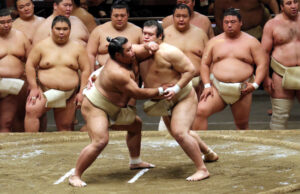
This is a plain-English glossary of the sumo terms you actually hear. Sumo keeps its Japanese vocabulary untranslated, so a broadcast throws thirty unfamiliar words at a new viewer in twenty minutes. Below, every term is given in romanized Japanese, the Japanese script, and one line of what it means. Terms with a full guide on this site link through to it.
Start with eight words. Rikishi (wrestler), dohyo (ring), mawashi (belt), gyoji (referee), tachiai (the charge), kimarite (the winning move), banzuke (the rankings), basho (tournament). Those eight carry most of a broadcast.
The ranks run in one order. Yokozuna, ozeki, sekiwake, komusubi, maegashira — then down through juryo, makushita, sandanme, jonidan and jonokuchi.
Eight is the magic number. Eight wins out of fifteen days is a winning record. It decides promotion, demotion, salary and prize eligibility.
Three different men are shouting. The yobidashi chants the names, the gyoji referees inside the ring, and five shimpan judge from the floor and can overrule him.
Most of it is ritual with a reason. The salt, the stamping, the four-minute staring contest and the bow-twirling all have fixed names and fixed places in the day.
The eight words to learn first
If you are watching your first tournament, do not try to absorb the whole list. Eight terms will get you through a day of sumo, and everything else can wait until you meet it.
| Term | Japanese | What it means |
|---|---|---|
| rikishi | 力士 | A sumo wrestler. The word sumo itself refers to the sport, not the man. |
| dohyo | 土俵 | The raised clay ring. Step out of it and you lose. |
| mawashi | まわし | The heavy silk belt, and the handhold most throws start from. |
| gyoji | 行司 | The referee in robes who stands inside the ring. |
| tachiai | 立合い | The charge that starts a bout, launched from a crouch. |
| kimarite | 決まり手 | The officially named technique that decided the bout. |
| banzuke | 番付 | The ranking sheet, redrawn after every tournament. |
| basho | 場所 | A tournament. Six a year, fifteen days each. |
The ranks, in order
Sumo has one ladder and everyone is on it. The top division is makuuchi; the top five ranks inside it are the ones with names you will hear. Below makuuchi the divisions descend through juryo to jonokuchi at the bottom.
| Rank or division | Japanese | Where it sits |
|---|---|---|
| yokozuna | 横綱 | The top rank. Cannot be demoted; a failing yokozuna is expected to retire. |
| ozeki | 大関 | Second rank, and the highest one you can be demoted from. |
| sekiwake | 関脇 | Third rank. Where a demoted ozeki lands. |
| komusubi | 小結 | Fourth rank, and the lowest of the sanyaku group. |
| maegashira | 前頭 | The rank-and-file of the top division, numbered from 1 downward. |
| juryo | 十両 | Second division. The lowest salaried rank. |
| makushita | 幕下 | Third division. Unsalaried; competes on seven days, not fifteen. |
| sandanme | 三段目 | Fourth division. |
| jonidan | 序二段 | Fifth division. |
| jonokuchi | 序ノ口 | Bottom division, where a new wrestler first appears on the rankings. |
Two group names cut across that ladder. Sanyaku (三役) means ozeki, sekiwake and komusubi together — the titled ranks below yokozuna. Sekitori (関取) means juryo and above: the wrestlers who draw a salary, wear the silk belt in competition and have attendants. Everyone below that line is, in practical terms, an unpaid apprentice.
A to Z of sumo terms
Everything else, alphabetically. Where a term has its own guide on this site, the term links to it.
| Term | Japanese | Meaning |
|---|---|---|
| banzuke | 番付 | The ranking sheet issued before each tournament in stylized calligraphy, with every wrestler’s rank for the next fifteen days. |
| basho / honbasho | 場所 / 本場所 | An official tournament. Six a year: Tokyo in January, May and September, Osaka in March, Nagoya in July, Fukuoka in November. |
| chanko-nabe | ちゃんこ鍋 | The stew that is the staple of stable cooking, eaten in enormous quantities after morning training. |
| chikara-mizu | 力水 | “Power water.” A wrestler rinses his mouth with water handed to him by the previous winner or the next man on his side. |
| chonmage | 丁髷 | The plain topknot worn by wrestlers below juryo. |
| danpatsu-shiki | 断髪式 | The retirement ceremony, in which the topknot is cut off one snip at a time by hundreds of guests. |
| dohyo | 土俵 | The ring: a raised clay platform with the fighting circle marked by half-buried straw bales. |
| dohyo-iri | 土俵入り | The ring-entering ceremony, performed by the top two divisions in ceremonial aprons before their bouts. |
| dohyo-matsuri | 土俵祭 | The Shinto rite that consecrates the ring the day before a tournament opens. |
| gunbai | 軍配 | The lacquered war-fan the referee carries and points at the winner. |
| gyoji | 行司 | The referee. Stands inside the ring throughout, and is never allowed to call a draw. |
| hakkeyoi | 発気揚々 | The referee’s call when a bout stalls: get moving. |
| heya | 部屋 | A sumo stable: the training house a wrestler lives in and fights out of. |
| ichimon | 一門 | A lineage of stables that share a tradition and cooperate in the association’s politics. |
| jungyo | 巡業 | The regional tours between tournaments, where sumo travels to towns without a big arena. |
| kachikoshi | 勝ち越し | A winning record: eight wins or more in a fifteen-day tournament. |
| kadoban | 角番 | An ozeki fighting with his rank at risk after one losing record. A second one demotes him. |
| keiko | 稽古 | Training. Done in the early morning on an empty stomach, in the stable’s own practice ring. |
| kensho | 懸賞 | The sponsor banners carried around the ring, and the prize money the winner collects from them. |
| kesho-mawashi | 化粧廻し | The embroidered silk ceremonial apron worn for the ring-entering ceremony, not for fighting. |
| kimarite | 決まり手 | One of the 82 officially recognized winning techniques, announced at the end of every bout. |
| kinboshi | 金星 | The “gold star” a maegashira earns by beating a yokozuna. It pays a bonus for the rest of his career. |
| kyujo | 休場 | Sitting out a tournament, or the remainder of one, through injury or illness. Absence counts as a loss. |
| makekoshi | 負け越し | A losing record: eight losses or more. Costs rank, and for an ozeki starts the demotion clock. |
| makuuchi | 幕内 | The top division, of up to 42 wrestlers, comprising the five named ranks. |
| maezumo | 前相撲 | “Pre-sumo.” The unranked bouts a brand-new recruit fights before he appears on the rankings. |
| mawashi | まわし | The belt: heavy silk about 9 m long, folded in six and wrapped four to seven times around the waist. |
| mono-ii | 物言い | The conference the ringside judges hold when they want to review the referee’s decision. |
| nokotta | 残った | “Still in.” The referee’s call while the bout is live and neither wrestler is out. |
| oicho-mage | 大銀杏 | The elaborate ginkgo-leaf topknot, worn only by juryo and makuuchi wrestlers. |
| oyakata | 親方 | A stablemaster or elder of the association: a retired wrestler holding one of the elder shares. |
| sagari | 下がり | The stiffened silk strings hanging from the front of the belt. Purely ornamental, and discarded if they come loose mid-bout. |
| sansho | 三賞 | The three special prizes: outstanding performance, fighting spirit and technique. Eight wins minimum to qualify. |
| sekitori | 関取 | A salaried wrestler, meaning juryo and above. The dividing line of a sumo career. |
| senshuraku | 千秋楽 | The final day of a tournament, when the championship and the prizes are decided. |
| shikiri | 仕切り | The staring-down ritual before the charge: crouch, rise, salt, repeat. Four minutes are allowed in the top division. |
| shikona | 四股名 | A wrestler’s ring name, often built from his stablemaster’s name or his birthplace. |
| shimpan | 審判 | The five ringside judges, all former wrestlers, who can overrule the referee. |
| tachiai | 立合い | The initial charge. Both wrestlers must rise together; it is where most bouts are effectively decided. |
| tawara | 俵 | The rice-straw bales that mark the ring, buried in the clay so a wrestler can brace against them. |
| tokoyama | 床山 | The hairdressers who tie every wrestler’s topknot. They are employed by the association and ranked in their own hierarchy. |
| toshiyori kabu | 年寄株 | An elder share. There is a fixed number, and a retiring wrestler needs one to stay in the sport. |
| tsukebito | 付け人 | The junior wrestlers assigned to serve a sekitori, carrying his bags and looking after his belt. |
| tsuna | 綱 | The braided hemp rope a yokozuna wears, weighing roughly 11 to 15 kg. The rope is what the rank is named for. |
| yobidashi | 呼出 | The ring attendants who chant the names, build and sweep the ring, carry the banners and beat the drum. |
| yokozuna | 横綱 | The highest rank, and the only one that cannot be demoted. |
| yumitori-shiki | 弓取式 | The bow-twirling ceremony that closes each day, performed by a lower-ranked wrestler. |
| yusho | 優勝 | The tournament championship, taken by whoever finishes with the best record. |
| zensho yusho | 全勝優勝 | A perfect championship: fifteen wins, no losses. |
Once you know the words
The glossary explains what things are called. These three pages answer the questions people ask next, using figures compiled from the Japan Sumo Association and from Michihiro Taguchi’s own record-keeping.
- How much do sumo wrestlers weigh? — the current top-division roster, weighed and sorted.
- How much do sumo wrestlers earn? — pay by rank, and how much of it is actually published.
- Who is the greatest of all time? — ranked on win rate, title rate and availability, with the method shown first.
Why sumo keeps its Japanese
Other Japanese sports export happily into English. Judo throws have English names in Olympic commentary; karate belts are described by colour. Sumo does not translate, and the reason is that most of its terms have no equivalent to translate into.
Yokozuna is often rendered “grand champion,” which is roughly right and misses the point: the rank is named after a rope, worn only in ceremony, that marks a man as the sport’s representative rather than merely its best wrestler. Kinboshi is a “gold star,” which sounds decorative until you learn it pays a bonus in every pay packet for the rest of a career. Kadoban has no English word at all, because no other sport demotes a champion for two bad months in a row.
So the vocabulary is not an obstacle placed in front of the sport. It is the sport, described accurately. Once the words stop being noise, the ritual stops looking arbitrary — each thing on the clay has a name because it has a function.
If you are starting from zero, the fastest route in is the rules of sumo, then what a rikishi actually is, and then the two words the referee shouts — which is the difference between watching noise and watching a contest.
Frequently asked questions
What are the basic sumo terms a beginner needs?
Eight will carry you through a broadcast: rikishi (wrestler), dohyo (the ring), mawashi (the belt), gyoji (the referee), tachiai (the charge that starts a bout), kimarite (the technique that ends it), banzuke (the ranking sheet), and basho (a tournament). Everything else can be picked up as you meet it.
What are the sumo ranks in order?
From the top: yokozuna, ozeki, sekiwake, komusubi and maegashira, which together make up the top division, makuuchi. Below that the divisions run juryo, makushita, sandanme, jonidan and jonokuchi. Juryo and above are salaried and are called sekitori.
What does the sumo referee shout?
“Nokotta” while the wrestlers are moving, meaning neither is out yet and the bout is live, and “hakkeyoi” when the action stalls, meaning get moving. Both come from the gyoji, the referee inside the ring. The long chant of the two names before the bout comes from a yobidashi, a ring attendant, not the referee.
What does sekitori mean?
Sekitori means a wrestler ranked in juryo or above. It is the most consequential line in sumo: sekitori draw a salary, get attendants, wear the silk belt in competition and fight on all fifteen days. Below that line, wrestlers are unsalaried and compete on only seven days.
Why are sumo terms not translated into English?
Mostly because there is nothing to translate them into. Yokozuna is named for a ceremonial rope; kadoban describes a demotion rule no other sport has; kinboshi is a bonus that follows a wrestler for life. English approximations like “grand champion” or “gold star” lose the mechanism the word exists to describe.
How many sumo winning techniques are there?
Eighty-two, recognized officially by the Japan Sumo Association, plus five recorded outcomes that are not techniques at all — cases where a wrestler steps out or touches down under his own momentum. A handful of the 82 decide most bouts.
Sources
Japan Sumo Association, Sumo (official English introduction, sumo.or.jp): the tournament calendar, the division order, the makuuchi cap of 42, the mawashi and kesho-mawashi descriptions, the yokozuna rope weight, the sagari, the chikara-mizu, the count of 82 winning techniques, the five ringside judges, and the yokozuna’s exemption from demotion. Japan Sumo Association, official kimarite list (sumo.or.jp/Kimarite/), for the 82 techniques and 5 non-technique outcomes. Retrieved August 3, 2026.
Photo by Michihiro Taguchi.