How Much Do Sumo Wrestlers Make? Salary by Rank, Explained

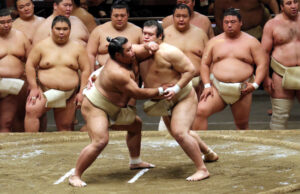
A sumo champion receives the Emperors Cup at the closing ceremony of a grand tournament

Only wrestlers ranked in juryo or above are paid a salary at all. At the top the monthly figure is ¥3,000,000 for a yokozuna and ¥1,100,000 for a juryo wrestler, with three steps in between. The four divisions below juryo — the great majority of everyone in professional sumo — receive no salary whatsoever, only an allowance paid once per tournament, six times a year. On top of the salary come the reward money that accrues over a career, the championship purse, and the prize envelopes attached to individual bouts. One thing to know before you read any figure anywhere: the Japan Sumo Association does not publish wrestlers’ salaries. Every number below is sourced, and we say for each one exactly how far it can be verified.

The salary line is juryo. Cross it and you are a sekitori on a monthly wage. Fall below it and the wage stops entirely.

Pay attaches to the rank, not the man. Every yokozuna is paid the same, and the top-ranked maegashira is paid the same as the bottom-ranked one.

The current scale dates from January 2019. It was the first rise in eighteen years.

The salary is not the whole income. Reward money, the championship purse and the prize envelopes on individual bouts can matter more than the wage for a wrestler who is winning.

Sumo has only had salaries since 1957. They were introduced by a chairman acting under pressure from the Japanese parliament.

TOC

Who gets paid, and who does not

Professional sumo is stacked into six divisions, and one line inside that stack decides whether a wrestler earns a living. Reach juryo, the second division, and you become a sekitori: a salaried member of the sport, paid every month against your rank. Everyone in makushita, sandanme, jonidan and jonokuchi is classified as a trainee. They are housed and fed by their stable, and they are paid an allowance once per tournament — but no salary.

The gap either side of that line is not a step. It is a cliff, and it is the reason promotion to juryo is the moment a sumo career is usually said to begin.

Monthly salary by rank

The scale in force was decided at the association’s board meeting on November 29, 2018 and applied from January 2019. It raised pay for the first time since 2001. Not every rank in the scale was reported in the press at the time, so the table carries a column saying how far each figure can be checked.

Monthly salary by rank, in force since January 2019.
RankMonthly salaryPrevious figureHow far the figure can be verified
Yokozuna¥3,000,000¥2,820,000Reported by two news organisations, Nikkei and Kyodo
Ozeki¥2,500,000¥2,347,000Reported by Nikkei and Kyodo
Sekiwake and komusubi¥1,800,000Not carried in either report. Michihiro Taguchi’s own reporting
Maegashira¥1,400,000Not carried in either report. Michihiro Taguchi’s own reporting
Juryo¥1,100,000¥1,036,000Reported by Nikkei and Kyodo
Figures compiled by Michihiro Taguchi from the November 2018 revision. The Japan Sumo Association does not publish wrestlers’ salaries; confirmed against the association’s official English introduction, which contains no pay figures (sumo.or.jp, retrieved August 3, 2026). Amounts are in Japanese yen; we do not convert them, because the exchange rate moves and the figures do not.

Five steps, and nothing in between. There is no separate rate for the East side and the West, no premium for a wrestler who has held his rank for ten years over one promoted last week, and no distinction at all inside the largest rank of the lot.

What the unsalaried divisions receive instead

Below juryo the money arrives once per tournament, six times a year. The January 2019 revision raised these allowances by a flat ten per cent, and Kyodo reported the whole package — salaries and allowances together — as costing the association roughly ¥120 million more a year.

Per-tournament allowance for the four unsalaried divisions.
DivisionAllowance per tournamentSix tournaments a year
Makushita¥165,000¥990,000
Sandanme¥110,000¥660,000
Jonidan¥88,000¥528,000
Jonokuchi¥77,000¥462,000
Allowance figures from Michihiro Taguchi’s reporting; the two news reports of the 2018 revision carried the flat ten per cent rise but not the amounts. The annual column is the allowance multiplied by the six tournaments held each year, calculated by The Sumo.

Set the two tables side by side and the cliff is obvious. A makushita wrestler — one rung below the salary line, and often a man who has been in the sport for years — collects about ¥990,000 across a whole year. The juryo wrestler he loses to collects ¥1,100,000 in a month. This is also why a withdrawal lands so differently by division: a salaried wrestler keeps his monthly pay while he is out, while a makushita wrestler who misses the tournament is cutting into the only money he gets.

Everything that is not the salary

For a wrestler who is winning, the wage is only the floor.

  • Reward money (mochikyukin). A career total that only ever goes up, paid out once per tournament to every sekitori. The minimum payment is ¥600,000 per tournament at yokozuna and ¥160,000 at juryo. How it accumulates is set out below.
  • The championship purse. The top-division title carries ¥10,000,000. Each of the three special prizes and the juryo championship carries ¥2,000,000. Winners also receive the trophies and gifts that fill the closing ceremony.
  • Prize envelopes (kensho). Company-sponsored banners hung on individual top-division bouts, collected by whoever wins the bout. This is the one figure the association does publish: ¥70,000 per banner including tax, of which ¥60,000 reaches the wrestler and ¥10,000 is retained as a fee. We cover the system in detail in our guide to kensho banners.
  • Regional tour allowance. Paid for the jungyo tours held between grand tournaments. The amount is not published.

Note what this does to the shape of a top wrestler’s income. A yokozuna who wins a tournament with a heavy sponsorship load can take more from the envelopes in fifteen days than his salary pays him in a month, and none of it is guaranteed. Lose, and the envelopes go to the other man.

Annual earnings by rank

Adding the reward money to the salary gives an outline of what each rank is worth over a year. The formula is: monthly salary × 12 months + minimum reward payment × 6 tournaments. It assumes a wrestler holds one rank for a full year, which almost nobody does, and it uses the minimum reward payment, so a wrestler with a long record of wins behind him will be above these figures. The championship purse, the special prizes, the prize envelopes and the tour allowance vary so much between individuals that they are left out entirely.

Annual earnings by rank, salary plus minimum reward money.
RankMonthly salary× 12 monthsReward money, minimum per tournament× 6 tournamentsAnnual total
Yokozuna¥3,000,000¥36,000,000¥600,000¥3,600,000¥39,600,000
Ozeki¥2,500,000¥30,000,000¥400,000¥2,400,000¥32,400,000
Sekiwake and komusubi¥1,800,000¥21,600,000¥240,000¥1,440,000¥23,040,000
Maegashira¥1,400,000¥16,800,000¥240,000¥1,440,000¥18,240,000
Juryo¥1,100,000¥13,200,000¥160,000¥960,000¥14,160,000
Calculated by Michihiro Taguchi from the salary and reward-money figures above, using the formula stated in the text. These are estimates, not published earnings.

The calculation does not extend below juryo, because there is no monthly salary to multiply. A makushita wrestler’s ¥990,000 a year is about ¥13,000,000 short of the juryo wrestler immediately above him.

How reward money accumulates

Reward money works unlike the salary in one crucial respect: it is cumulative and it never falls. Each wrestler carries a running base figure, quoted in yen but functioning as points, which grows whenever he achieves something. Nothing subtracts from it.

What adds to a wrestler’s reward-money base.
AchievementAdded to the base
Promotion into jonokuchi (entering the rankings)¥3
Each win above an even record, per win¥0.50
A kinboshi — a maegashira beating a reigning yokozuna¥10
Winning the top-division championship¥30
Winning the top-division championship undefeated¥50
From Michihiro Taguchi’s reporting. There are no deductions.

The payment is the base multiplied by 4,000, made once per tournament. A kinboshi therefore adds ¥10 to the base and ¥40,000 to every tournament payment the wrestler receives for the rest of his career — which is why a single upset win over a yokozuna is treated as a life event rather than a result. Each rank also carries a floor, so a wrestler promoted into it is lifted to that minimum if his own record has not yet taken him there.

Minimum reward-money base by rank, and what it pays per tournament.
RankMinimum baseMinimum payment per tournament
Yokozuna¥150¥600,000
Ozeki¥100¥400,000
Makuuchi¥60¥240,000
Juryo¥40¥160,000
From Michihiro Taguchi’s reporting. The payment column is the base multiplied by 4,000.

Why every yokozuna is paid the same

Sumo ranks everything. The ranking sheet places wrestlers in a strict order, East above West, first-ranked maegashira above second. The pay scale ignores almost all of it. When four yokozuna were serving at once, as they were in 2017, all four drew exactly the same salary. The top-ranked maegashira and the man at the very bottom of the top division draw the same ¥1,400,000, despite fighting completely different opponents.

The effect on behaviour is real. Kitanofuji, the former yokozuna and long-serving NHK commentator, has said that as an active wrestler he was indifferent to whether he held sekiwake or komusubi, because the pay was identical. Taguchi’s own view, argued in his archive, is that this is a defect: a professional sport should distinguish every half-rank, and a rank that has to fight every yokozuna and ozeki should not be paid the same as the one just below it, which does not.

Sumo has only had salaries since 1957

For most of its professional history, sumo had no salary system. It arrived in 1957, and it arrived under pressure.

In May of that year the former yokozuna Futabayama, by then the elder Tokitsukaze, became chairman of the association after his predecessor, the former yokozuna Tsunenohana, attempted to take his own life. Behind that crisis sat a series of questions raised in the budget committee of the Japanese parliament: what, exactly, distinguished the association from a commercial promoter of professional baseball or wrestling, and was a body holding public-interest foundation status actually doing public-interest work? Among the failings named was that wrestlers had no secured livelihood.

Tokitsukaze’s first act as chairman was to create the monthly salary, and it covered the referees, the elders and the ushers as well as the wrestlers. The original scale looks like this.

The first monthly salary scale for wrestlers, introduced in 1957.
RankMonthly salary, 1957Monthly salary today
Yokozuna¥150,000¥3,000,000
Ozeki¥110,000¥2,500,000
Sekiwake and komusubi¥70,000¥1,800,000
Maegashira¥45,000¥1,400,000
Juryo¥30,000¥1,100,000
1957 figures from Michihiro Taguchi’s archive. The referees were placed on the same system: ¥70,000 for the two most senior, ¥45,000 at sanyaku grade, ¥30,000 at makuuchi grade and ¥18,000 at juryo grade.

To read those 1957 numbers you need one comparison: a Japanese university graduate starting work that year earned somewhere between ¥10,900 and ¥13,800 a month. A juryo wrestler was on more than twice that, and a yokozuna on more than ten times it. The same year the calendar went to five tournaments, and to six the year after — which is the point at which the association’s finances first stood up on their own.

The chairman’s attitude to further increases is preserved in one line. When the first Wakanohana, then head of the wrestlers’ association, went to Tokitsukaze to ask for a rise, he was sent away with a question: since when had there been a union inside the association?

Where these figures come from

This matters more than usual here, because sumo salary figures circulate widely in English without anyone saying where they came from.

The Japan Sumo Association does not publish wrestlers’ salaries. We checked its official English introduction, which covers the ranks, the rituals, the referees and the tournament format, and it contains no pay figures at all (sumo.or.jp, retrieved August 3, 2026). The one money figure the association does state publicly is the prize-envelope rate: ¥70,000 per banner, ¥60,000 of it to the wrestler.

Everything else here traces to two places. The yokozuna, ozeki and juryo salaries were reported by Nikkei and Kyodo when the 2018 revision was decided, which makes them two-source figures. The sekiwake, komusubi and maegashira salaries, the allowances for the four lower divisions, and the reward-money rules were not in those reports; they come from Michihiro Taguchi’s own reporting over decades of covering the sport from ringside, and the table above says so on each line rather than blurring the two together. Where a number in this article is a calculation rather than a reported figure, the formula used is printed next to it.

Frequently asked questions about sumo wrestlers’ pay

How much do sumo wrestlers make a month?

A yokozuna is paid ¥3,000,000 a month, an ozeki ¥2,500,000, a sekiwake or komusubi ¥1,800,000, a maegashira ¥1,400,000 and a juryo wrestler ¥1,100,000. Wrestlers below juryo receive no monthly salary at all. The scale has been in force since January 2019.

Do all sumo wrestlers get paid?

No. Only the roughly seventy wrestlers ranked in juryo and the top division draw a salary. Everyone in makushita, sandanme, jonidan and jonokuchi is treated as a trainee: housed and fed by his stable, and paid an allowance once per tournament, from ¥165,000 down to ¥77,000 depending on the division.

How much does a sumo wrestler earn in a year?

Salary plus the minimum reward payment works out at roughly ¥39,600,000 a year at yokozuna, ¥32,400,000 at ozeki, ¥23,040,000 at sekiwake or komusubi, ¥18,240,000 at maegashira and ¥14,160,000 at juryo. Those are calculations from the monthly figures, not published earnings, and they exclude the championship purse, the special prizes and the prize envelopes.

How much is the sumo championship worth?

The top-division championship carries ¥10,000,000. The juryo championship and each of the three special prizes carry ¥2,000,000. Winners also receive the Emperor’s Cup and a long list of gifts presented at the closing ceremony.

Does a sumo wrestler get paid while he is injured?

A salaried wrestler does. Monthly pay attaches to the rank rather than to attendance, so sitting out does not switch it off. What it does is put the rank at risk, and pay follows the rank down. Below juryo, where the per-tournament allowance is the whole income, missing a tournament cuts into it directly.

Does the Japan Sumo Association publish salaries?

No. The association does not publish wrestlers’ pay, and its official English introduction contains no salary figures. The rates in circulation come from press reporting of the association’s board decisions and from journalists who cover the sport directly.

When did sumo wrestlers start receiving a salary?

In 1957, under chairman Tokitsukaze, the former yokozuna Futabayama, after the Japanese parliament’s budget committee questioned whether the association was meeting the obligations of its public-interest status and noted that wrestlers had no secured livelihood. The first scale paid a yokozuna ¥150,000 a month at a time when a university graduate started on ¥10,900 to ¥13,800.

Sources

Salary and allowance figures, the reward-money rules, the annual calculations and the 1957 origin of the salary system come from the archive of Michihiro Taguchi at Dohyo no Mokugekisha (dohyounomokugekisya.net), principally “力士の給料はいくら?”, “大相撲事始 月給制” and “番付差を月給差に反映せよ”. The yokozuna, ozeki and juryo salaries were reported by Nikkei and Kyodo at the time of the November 2018 revision. That the association publishes no salary figures was verified against its official English introduction at sumo.or.jp. Retrieved August 3, 2026.

Reporting note: this article draws on Michihiro Taguchi’s ringside reporting and original statistical work published in Dohyo no Mokugekisha. Figures were rechecked against the Japan Sumo Association on August 3, 2026.

Published August 3, 2026. Figures verified August 3, 2026. Salary rates in force since January 2019.

Photo by Michihiro Taguchi — shot ringside.

Let's share this post !

Author of this article

Michihiro Taguchi spent 15 years as a reporter for the Nihon Keizai Shimbun (Nikkei) and later worked as an editor at Nikkei HR before going independent as a full-time sumo writer. He attends and photographs nearly every grand sumo tournament from ringside, and ranks #1 in the Sumo category on Blogmura, Japan's largest blog ranking.

TOC