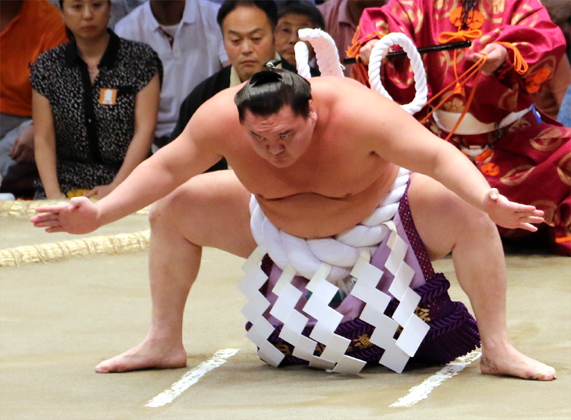
By championships won, the answer is Hakuho, with 45 — more than any wrestler in history. Rank the yokozuna instead by how often they won, how often they took the title and how often they were fit enough to be on the ring at all, and the order changes completely: Tochigiyama and Futabayama come first, and Hakuho is sixth. The two answers are both correct. They are answers to different questions, and this page sets out the criteria before the ranking so you can see which question is being asked.
Most titles and strongest are not the same list. Career championship totals reward longevity at the top. Rates reward dominance while at the top. Hakuho leads the first by a distance and sits sixth on the second.
The ranking below counts only what a man did as yokozuna. Everything he did on the way up is excluded, which is the point: it measures how he held the rank, not how he reached it.
Availability is treated as a third measure, alongside winning and titles. A yokozuna who sits out is not losing, but he is not competing either, and the composite ranking penalises it.
The highest yokozuna win rate ever recorded is .955, by Tachiyama. The lowest is .471, by Maedayama, and it still stands.
The composite ranking is Michihiro Taguchi’s own work, calculated in June 2021 from yokozuna-era records. The comparison against official career championship totals, further down, is ours.
The question behind the question
“Best sumo wrestler of all time” usually gets answered with a championship count, because that is the number everybody has. The Japan Sumo Association publishes it for every yokozuna in its official list, and the top of that list is not in dispute: Hakuho 45, Taiho 32, Chiyonofuji 31, Asashoryu 25.
The trouble is what that number measures. A championship total is a product of how good a wrestler was and how long he lasted, and it is also a product of how many tournaments his era happened to hold. Sumo ran two tournaments a year for much of the pre-war period and six a year since 1958. Futabayama held the rope for eight years and had 17 chances at a title. Chiyonofuji held it for ten and had 59.
So “who won the most” and “who was hardest to beat” are separate questions with separate answers. The ranking below answers the second one, and it does it by publishing what it counts.
The three measures, stated before the ranking
Michihiro Taguchi built a composite ranking of the yokozuna out of three rates, each calculated from yokozuna-era bouts only. He then added the three scores together and laid the result out as a banzuke — a mock ranking sheet, with an east and west yokozuna at the top.
| Measure | What it counts | What it is trying to catch |
|---|---|---|
| Win rate (shoritsu) | Wins divided by decided bouts, while ranked yokozuna | How hard he was to beat on an ordinary day |
| Championship rate (yushoritsu) | Championships divided by tournaments ranked yokozuna | How often being hard to beat turned into a title |
| Appearance rate (shutsujoritsu) | Days actually fought divided by days available, while ranked yokozuna | Whether he was there at all |
The third measure is the one that separates this from every other list. A yokozuna who withdraws is not recorded as losing — a kyujo absence simply removes him from the accounting. That means a wrestler can protect a high win rate by not fighting when he is not right. Counting availability closes that door.
The exact rules matter as much as the measures, and Taguchi published them.
| Population | The yokozuna from Hitachiyama, the 19th, onward — the point from which Taguchi treats yokozuna as a rank in its own right rather than an honour conferred on a leading wrestler. That is 50 men from Hitachiyama to Kisenosato at the time of writing. Tokyo yokozuna only; Miyagiyama, who was made yokozuna in Osaka sumo, is counted from the Osaka–Tokyo merger onward. |
|---|---|
| Period counted | Yokozuna-era bouts only. Nothing a wrestler did at ozeki or below enters any of the three rates. |
| Draws and no-decisions | Draws (hikiwake), held-over bouts (azukari), injury draws (itamiwake) and no-contests (mushobu) each count as half a win and half a loss. Taguchi’s reason for not simply discarding them: a record of one win and fourteen draws would otherwise score a perfect 1.000 and outrank 14-1, which is absurd. |
| Championships before 1926 | The championship system was formalised in 1926. Before that, the best record of the tournament is counted as a championship. |
| Forfeits | A forfeit loss (fusenpai) is not counted as an appearance. |
| Absences before the forfeit system | Before forfeits existed, a wrestler whose opponent withdrew was rested too. Those days are not counted as absences. Nor are the final days of the pre-Kokugikan era, when top-division wrestlers did not fight on the closing day. |
| Play-offs | How championship play-offs are treated is not stated in the source, and is left unstated here rather than guessed. |
| Calculated | June 2021. Hakuho was still an active yokozuna at that date; Taguchi noted his figures would move. He retired in September 2021. |
| Calculated by | Michihiro Taguchi. |
The ranking
Adding the three rates together produces this order. Taguchi laid the top eight out as a banzuke, which is why the positions carry rank names rather than numbers — the two at the top are the “yokozuna among the yokozuna.”
| Position | Wrestler | Yokozuna years | Basho as yokozuna | Win rate | Championship rate | Appearance rate | Career titles (JSA) |
|---|---|---|---|---|---|---|---|
| Yokozuna, East | Tochigiyama | 1918–1925 | 15 | .905 | .467 | .937 | 9 |
| Yokozuna, West | Futabayama | 1938–1945 | 17 | .882 | .529 | .894 | 12 |
| Ozeki, East | Tamanoumi | 1970–1971 | 10 | .867 | .400 | 1.000 | 6 |
| Ozeki, West | Asashoryu | 2003–2010 | 42 | .836 | .548 | .873 | 25 |
| Sekiwake, East | Taiho | 1961–1971 | 58 | .858 | .500 | under .850 | 32 |
| Sekiwake, West | Hakuho | 2007–2021 | — | .873 | .500 | under .850 | 45 |
| Komusubi, East | Chiyonofuji | 1981–1991 | 59 | .848 | .492 | under .850 | 31 |
| Komusubi, West | Tachiyama | 1911–1918 | 14 | .955 | .500 | under .850 | 9 |
Six more follow the top eight, in Taguchi’s order: Tamanishiki, Kitanoumi, Onishiki, Tsunenohana, the first Wakanohana, and Tochinishiki.
Two of those eight names surprised Taguchi himself. Tamanoumi and Asashoryu both placed higher than he expected, and for the same structural reason: neither career ran to its natural end. Tamanoumi died in 1971 while still an active yokozuna, at the point where he was being talked about as the man who might approach Futabayama. Asashoryu retired at 29, immediately after winning a championship, following an off-the-ring incident rather than any decline. Neither has the trailing years of losing and withdrawing that pull a long career’s rates down.
Tochigiyama’s position has a version of the same cause and a very different flavour. He retired after three consecutive tournaments with the best record — at the top, with the sport still expecting more. The convention of the day held that a yokozuna should leave like cherry blossom falling, not be cornered into retiring. His figures are what a career looks like when nobody is allowed to see the end of it.
The names further down the composite are instructive too. Hitachiyama, the man they called the sage of sumo, comes out at the equivalent of Maegashira 12, because he withdrew often: 22 tournaments as yokozuna produced only four best records. Takanohana, with 22 career championships, is dragged down by the seven straight tournaments he missed entirely at the end. Haguroyama tore an Achilles tendon twice. The third measure is doing exactly what it was built to do.
Win rate: who was hardest to beat
Fourteen yokozuna have a career win rate of .800 or better while holding the rank. A rate of .800 is 12-3 in a fifteen-day tournament, every tournament, for the length of a yokozuna career.
| # | Wrestler | Win rate as yokozuna |
|---|---|---|
| 1 | Tachiyama | .955 |
| 2 | Tochigiyama | .905 |
| 3 | Futabayama | .882 |
| 3 | Onishiki | .882 |
| 5 | Hakuho | .873 |
| 6 | Tamanoumi | .867 |
| 7 | Taiho | .858 |
| 8 | Tamanishiki | .850 |
| 9 | Chiyonofuji | .848 |
| 10 | Asashoryu | .836 |
| 11 | Hitachiyama | .833 |
| 12 | Takanohana | .813 |
| 13 | Kitanoumi | .811 |
| 14 | Tsunenohana | .801 |
Tachiyama’s .955 is the number that stops people. It is roughly 14-1 sustained across seven years at the top. There is a caveat, and it is a large one, which Taguchi states himself: Tachiyama fought under the East–West system, in which a wrestler never met anyone on his own side of the banzuke. He and the second Umegatani, both yokozuna at the same time, never fought once. Rates from that era are inflated relative to modern ones and cannot be compared straight across.
Hakuho’s .873 is the highest recorded under the modern stable-based pairing system, in which a wrestler meets everyone in the top ranks except his own stablemates. That is the like-for-like record, and it belongs to him.
Below the .800 line the drop is steep. Five more yokozuna sit between .767 and .793 — Wakanohana I, Haguroyama, Akebono, Tochinishiki and Hokutoumi — and Wajima misses the group by a thousandth at .766. At the other end of the scale, Maedayama’s .471 remains the lowest win rate any yokozuna has recorded, and Kisenosato and Musashiyama share the next mark at exactly .500. The rank does not guarantee the record.
Championship rate: who converted
Fourteen yokozuna took a championship in at least three of every ten tournaments they entered at the rank.
| # | Wrestler | Championship rate as yokozuna |
|---|---|---|
| 1 | Asashoryu | .548 |
| 2 | Futabayama | .529 |
| 3 | Tachiyama | .500 |
| 3 | Hakuho | .500 |
| 3 | Taiho | .500 |
| 6 | Chiyonofuji | .492 |
| 7 | Tochigiyama | .467 |
| 8 | Tamanoumi | .400 |
| 8 | Tsunenohana | .400 |
| 10 | Kitanoumi | .349 |
| 11 | Onishiki | .333 |
| 11 | Tamanishiki | .333 |
| 13 | Wakanohana I | .308 |
| 14 | Takanohana | .306 |
Five men converted at .500 or better, which is a championship every other tournament sustained across a career. Asashoryu leads because he spent long stretches as the only yokozuna in the sport, with no equal above him to lose to, and because his career ended before it could decline.
The trap in this column is the calendar. A rate of .500 in Futabayama’s two-tournament year meant one championship a year; the same rate in Taiho’s six-tournament year meant three. Taguchi is explicit that you cannot simply triple a pre-war wrestler’s total to get a modern equivalent — injuries heal differently over a six-tournament schedule, and the physical and nervous cost of fifteen days six times a year is not three times the cost of doing it twice.
Appearance rate: who was actually there
Twelve yokozuna appeared on 85% or more of the days available to them at the rank.
| # | Wrestler | Appearance rate as yokozuna |
|---|---|---|
| 1 | Tamanoumi | 1.000 |
| 2 | Tochigiyama | .937 |
| 3 | Tochinishiki | .912 |
| 4 | Kagamisato | .905 |
| 5 | Sadanoyama | .903 |
| 6 | Futabayama | .894 |
| 7 | Tamanishiki | .8768 |
| 8 | Kitanoumi | .8767 |
| 9 | Futahaguro | .875 |
| 10 | Asashoryu | .873 |
| 11 | Wajima | .866 |
| 12 | Minanogawa | .860 |
Tamanoumi’s 1.000 means he never sat out a single day of a single tournament as yokozuna. Ten tournaments, and he was on the ring for every day of every one of them. No other yokozuna in the population has that line.
This table also explains why the composite ranking rewards men who are not household names. Kagamisato, Sadanoyama, Futahaguro and Minanogawa are not on anyone’s greatest-ever shortlist, but they turned up. Taguchi’s position on this is not neutral: a yokozuna cannot demonstrate the value of the rank from the dressing room, and withdrawal is not a sanctuary. Sumo has no mechanism to demote a yokozuna, so availability is the only pressure the record can apply.
Why the most-titles list looks so different
Set the two orderings beside each other and the mechanism is visible. The table below is ours, built by putting the association’s official career championship totals next to the position each man holds in Taguchi’s composite.
| By career championships (JSA official) | Titles | Position in the composite ranking |
|---|---|---|
| Hakuho | 45 | 6th |
| Taiho | 32 | 5th |
| Chiyonofuji | 31 | 7th |
| Asashoryu | 25 | 4th |
| Kitanoumi | 24 | 10th |
| Takanohana | 22 | outside the top 14 |
| Futabayama | 12 | 2nd |
| Tsunenohana | 10 | 12th |
| Tochigiyama | 9 | 1st |
| Tachiyama | 9 | 8th |
| Tamanoumi | 6 | 3rd |
| Hitachiyama | 1 | outside the top 14 |
Read down the left column and you get a list of men who were very good for a long time in a six-tournament era. Read down the right and you get a list of men who were close to unbeatable while they were there. Futabayama’s 12 championships came out of 17 chances. Hakuho’s 45 came out of an era that offered him more than five times as many.
Neither ordering is a trick. Longevity at the top of a brutal sport is itself an achievement, and Hakuho’s 45 will very likely never be beaten. But a reader who wants to know who was strongest, rather than who accumulated most, is asking about rates, and rates give a different answer.
A modern test: where Terunofuji lands
The framework is worth watching on a wrestler whose career is fresh. Taguchi ran the same three measures on Terunofuji in April 2024, part-way through his time at the rank.
| Basho as yokozuna | 16 |
|---|---|
| Record | 100 wins, 28 losses, 4 forfeit losses, 108 days absent |
| Win rate | .758 — equivalent to 11.8 wins a tournament |
| Championships as yokozuna | 5, a championship rate of 31% |
| Appearance rate | .533 — 128 appearances from 16 tournaments |
| Position in the composite | Around Maegashira 10 |
The win rate is a strong one — nearly twelve wins a tournament — and it lands him nowhere near the top, because he fought fewer than 54% of the days available to him. Taguchi’s note on the win rate is the important line: it flatters him, because absences are excluded from it. That is precisely the effect the third measure exists to correct.
What this ranking cannot tell you
A published method invites you to check it, so here are its limits, most of them Taguchi’s own.
- It only ranks yokozuna. A wrestler who never reached the top rank cannot appear, however strong. The comparison is between men who held the same job.
- It starts in 1904. Everything before Hitachiyama, whose tenure began in January 1904, is outside the population. Raiden Tameemon, whom Taguchi notes some people place alongside Tachiyama at the head of any all-time list, fought in the late eighteenth and early nineteenth centuries and cannot enter it.
- Three eras of pairing are treated as one. Under the East–West system a wrestler never met his own side; under the group system he never met men of his own lineage; only the modern stable-based system pairs across the whole division. Taguchi treats them alike and says plainly that he had to, and that it is a limitation of the era rather than a defensible choice.
- Two-tournament and six-tournament years are compared directly. The rates control for the number of chances, which is the point, but they cannot control for what six tournaments a year does to a body.
- Hakuho’s figures are from June 2021, while he was still competing. Taguchi flagged this at the time.
- Three measures is a choice, not a law. Taguchi says so himself: add consecutive wins, consecutive championships, or the length of a wrestler’s peak, and the order would come out differently. Futabayama’s 69 straight wins, unbeaten for more than eighty years, do not appear anywhere in these three columns.
What the ranking does do is state its terms. That is the difference between an argument and an opinion, and it is why the two names at the top — a wrestler who retired in 1925 and one who retired in 1945 — are worth taking seriously even by a reader who came here expecting Hakuho.
Frequently asked questions
Who is the best sumo wrestler of all time?
It depends on the measure. By career championships the answer is Hakuho, with 45, more than anyone in history. By a composite of win rate, championship rate and appearance rate across yokozuna-era bouts only, the answer is Tochigiyama first and Futabayama second, with Hakuho sixth. Both are defensible; they measure different things.
Who has won the most sumo championships?
Hakuho, with 45 career championships, according to the Japan Sumo Association’s official list of yokozuna. Taiho is second with 32 and Chiyonofuji third with 31. Hakuho held the rank from July 2007 to September 2021.
Why isn’t Hakuho ranked first here?
Because this ranking uses rates rather than totals, and counts only what a wrestler did while ranked yokozuna. Hakuho’s win rate of .873 is the highest ever recorded under the modern pairing system and his championship rate is .500, but his appearance rate falls below the 85% mark, and his fourteen years at the rank included long absences at the end. A career of that length cannot avoid them.
What is the highest win rate ever recorded by a yokozuna?
.955, by Tachiyama, who held the rank from 1911 to 1918. That figure comes from the East–West era, in which a wrestler never faced anyone on his own side of the banzuke, so it is not directly comparable to modern records. The highest under the modern stable-based system is Hakuho’s .873.
Was Futabayama the greatest sumo wrestler?
He is second on this ranking and first by the most famous single record in the sport: 69 consecutive wins, set in the 1930s and unbeaten since. As yokozuna he won .882 of his bouts and took the championship in .529 of his tournaments, from only 17 chances across eight years at the rank.
Who was the weakest yokozuna?
By win rate at the rank, Maedayama, at .471 — the lowest any yokozuna has recorded, and still standing. Kisenosato and Musashiyama follow at exactly .500. Because sumo cannot demote a yokozuna, a wrestler who declines at the rank stays there until he retires, and the record keeps counting.
Does this ranking include wrestlers who never became yokozuna?
No. It compares the 50 yokozuna from Hitachiyama, the 19th, onward, and it counts only their yokozuna-era bouts. Wrestlers who peaked at ozeki or below are outside it, as is anyone from before 1904, the point from which the ranking treats yokozuna as a rank in its own right.
Sources
The composite ranking and all three rate tables — win rate, championship rate and appearance rate, together with the counting rules governing them — are the original statistical work of Michihiro Taguchi, published in his archive at Dohyo no Mokugekisha and calculated in June 2021. The Terunofuji figures are Taguchi’s, calculated in April 2024. The commentary on individual wrestlers is his reporting. Career championship totals, yokozuna tenure dates and the count of yokozuna are from the Japan Sumo Association’s official list of yokozuna (sumo.or.jp), retrieved August 4, 2026; the table setting those totals against the composite positions was assembled by The Sumo, and the association publishes no composite ranking of its own. Photograph by Taguchi.
Related: what a yokozuna is · how a wrestler is promoted to yokozuna · the sumo championship explained · Hakuho · Asashoryu
Photo by Michihiro Taguchi.