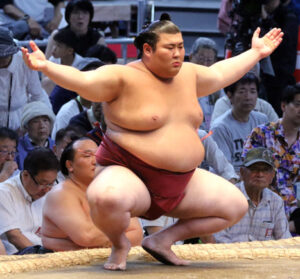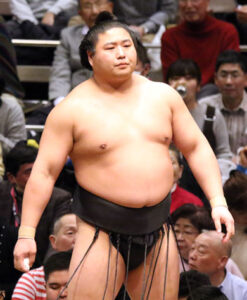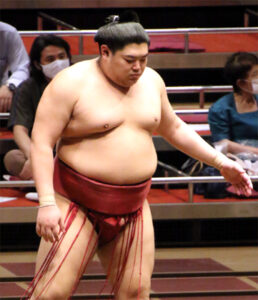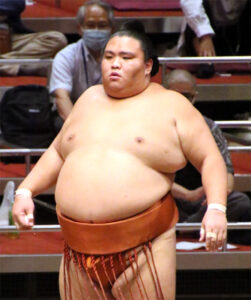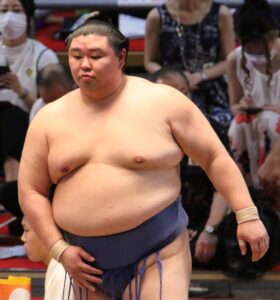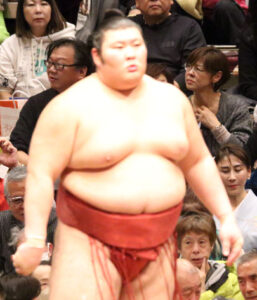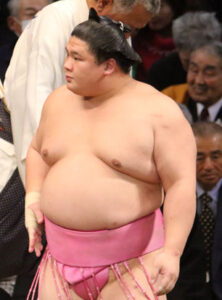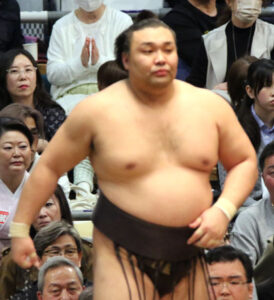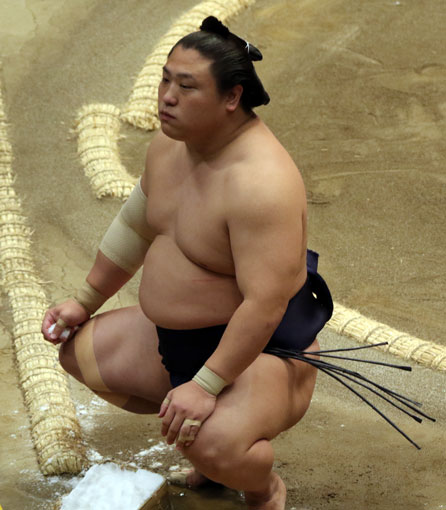
Photo by Michihiro Taguchi.
Wakatakakage is a Japanese professional sumo wrestler who fights in the top makuuchi division for Arashio stable, and he has won the Emperor’s Cup twice: in March 2022 as a newly promoted sekiwake, the first such title since the legendary Futabayama, and again in May 2026 as a komusubi, after a run of knee injuries had dropped him all the way to the unsalaried ranks. Twenty-four tournaments separated the two. He is the youngest of the three Onami brothers. He was ranked East sekiwake for Nagoya 2026 and sat out all fifteen days. This guide explains his rise, his style, his comeback and where he stands now.
The second championship, May 2026
Four years and one tournament after the first one, Wakatakakage won again. He came into the May 2026 tournament as East komusubi and finished 12–3, level with the ozeki Kirishima. On the final day he dispatched Toryoga, in only his second top-division tournament, with a katasukashi; Kirishima beat Ura in the last bout of the day; and the playoff that followed was over in a moment, Wakatakakage driving him straight out from the charge. He took the Technique Prize with it.
Twenty-four tournaments had passed since his first title in March 2022. By Michihiro Taguchi’s count of every such interval, that is the third-longest gap between a first and second championship in the sport’s history, behind Kotonishiki’s 43 and Terunofuji’s 29.
What filled the gap is documented in the Association’s own sheets. In March 2023, ranked East sekiwake, he pulled out on the final day. He then missed the next three tournaments entirely and the ranking sheet carried him down to makushita, the unsalaried division. Taguchi lists the injuries: a torn right anterior cruciate ligament, a torn right lateral meniscus, a bone bruise and a torn right lateral collateral ligament. He needed two tournaments in makushita and two in juryo to get back to the top division, winning the makushita championship in January 2024 and the juryo championship at 14–1 in May.
Taguchi praised the man and marked down the tournament
Two grand champions and two ozeki sat out the May 2026 tournament. Taguchi’s daily reports were hard on it — he asked on the fourteenth day why low-level championships kept happening, argued on the final day that 11–4 should not count as a title at all, and gave the fortnight 50 out of 100 in his review. He also wrote that 12–3 championships have come up 55 times in 437 tournaments since the 15-day format settled in 1949, 13 per cent of all of them, and counted this as the fourth in a row decided at that score, which he called a first.
None of that landed on Wakatakakage. The same reports say the opposite about him.
Nobody could have predicted this before the tournament. It was a championship beyond anyone’s expectations. With two yokozuna and two ozeki out, he lifted a tournament nobody expected to be lifted. The man who did the work closed it out at the end.
Michihiro Taguchi, Dohyo no Mokugekisha, May 24, 2026
Where he stands now
Wakatakakage is 31, stands 183 cm and weighs 138 kg. On the Nagoya 2026 ranking sheet he was East sekiwake — and he did not wrestle a single bout, sitting out all fifteen days. At the September 2026 tournament, ranked East maegashira 12, he again sat out all fifteen days. His career record is 420 wins, 261 losses and 102 days out over 57 tournaments; in the top division, 259–164 with 87 days out over 34. His highest rank is still sekiwake.
| Tournament | Rank | Record |
|---|---|---|
| September 2025 | East sekiwake | 6–9 |
| November 2025 | West maegashira 1 | 7–8 |
| January 2026 | West maegashira 2 | 9–6 |
| March 2026 | East maegashira 1 | 8–6, 1 day out |
| May 2026 | East komusubi | 12–3, championship, Technique Prize |
| July 2026 | East sekiwake | 0–0, 15 days out |
| September 2026 | East maegashira 12 | 0–0, 15 days out |
In June 2026, before that absence, Taguchi counted his career withdrawals: six of them, and 60 days missed once forfeits are included. The first came in November 2019, in his very first top-division tournament, with a dislocated right Chopart’s joint; it took him two tournaments to get back. Nagoya makes seven.
Can he make ozeki? Taguchi is not convinced
A championship from komusubi normally starts a promotion run. Two days after this one, Taguchi wrote the case against it, and it is worth reading next to the fact that Wakatakakage then missed the following tournament entirely.
His argument is about what the rank demands rather than what the fortnight produced. An ozeki who cannot win ten consistently gets called a kunroku ozeki or a hachi-nana ozeki — the 9–6 man, the 8–7 man. He set out what the standard actually looks like: Kotokaze held ozeki for 22 tournaments, won ten or more in 13 of them and had a run of eight consecutive double-figure fortnights; Baruto held it for 15, with ten or more in eight and a run of six. Then the line about Wakatakakage: he is 31, and there is reason to doubt he could do the job.
Taguchi applies the same test upward. In the same review he refused to endorse a yokozuna promotion for Kirishima on two 12-win championships, quoting the first chairman of the Yokozuna Deliberation Council on holding the line at 13 wins, and asking for five tournaments of steadiness rather than three months of form. He has been making that argument about promotions since at least the Taiho and Kashiwado case of 1961.
Wakatakakage is the ring name, or shikona, of one of the most consistent wrestlers in the upper ranks of modern sumo. He fights out of Arashio stable, an Arashio-beya household that has become a family affair, and his career carries two defining chapters: an upset championship that put his name in the record books, and a long road back from injury that tested whether he could ever climb that high again.
A Sumo Family: The Three Onami Brothers
Wakatakakage did not arrive in sumo alone. He is the youngest of three brothers who all became professional wrestlers at Arashio stable. The eldest is Wakatarumoto, the middle brother is Wakamotoharu, and Wakatakakage is the youngest of the three. They come from Fukushima Prefecture, and the wrestling runs back through the family on both sides.
Their maternal grandfather was Wakabayama, a former komusubi who competed in the makuuchi division for Tokitsukaze stable, the very house of the legendary Futabayama. Wakabayama won a Shukun-sho, an Outstanding Performance prize, in 1951. Their father, Wakanobu, was a former makushita-division wrestler. That makes the Onami brothers a multi-generation sumo household, a lineage that helps explain how three sons followed the same path into the same stable.
Career and Rise
As a teenager Wakatakakage had no standout results in elementary or junior high school. The breakthrough came late: in his third year of high school he won the All-Japan Junior weight-class championship. He then went to Toyo University, where he finished runner-up at the National Collegiate Sumo Championship, a result strong enough to earn him makushita tsukedashi entry status, specifically sandanme 100 tsukedashi, which let him start his professional career partway up the lower ranks rather than at the very bottom.
He made his professional debut in March 2017 as a sandanme tsukedashi, following his two older brothers into Arashio stable. The climb up the banzuke was fast. He passed through the sandanme and makushita divisions in only seven tournaments to reach juryo, going 36-13 over that span. From there the salaried ranks and then the top division came into reach.
Style and Techniques
Wakatakakage is, by the standards of modern sumo, on the smaller side. In a 2020 profile he was listed at around 182 cm and 125 kg, which marks him as a kohyo, a relatively small wrestler, in an era of much heavier men. He makes up for it with technique rather than mass.
His specialty is migi-yotsu, a right-hand inside grip, from which he works toward yori, a force-out. When he can secure his grip and drive forward, his sumo combines skill with fast forward-attacking pressure, and that blend is what carried him past bigger opponents during his best tournaments.
The March 2022 Championship
Wakatakakage won his first top-division championship at the March 2022 Haru tournament in Osaka, and he did it as a newly promoted sekiwake. Sumo holds six honbasho a year, each lasting fifteen days, and the title goes to the wrestler with the best record in his division. He finished this one at 12-3, a strong score but not a perfect one, which is worth keeping in mind against a clean zensho-yusho sweep.
The tournament turned on its biggest names. On day 11 Wakatakakage decisively beat the then-undefeated Takayasu, getting moro-zashi, a double inside grip, straight off the tachiai and forcing him out. On the final day, senshuraku, he lost to ozeki Shodai, which dropped him into a championship playoff. The opponent in that playoff was, once again, Takayasu. Wakatakakage won it with a shitatenage, an underarm throw, at the edge of the ring to clinch his first title.
The win was a genuine upset. It was the first championship by a newly promoted sekiwake since Futabayama, and before this tournament Wakatakakage’s best result at the sanyaku ranks had been 10-5. His sumo that fortnight drew high praise for pairing his usual craft with quick, forward-attacking aggression, and he turned in several near-flawless performances against the field, including standout bouts with Hoshoryu among others.
An Ozeki Candidate, Then a Serious Injury
For a stretch after the title, Wakatakakage was repeatedly paired with Hoshoryu as one of the two leading ozeki candidates of the era. He had reached sekiwake and held it, the more senior of the two in the rankings, and was described as the strongest of the wrestlers below ozeki, a mantle that had passed to him from Mitakeumi. He headed into a seventh straight tournament at sekiwake on that reputation.
Then his right knee gave way. He suffered a torn right anterior cruciate ligament, a torn right lateral meniscus, a bone bruise, and a torn right lateral collateral ligament, an injury severe enough to force him out of four tournaments in a row. He sat out three of them completely and fell all the way down the banzuke to the makushita division, well below the salaried ranks. Climbing back took two makushita tournaments plus two juryo tournaments before he returned to the top division.
It was not his first major setback. At his top-division debut in November 2019 he dislocated the Chopart joint of his right foot, an injury that cost him absences and needed two tournaments to recover from before he was back in makuuchi. Across his career he has withdrawn from competition several times, with his absences mounting, a record that underlines how much of his story is about coming back rather than simply staying healthy.
The 2025 Comeback and Ozeki Run
The comeback peaked at the May 2025 tournament. Back at komusubi, Wakatakakage went 12-3 and tied for runner-up, and he gave eventual champion Onosato his toughest fight of the basho. That re-established him, at least for a moment, as an ozeki candidate all over again.
The May 2025 result carried a particular weight. It was the first time he had ever put together back-to-back double-digit wins at the sanyaku ranks. Around his 2022 championship he had gone 9-6 both in the tournament before and the tournament after, which meant he had never been able to build a true ozeki run off that title. By 2025 he was 30 years old, turning 31 that December, past the age when wrestlers usually still improve, which framed this bid as a rare and possibly final chance.
The renewed run effectively ended at the September 2025 tournament. A loss to Hiradoumi left him at 5-5 with only the yokozuna and ozeki bouts still to come, and at that point his promotion challenge was, in practical terms, over.
Against the Very Top
One gap has stayed on his record. Wakatakakage never beat Terunofuji on the dohyo. His only win over the yokozuna came by default, a fusen win, recorded when Terunofuji was ranked down at maegashira number one rather than at the top of the banzuke. For all his consistency in the upper ranks, the very summit of the sport proved a step he could not quite take in a live bout.
Wakatakakage is a top-division sumo wrestler from Fukushima Prefecture, fighting for Arashio stable, and the youngest of the three professional Onami brothers.
He won the March 2022 Osaka tournament at 12-3 as a newly promoted sekiwake, beating Takayasu in a playoff with a shitatenage, the first title by a fresh sekiwake since Futabayama.
A severe right-knee injury sent him down to the makushita division, but he fought back to the top and went 12-3 at komusubi in May 2025 to revive an ozeki challenge.
His specialty is a right-hand inside grip and force-out, and his one win over yokozuna Terunofuji came only by default.
Frequently Asked Questions
What is Wakatakakage known for?
He is best known for winning the March 2022 top-division championship in Osaka as a newly promoted sekiwake. He finished at 12-3 and won a final-day playoff against Takayasu with a shitatenage, an underarm throw at the edge of the ring. It was the first title by a freshly promoted sekiwake since Futabayama, which made it a major upset.
Who are the Onami brothers?
The Onami brothers are three siblings from Fukushima Prefecture who all became professional wrestlers at Arashio stable. The eldest is Wakatarumoto, the middle brother is Wakamotoharu, and Wakatakakage is the youngest. Their maternal grandfather Wakabayama was a former komusubi, and their father Wakanobu was a former makushita-division wrestler.
What is Wakatakakage’s fighting style?
His specialty is migi-yotsu, a right-hand inside grip, which he uses to set up a yori force-out. Listed in a 2020 profile at around 182 cm and 125 kg, he is relatively small for the modern top division and relies on technique and fast forward-attacking sumo rather than sheer size.
What injury did Wakatakakage suffer?
He suffered a serious right-knee injury that included a torn right anterior cruciate ligament, a torn right lateral meniscus, a bone bruise, and a torn right lateral collateral ligament. It forced him out of four tournaments in a row and dropped him down the banzuke to the makushita division. He needed two makushita tournaments and two juryo tournaments to climb back to the top division.
Did Wakatakakage become an ozeki?
He came close more than once but did not earn promotion. He was repeatedly named as a leading ozeki candidate after his 2022 title, and he revived the bid by going 12-3 at komusubi in May 2025. That run effectively ended at the September 2025 tournament, where a loss to Hiradoumi left him at 5-5 and, in practical terms, ended his promotion challenge.
Has Wakatakakage ever beaten Terunofuji?
Not on the dohyo. His only recorded win over the yokozuna Terunofuji came by default, a fusen win, at a time when Terunofuji was ranked at maegashira number one. In their actual bouts, Wakatakakage was never able to beat him.
Reporting note: this article draws on Michihiro Taguchi’s tournament reporting and original statistical work published in Dohyo no Mokugekisha — his day-14 and final-day reports from the May 2026 tournament (May 23 and 24, 2026), his review of that tournament (May 26, 2026), his study of championships decided at 12-3 (May 27, 2026), his ranking of the gaps between a first and second title (May 28, 2026) and his count of career withdrawals (June 26, 2026). Rank, age, measurements, stable, career totals and per-tournament results were rechecked against the Japan Sumo Association’s wrestler profiles and tournament sheets on August 6, 2026. Age, measurements, career totals and the September 2026 results were checked again against the Association’s wrestler profile on October 15, 2026. Figures described as our count are arithmetic on those published sheets, not the Association’s own totals.
Updated August 6, 2026.
Read next: the May 2026 tournament in full · sekiwake and komusubi explained · Wakamotoharu, his older brother · what happens when a wrestler sits out