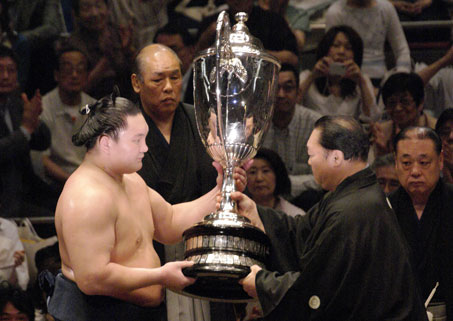
Sumo is Japan’s national sport, with roots as a Shinto ritual performed over a thousand years ago. It began not as competition but as a way of praying to the gods for a good harvest, and it survives in Japan’s earliest myth-histories and in records of contests staged at the imperial court. Across the centuries it grew into popular entertainment, took its professional shape in the Edo period, and was finally organised under the Japan Sumo Association. This guide explains how sumo travelled from sacred rite to national sport, and why its rituals still stand in the modern ring.
Sumo began as a Shinto harvest ritual, not a sport. Wrestling was offered to the gods for a good rice crop long before anyone kept score, and in ancient times there was no ring at all.
The ring and the spectator sport emerged together. The dohyo is said to have been born around the era of kanjin-zumo, the fundraising bouts held to repair shrines and temples, and sumo pictures confirm the ring from around 1673 to 1683.
The modern competitive game is younger than fans assume. The old Ryogoku Kokugikan opened in 1909, the individual championship system dates only from 1926, and the governing body reached its present form, the Japan Sumo Association, in 1958.
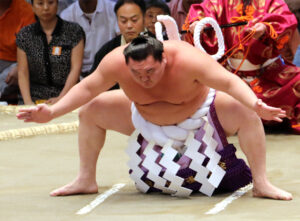
The ceremony is the history. Salt, the shrine-style roof and the referee’s court robes are surviving pieces of sumo’s sacred origins, not later decoration.
Walk into a sumo arena today and you are watching two strands at once. One is elite athletic combat, decided in seconds. The other is older and quieter: salt thrown into the ring, a referee dressed like a court official, a roof above the action shaped like a shrine. To understand why a national sport behaves like a religious rite, you have to follow it back to where it started.
Born from the rice fields: sumo’s Shinto roots
Long before there were tournaments, rankings or paying crowds, sumo was an act of worship. In an agricultural society that lived and died by the rice crop, communities held wrestling bouts as offerings to the kami, the gods of Shinto, asking for a good harvest and reading the result as a sign of the year to come. The contest was the prayer. Who won mattered less than the act of staging it at all.
Early sumo also looked nothing like the bordered clay circle fans know now. In ancient and medieval times there was no dohyo at all. Sumo was a raw test of strength, a rough grappling combat fought without a ring, and the ring itself arrived only later. That single structural fact separates the oldest forms of the sport from the modern one, and it explains why the ring is treated as such a meaningful piece of ground.
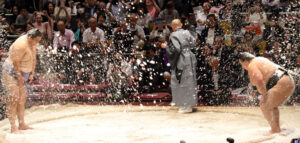
The origin also explains a great deal about how the sport still feels. The ceremony came first, and the competition grew up inside it. When a wrestler stamps the ground hard before a bout, or scatters a handful of salt across the clay, he is repeating gestures meant to drive out evil spirits and purify the ground. These were never sporting flourishes. They were religious necessity, and they have simply never been dropped.
How long has sumo been played? A timeline from the Japan Sumo Association
The association puts a figure on it on its own history page: sumo has continued for more than 1,500 years. Written evidence starts in the eighth century, the imperial court ran sumo as a fixed event for three hundred years, professional sumo took shape in the Edo period, and the governing body and the ring reached their modern form inside the last hundred. The dated milestones below are the ones the association itself records.
| When | What the Japan Sumo Association records |
|---|---|
| 712 and 720 | Japan’s oldest surviving books, the Kojiki (712) and the Nihon Shoki (720), carry the trials of strength and the legendary bout between Nomi no Sukune and Taima no Kehaya staged before the emperor. The association names these as the origin of sumo in Japan. |
| Heian court, 300 years | Sumo was held every year as a ritual to divine the rice harvest, then became a court event that ran for three hundred years. |
| 1570–92 (Genki–Tensho) | Oda Nobunaga gathered wrestlers from across the country at Azuchi Castle and other sites, and took the winners into his service as retainers. |
| Edo period | Ronin and strongmen began to make sumo a profession. Kanjin-zumo spread nationwide and, by the middle of the Edo period, tournaments were staged on a regular schedule. |
| Later Edo period | In time Tanikaze, Onogawa and Raiden appeared, the shogun watched sumo in person, and the foundations of today’s professional sumo were laid. |
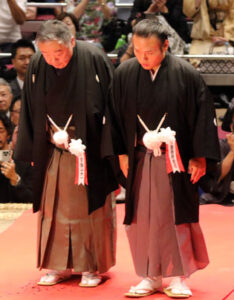
| 1845 (Koka 2) | Utagawa Toyokuni III’s print of the East-side ring-entering ceremony shows the makuuchi wrestlers of the eleventh month of that year. |
| 1866 (Keio 2) | Utagawa Kuniteru II’s print of a kanjin grand sumo ring-entering ceremony shows the makuuchi wrestlers of the third month of that year. |
| December 1925 | The Dai-Nippon Sumo Association was founded as an incorporated foundation. |
| January 1927 | The Tokyo and Osaka sumo associations merged. |
| January 1928 | A time limit for the shikiri and the two shikiri lines were introduced. |
| April 1931 | The ring was reformed: its diameter went from 13 shaku to 15 shaku (4.55 m), and the double ring became a single one. |
| September 1952 | The four pillars were removed and replaced by a suspended roof with four coloured tassels hanging from it. |
| September 1954 | The Kuramae Kokugikan opened. |
| January 1985 | The new Ryogoku Kokugikan opened. |
Myth, legend and the imperial court
Sumo is old enough to appear in the stories Japan tells about its own beginnings. The country’s earliest myth-histories include wrestling among the deeds of gods and legendary strongmen, treating a grappling match as powerful enough to settle questions of myth. The most famous of these tales is the legend of Nomi no Sukune. The Nihon Shoki records a bout between Nomi no Sukune and Taima no Kehaya, set in ancient times.
From the realm of legend, sumo moved into the life of the state. For long stretches of early history it was performed at the imperial court, where bouts were staged as a formal event tied to the ritual calendar and watched by the emperor and his nobles. This courtly phase pulled the village harvest rite toward something more codified, and it began the slow process that mattered most for the sport’s future: turning sumo from a thing communities did into a thing trained men performed for an audience.
From spectacle to profession: the Edo turn
The version of sumo a modern fan would recognise took shape during the Edo period, the long stretch of peace under the Tokugawa shoguns. Cities grew, a merchant class found money to spend, and popular entertainment boomed. Sumo rode that wave. Bouts were staged as public events, often to raise funds, and crowds turned up to watch strong men fight for reasons that had nothing to do with the harvest.
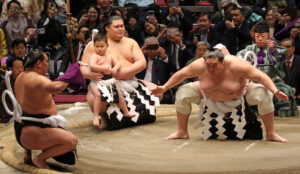
The ring itself belongs to this turn. The dohyo is said to have been born around the time of kanjin-zumo, the practice of soliciting donations to raise funds for building and repairing shrines and temples, and sumo pictures, or sumo-e, confirm the ring in use from around 1673 to 1683. Those early rings were simple: straw bales packed with earth and laid on the ground. Both round and square rings existed, and in a square ring a wrestler driven into a corner had nowhere to escape, a quirk that helped push the sport toward the circle used today.
That demand created something new: the professional wrestler. Men could now make a living from sumo, which meant the sport needed structure. Stables formed to train and house fighters. Ranking systems developed to sort the strong from the merely large and to tell spectators who was worth their attention. Competition was organised as a contest between two camps, East and West, and in the Edo period two wrestlers from the same side, the kataya, did not fight each other. The ranked tournament, the listed hierarchy recorded on the banzuke, and the wrestler as a recognisable public figure all grew out of this commercial era, while the sacred frame stayed in place around it.
Building the modern game and the Japan Sumo Association
As Japan modernised, the loose world of Edo-era sumo, with its competing groups and local promoters, was pulled together into a single national structure. The governing body’s name evolved through documented stages. A Sumo Kaisho was formed around 1757, the relevant Tokyo organisation was renamed the Tokyo Sumo Association in January 1889, and the Dai-Nippon Sumo Association was incorporated as a foundation in December 1925, a name used officially from 1927 at the East-West merger. It became the Japan Sumo Association in January 1958, and was reconstituted as the Public Interest Incorporated Foundation Japan Sumo Association on 30 January 2014. That body administers professional sumo, runs the official tournaments and maintains the ranking ladder every wrestler climbs or slides down.
Two milestones turned sumo into a reliably staged spectacle. The opening of the old Ryogoku Kokugikan in 1909 was epochal because tournaments could finally run on schedule whatever the weather. Before it, no one could be sure when a tournament would end, and some were even cancelled midway. An East-West team format, the Tozai-sen, began together with the Kokugikan’s birth that same year. Then, in 1926, professional sumo adopted an individual championship, the yusho, a surprisingly recent invention. Establishing it meant reforming irrational older rules, including draws, held bouts and a wrestler being counted absent when his scheduled opponent sat out.
Under that system, professional sumo settled into the rhythm fans follow now: a regular calendar of major tournaments, a single ranked pyramid that all wrestlers share, and a top tier whose results decide champions. At the summit sits the yokozuna, grand champion, a rank that carries duties as much as glory and is held to standards of conduct as well as wins. Just below stands the ozeki, the second-highest rank in professional sumo. Promotion through the ranks is earned bout by bout, which keeps the hierarchy in constant, visible motion across a tournament.
Why the rituals survived
Plenty of old sports modernised by shedding their ceremony. Sumo did the opposite. It professionalised, commercialised and nationalised while keeping its religious skin intact, which is exactly what makes it strange and compelling to a newcomer. The roof suspended over the ring is built to resemble the roof of a Shinto shrine. The clay ring itself, the dohyo, is treated as sacred ground, prepared and blessed rather than merely laid out.
Even the roof tells that story of change inside continuity. Four pillars once supported the roof over the ring, in place from 1791, and they were abolished from the autumn tournament of 1952. The roof was then suspended from above, with four coloured tassels left in the pillars’ place as a vestige, the form seen today. The referee, the gyoji, still officiates in elaborate robes modelled on the dress of old court officials, a walking reminder of the sport’s centuries at the heart of Japanese ceremony. And the throwing of salt before a bout remains an act of purification, the wrestler cleansing the ring as a rite rather than a flourish. None of this is performance for the cameras. It is the harvest rite, still running underneath the modern sport. For anyone learning how the bouts themselves work, the modern rules of sumo sit on top of this old foundation rather than replacing it.
Frequently Asked Questions
How old is sumo?
Sumo’s roots reach back well over a thousand years. It is widely accepted as one of the world’s oldest organised forms of wrestling, with origins in early Shinto ritual and appearances in Japan’s oldest myth-histories. The Nihon Shoki, for instance, records a legendary bout between Nomi no Sukune and Taima no Kehaya in ancient times. Exact starting dates are impossible to pin down because the practice predates reliable record-keeping, but its great age is not in doubt.
Why was sumo originally performed?
It began as a religious act. In Japan’s farming communities, wrestling bouts were staged as offerings to the Shinto gods, chiefly as prayers for a good harvest. The contest functioned as ritual rather than entertainment, and in those ancient and medieval times there was no ring, only a rough test of strength. That sacred beginning is why so much ceremony remains attached to the modern sport.
Who is Nomi no Sukune?
Nomi no Sukune is a legendary strongman from Japan’s early chronicles. The Nihon Shoki records his contest of strength against Taima no Kehaya, set in ancient times, and his story is one of the reasons the sport is woven so tightly into Japan’s founding myths.
When did sumo become a sport?
Professional sumo took its modern shape during the Edo period, when public, ticketed bouts created full-time wrestlers, training stables and the ranking ladder. The dohyo itself emerged around the kanjin-zumo era, with the ring confirmed in pictures from about 1673 to 1683. The competitive structure fans know is even more recent: the old Ryogoku Kokugikan opened in 1909, letting tournaments run on schedule, and the individual championship was introduced in 1926.
What is the Japan Sumo Association?
The Japan Sumo Association is the body that governs professional sumo, running the official tournaments and maintaining the ranking system. Its name evolved over time, from a Sumo Kaisho around 1757 to the Tokyo Sumo Association in 1889, the Dai-Nippon Sumo Association in the 1920s, the Japan Sumo Association in 1958, and finally the Public Interest Incorporated Foundation Japan Sumo Association in 2014.