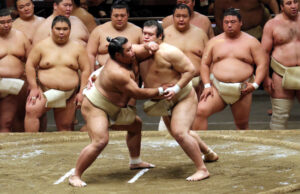
Before a sumo bout, wrestlers move through a sequence of Shinto-rooted rituals that turn the dohyo into sacred ground. They throw salt (shio) to purify the ring, rinse their mouths with chikara-mizu (“power water”) and wipe with chikara-gami (paper), and drive the high leg stomps of shiko into the clay to chase away evil spirits. Then comes the shikiri, the tense face-off where the two crouch, glare and rise again until the time runs out and they collide in the tachi-ai charge. Every gesture carries meaning, and together they build the hush before the launch.
A Shinto Stage, Not Just a Ring
Strip sumo down to its mechanics and you have two large people trying to push each other out of a circle. Watch the minutes before that, though, and the sport reveals its other half: a religious rite that predates the modern bout by centuries. Sumo grew out of Shinto, Japan’s indigenous belief system, and many of its oldest forms were performed at shrines as offerings to the gods and prayers for a good harvest.
The clearest sign is the ring. The dohyo is consecrated ground, not a neutral surface: above it hangs a roof modeled on a Shinto shrine, and the clay platform is ritually purified before a tournament begins. Once you accept that the wrestlers are stepping onto holy ground, the pre-bout sequence stops looking like superstition and starts looking like protocol, with the salt, water and stomping each preparing the space and the body for what comes next. For how a match is then won, our guide to the rules of sumo covers the mechanics.
The pre-bout ritual, step by step
The Japan Sumo Association sets out the sequence itself in its official English introduction to the sport. The six stages below are its own captions, in its own order, and the sections that follow explain what each one is for.
| Stage | What the Japan Sumo Association says |
|---|---|
| Shiomaki — spreading the salt | “Purifying salt is used to expel evil from the sacred area of the ring and to pray for safety.” |
| Sonkyo — the crouch | “A basic pose where the rikishi rises on his toes and crouches with his waist low to the ground.” |
| Chirichozu | “The rikishi clap their hands, spread their arms out wide in both directions and turn their palms downward.” |
| Shikiri — the face-off | “The rikishi try to listen to their opponent’s breathing to seize control of the match just after the bout begins.” |
| Tachiai — the charge | “The moment when the rikishi synchronize their breathing, rise, and begin the bout.” |
| Torikumi — the bout | “The rikishi grab each other’s belts, press their bodies together, and try to knock each other off balance.” |
Two practical details sit alongside the religious ones. The salt “is also believed to shield him from potential injuries”, and on a working level it “moistens the rikishi’s hands and also works to disinfect any scrapes”. It is “scooped from bamboo baskets placed at the east and west points of the ring”.
Throwing Salt to Purify the Ring
The most photographed ritual in sumo is the salt toss. A wrestler reaches into a basket at the edge of the ring, takes a handful of salt and flings it across the clay before stepping in. In Shinto, salt is a purifying agent used to cleanse spaces and ward off bad spirits, and that is its job here: the throw symbolically clears the dohyo of impurity and offers a measure of protection in a sport where injuries are real. Reserved for the upper divisions, it grows more theatrical as a bout climbs the ranks. Some wrestlers scatter a modest pinch; others hurl a great spray of white that hangs in the light before falling, drawing a roar that arrives well before any wrestling does.
Chikara-Mizu and Chikara-Gami: Power Water and Paper
Before the salt, there is water. A wrestler about to compete receives chikara-mizu, literally “power water,” and uses it to rinse his mouth at the edge of the ring. The act purifies from the inside, a cleansing of the self to match the cleansing of the ground, and the name carries the idea of taking on strength for the fight ahead. After rinsing, he wipes his face and body with chikara-gami, the “power paper,” to complete the preparation.
There is a quiet code in who hands the water over: it comes from the wrestler who has just won or the one waiting to fight next on the same side, never from someone who has just lost, since passing strength to a rival would carry the wrong omen.
Shiko: The Leg Stomps That Drive Out Evil
Few images say “sumo” as instantly as a wrestler lifting one leg high into the air, holding the pose, then bringing the foot crashing down onto the clay. This is shiko, far older and deeper than a warm-up. Each stomp is meant to drive evil spirits out of the ring and stamp down bad energy in the ground, a forceful gesture of purification to go with the gentler work of the salt and water. Because the same movement is also a core training drill, those towering stomps are at once a prayer, a threat and an athletic foundation.
The Shikiri and the Tachi-Ai: Staredown to Collision
With the ground purified and the body prepared, the contest narrows to two wrestlers and the two short white lines, the shikiri-sen, painted in the centre of the ring. The wrestlers crouch at the lines, plant their fists toward the clay and stare each other down, reading posture and nerve. Then, more often than not, they stand, walk back to the salt and do it all again. This repeated crouching, glaring and returning is the shikiri, psychological warfare in near silence.
Why They Keep Returning to the Lines
The back-and-forth is not indecision. Each approach is a chance to time the start and unsettle the opponent, and the salt toss between attempts paces the duel like the rounds of a longer fight. It cannot run forever, though: there is a set time limit on the shikiri, and once it is reached the wrestlers must go on the next approach.
The Tachi-Ai
Then it ends in an instant. The tachi-ai is the initial charge, the moment both wrestlers spring from their crouch and collide. There is no whistle or starting gun; the launch must be mutual, read in the body language built up over the shikiri, and a clean, well-timed tachi-ai can decide a bout before it has properly begun. After all the slow ceremony, the contest is often over in seconds, the long inhale before a very short exhale. Our guide on how to watch sumo covers what to look for on a broadcast.
Who is allowed what, and how long the face-off lasts
Not every wrestler goes through the full ceremony. The salt and the water belong to the upper divisions, and the clock on the face-off is shorter the further down the banzuke you look. Where the association says nothing, the cell stays blank rather than being filled in by guesswork.
| Division | Time allowed for the face-off (shikiri) | Purifying salt | Chikara-mizu (power water) |
|---|---|---|---|
| Makuuchi (top division) | Four minutes | Allowed | Receives it — the association names “the two top divisions” |
| Juryo | Three minutes | Allowed | Receives it — the association names “the two top divisions” |
| Makushita | Must begin almost immediately — the association’s wording is “the lowest ranks” | Allowed “on some occasions” | |
| Sandanme, Jonidan and Jonokuchi | Must begin almost immediately — the association’s wording is “the lowest ranks” |
The four minutes are recent. The association notes that “the time limit was not fixed until about 90 years ago” and traces the cuts:
| When | Limit on the shikiri |
|---|---|
| Early sumo | No limit — “the start of a match could be delayed indefinitely” |
| 1928 | 10 minutes |
| Later | Seven minutes |
| Then | Five minutes |
| Today | Four minutes |
How the Ritual Builds Tension for the Crowd
For a first-time spectator, the gap between ceremony and combat can be jarring, but that contrast is the point. The rituals are an engine for tension: each salt toss and each renewed staredown winds the crowd tighter, so that by the final charge the hall is leaning in as one. The effect grows with the stakes, and a bout featuring the sport’s highest rank, the yokozuna, turns the ceremony into an event of its own. Once you know what each gesture means, the slow build becomes half of why the wrestling lands.
Purification runs through everything: salt cleanses the ring, chikara-mizu and chikara-gami cleanse the wrestler, and shiko stomps drive evil out of the clay.
The dohyo is sacred ground, a Shinto stage crowned with a shrine-style roof, which is why the pre-bout sequence is treated as ceremony rather than warm-up.
The shikiri builds tension on purpose: wrestlers crouch, glare and return to the lines until a set time limit forces the tachi-ai, the explosive charge that ends it in seconds.
Frequently Asked Questions
Why do sumo wrestlers throw salt before a match?
The salt, called shio, is a purifying agent in Shinto. Throwing it across the ring symbolically cleanses the dohyo of impurity and bad spirits before the wrestlers step in, reflecting sumo’s roots as a religious rite. The toss is reserved for the upper divisions.
What is chikara-mizu in sumo?
Chikara-mizu means “power water.” A wrestler about to compete uses it to rinse his mouth before the bout, then wipes down with chikara-gami, or “power paper.” By custom it is handed over by the previous winner or the next wrestler on the same side, never by someone who has just lost.
What does shiko, the leg stomping, mean?
Shiko is the ritual where a wrestler raises one leg high and stamps it down onto the clay to drive evil spirits out of the ring and stamp down bad energy in the ground. It doubles as a show of strength and balance, and the same movement is a core training exercise that builds the legs and hips.
What is the shikiri and why do wrestlers keep returning to the lines?
The shikiri is the face-off before the charge, when the wrestlers crouch at the central lines, stare each other down, then rise and return to the salt before trying again. The repetition lets them time the start and unsettle the opponent. A set time limit eventually forces them to begin the tachi-ai, the initial charge, on the next approach.