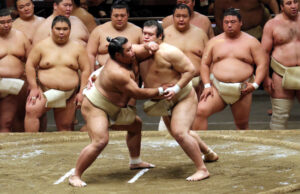
A tokoyama is a professional hairdresser employed by the Japan Sumo Association to comb, oil and tie the hair of sumo wrestlers. They are salaried members of the Association, not freelancers, and each one is attached to a stable rather than to an individual wrestler. The Association’s own roster lists 46 tokoyama across 34 stables, ranked in six grades from fifth class up to the single special-grade hairdresser at the top.

The six grades of tokoyama
Tokoyama are ranked, in the same way that referees and ring announcers are ranked. The grades run from fifth class at entry to special class at the top, and the grade appears next to every name on the Association’s published roster. The counts below come from tallying that roster by hand on August 3, 2026.
| Grade | Japanese | How many hold it |
|---|---|---|
| Special class | 特等床山 tokuto-tokoyama | 1 |
| First class | 一等床山 itto-tokoyama | 18 |
| Second class | 二等床山 nito-tokoyama | 7 |
| Third class | 三等床山 santo-tokoyama | 10 |
| Fourth class | 四等床山 yonto-tokoyama | 2 |
| Fifth class | 五等床山 goto-tokoyama | 8 |
| Total | 46 |
The shape of that table is worth a second look. Eighteen of the 46 sit at first class, and only two at fourth. The grades are not evenly filled, and the Association does not explain why, so the honest answer is that the distribution is what it is.
What a tokoyama does
A wrestler cannot tie his own hair. It is grown long, kept oiled, and dressed by a tokoyama — every day in the stable, and again before he steps out in front of a crowd. The style depends on where the wrestler sits on the banzuke, and that rule is set out in the Association’s own English guide.
| Wrestler’s division | Hairstyle | What it looks like |
|---|---|---|
| Makuuchi and juryo (the salaried sekitori) | Oicho-mage 大銀杏 | The elaborate style, with the end of the topknot spread into a fan named after the ginkgo leaf |
| All divisions below juryo | Chonmage 丁髷 | The plainer style, tied with paper strings |
The same guide gives a reason for keeping the styles that has nothing to do with ceremony. Both come from hairstyles that were ordinary in the Edo period, and they survive “not merely because of tradition but also because they serve as head protection in the event of falls.” The oiled bundle of hair sits on the crown of the head and takes some of the impact when a wrestler goes down on the clay. The topknot itself is covered in more detail on our page about the chonmage.
A tokoyama belongs to a stable, not to a wrestler
Every entry on the roster carries a stable name, and that is the clearest signal of how the job works. A tokoyama is posted to a heya and dresses the hair of everyone in it, from the youngest recruit to the yokozuna. Forty-six hairdressers are spread across 34 stables, so most stables have one and a few have more than one.
What happens when a stable closes shows the same thing from the other direction. Sumo journalist Michihiro Taguchi, who has covered the sport for over a decade, recorded two of these moves. When Oguruma stable was broken up in 2022, the first-class tokoyama Tokogo went to the newly independent Oshiogawa stable along with wrestlers, an elder and a ring announcer. In a later reorganisation, one stable’s hairdressers were split between four different stables — Otowayama, Arashio, Oitekaze and Isenoumi. The hairdresser moves with the institution, not with any wrestler whose hair he happens to have been tying.
Taguchi’s 2022 note also survives as a check on the current roster. He identified Tokogo as a first-class tokoyama at Oshiogawa; the Association’s roster retrieved in August 2026 still lists Tokogo (とこごう) as 一等床山 at Oshiogawa. Two independent records, four years apart, agree.
How the backstage professions compare
Tokoyama are one of four groups of salaried staff who keep a tournament running. The Association publishes a roster for each, which makes it possible to line them up side by side. Every figure below was counted from those rosters on August 3, 2026.
| Profession | What they do | Headcount | Ranked grades |
|---|---|---|---|
| Tokoyama 床山 | Dress the wrestlers’ hair | 46 | 6 |
| Yobidashi 呼出 | Call the wrestlers up, build and tend the ring, beat the drum | 44 | 9 |
| Gyoji 行司 | Referee the bouts | 42 | 8 |
| Sewanin 世話人 | Former wrestlers kept on in support roles | 9 | — |
The three ranked professions are close in size — 46, 44 and 42 — and each carries its own ladder of grades. For gyoji and yobidashi, the rungs of that ladder borrow the names of the wrestlers’ divisions: there are makuuchi gyoji and jonokuchi yobidashi, just as there are makuuchi and jonokuchi wrestlers. Tokoyama are the exception. Their six grades are plain ordinal numbers, first class through fifth, with a special class above them all.
Frequently Asked Questions
What is a tokoyama?
A tokoyama is a hairdresser employed by the Japan Sumo Association to dress the hair of sumo wrestlers. The job is a salaried career inside the Association, not a service bought in from outside, and each tokoyama is assigned to a stable. The Association’s roster listed 46 of them across 34 stables when it was retrieved on August 3, 2026.
How many tokoyama are there?
Forty-six, according to the Japan Sumo Association’s published roster retrieved on August 3, 2026. They are spread across 34 stables and split into six grades: one at special class, 18 at first, seven at second, 10 at third, two at fourth and eight at fifth.
Why can’t sumo wrestlers do their own hair?
The oicho-mage cannot be tied one-handed on your own head. The hair has to be combed out, oiled, bound and then folded into a fan at the crown, which needs a second person working from behind. This is why the Association keeps hairdressers on the payroll and posts one to each stable rather than leaving wrestlers to manage.
What is the difference between the chonmage and the oicho-mage?
Rank decides which one a wrestler wears. Salaried wrestlers in the top two divisions, makuuchi and juryo, wear the oicho-mage, whose topknot is spread into a fan named after the ginkgo leaf. Everyone below juryo wears the chonmage, a plainer style tied with paper strings. Both descend from Edo-period hairstyles.
Are tokoyama ranked like referees?
They are ranked, but on a different scale. Referees and ring announcers climb a ladder whose rungs are named after the wrestlers’ divisions, so a gyoji can hold makuuchi or jonokuchi rank. Tokoyama grades are numbered instead — fifth class through first, with a single special class at the top. The Association publishes the grades but not the rules for promotion between them.
What happens to a tokoyama when his stable closes?
He transfers to another stable. Because a tokoyama is attached to a stable rather than to a wrestler, a closure or a split sends him wherever the Association reassigns him. When Oguruma stable was broken up in 2022 its first-class tokoyama moved to Oshiogawa, and in a later reorganisation one stable’s hairdressers were divided between Otowayama, Arashio, Oitekaze and Isenoumi.
Sources
- Japan Sumo Association, tokoyama roster (床山一覧), sumo.or.jp — retrieved August 3, 2026. Headcount, grades and stable assignments counted from this roster.
- Japan Sumo Association, gyoji, yobidashi and sewanin rosters, sumo.or.jp — retrieved August 3, 2026. Used for the comparison table.
- Japan Sumo Association, Sumo Introduction, official English PDF — retrieved August 3, 2026. Source for the oicho-mage and chonmage rule and for the head-protection explanation.
- Michihiro Taguchi, 相撲部屋最新事情 (April 14, 2022) and 相撲部屋への移転 下 (February 11, 2025) — stable reorganisations and hairdresser transfers.
Related reading
- Chonmage: the sumo topknot and the oicho-mage explained
- Yobidashi: the ring attendants who run a sumo tournament
- Gyoji and shimpan: who officiates a sumo bout
- Tsukebito: the apprentice attendants who serve sumo’s sekitori
- Sumo stables explained: life inside a heya
- Danpatsu-shiki: the sumo retirement ceremony