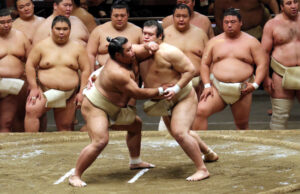
Kyujo is the word for sitting out of a grand tournament. A wrestler who withdraws, whether before the tournament starts or partway through it, is kyujo for the days he misses, and every missed day goes into the official record as a loss. What that costs him depends entirely on his rank. A yokozuna loses nothing on paper, because sumo has no mechanism for demoting the top rank. An ozeki who sits out long enough to finish with a losing record goes kadoban, and a second losing record drops him to sekiwake. Everyone from sekiwake down simply falls on the next ranking sheet. There is no injury exemption: a system that once protected wrestlers hurt in the ring was abolished with effect from the January 2004 tournament.
Missed days count as losses. Sitting out is not a neutral pause. A wrestler who misses all fifteen days is credited with fifteen losses, which is as bad a record as it is possible to have.
Only the yokozuna is protected. The rank cannot be demoted, so absence costs a yokozuna his reputation rather than his position. Every other rank falls.
Injury is not an excuse any more. The old public-injury system, which let a wrestler hurt in the ring keep his rank, was scrapped after the November 2003 tournament.
The salary keeps coming, the extras do not. Monthly pay attaches to the rank, not to attendance. The per-tournament allowance for the titled ranks is cut by the days missed, and prize-money envelopes only reach a man who is standing in the ring.
Long absences usually end careers. In Michihiro Taguchi’s tally of yokozuna who missed four tournaments in a row, thirteen cases produced nine retirements.
What kyujo means
Kyujo (休場) means being absent from a grand tournament. Sumo runs six of them a year, fifteen days each, and a wrestler is expected on the clay every one of those days. When he is not, the association records the day as 休 — rest — and his opponent takes a walkover. The word covers three different situations that look the same in the record book: withdrawing before day one, pulling out partway through, and pulling out and then coming back within the same fifteen days.
What matters is that the days do not simply vanish. A missed bout is scored against the absent man, so absence and defeat arrive at the same destination. A wrestler who fights nine days, wins four, then withdraws with a torn muscle finishes the tournament 4-11, exactly as if he had lost the last six on the clay. The rules that move wrestlers up and down the ranking sheet do not distinguish between the two, and this single fact is what makes a long absence so expensive.
What sitting out does to your rank
The same absence lands very differently depending on where a wrestler is printed on the sheet. The top rank is untouchable; everything below it is exposed, and the exposure grows the further down you go.
| Rank | Effect on the ranking | The detail that matters |
|---|---|---|
| Yokozuna | None. The rank has no demotion mechanism. | Repeated absence brings the Yokozuna Deliberation Council into play instead, working through encouragement, then a formal warning, then a recommendation to retire. None of it is binding. |
| Ozeki | Nothing immediately, but a losing record makes him kadoban, and two in a row cost him the rank. | He drops to sekiwake, and ten or more wins in the very next tournament restores him at once. That provision has been in force since the July 1969 tournament. |
| Sekiwake, komusubi, maegashira, juryo | Falls. Missed days count as losses, so absence pushes him toward a losing record and down the sheet. | These are the salaried ranks. With no injury exemption in force, a wrestler hurt in the ring pays for it in ranking exactly as one who was simply beaten. |
| Makushita and below | Falls. | These wrestlers draw no monthly salary at all, so an absence also cuts straight into the per-tournament allowance that is their income. |
The yokozuna’s exemption is the strangest thing in the system, and it cuts both ways. A yokozuna can miss a full year and be printed in exactly the same place on the sheet when he returns. Taguchi, who has covered the sport for decades, is blunt about the bargain that comes with it.
A yokozuna’s rank does not fall even when he sits out. This is an extraordinary privilege, one you will not find in any other sport. It comes with the duty to discharge the responsibilities of the rank. To claim only the privilege is to lose the balance.
When he can no longer meet that responsibility, retirement is the only course. That is the yokozuna’s fate.
Michihiro Taguchi, Dohyo no Mokugekisha
That is why yokozuna careers so often end abruptly rather than fading down the ranks. There is no gentle slope for them to slide down. For everyone else the sheet does the deciding, and the arithmetic is the same one that governs every wrestler in the top two divisions: eight wins from fifteen days is kachikoshi, a winning record, and eight losses is make-koshi.
The injury exemption that no longer exists
Sumo used to have an answer to the obvious unfairness of punishing a man for an injury he suffered on the job. The kosho seido, usually rendered as the public-injury system, allowed a wrestler hurt during a tournament to sit out the following one without the ranking penalty. It was extended to ozeki from the January 1983 tournament, and Asashio was the first ozeki to use it.
The system did not survive its own popularity. Wrestlers were taking the exemption in almost every tournament, and after the November 2003 tournament the association’s chairman, Kitanoumi, decided to abolish it. From the January 2004 tournament the exemption was gone, and the divisions were enlarged to absorb the churn that followed: the top division went from forty wrestlers to forty-two, and juryo from twenty-six to twenty-eight.
The consequence is the state of affairs described above. An injury sustained in the ring is treated, for ranking purposes, exactly like a run of defeats. A wrestler weighing whether to keep going on a damaged knee is weighing his rank against his body, with nothing in the rules to tip the decision toward the body.
What an absence costs in money
A salaried wrestler — anyone in juryo or above, which is what being a sekitori means — is paid monthly against his rank, not against his attendance. Sitting out does not switch the salary off. What it does is threaten the rank the salary is attached to: an ozeki who falls to sekiwake is paid as a sekiwake from then on, and a juryo wrestler who falls into makushita stops being paid at all.
The income that does move with attendance is everything on top of the salary. The special tournament allowance paid to wrestlers at the titled ranks and above is reduced in proportion to the days missed. The kensho prize envelopes that hang on individual bouts go to the man who wins the bout, so a wrestler who is not in the ring collects none of them. And for the four divisions below juryo, where there is no monthly salary in the first place, the per-tournament allowance is the whole of the income, and missing the tournament cuts into it directly.
The records: yokozuna who could not stay on the clay
Because the yokozuna rank never falls, absences at the top can pile up in a way that would be impossible anywhere else on the sheet. Taguchi’s tally of the longest unbroken runs, counted in days missed and including days lost to a default, reads as a chain of records being broken.
| Yokozuna | Days missed | How it was made up |
|---|---|---|
| Musashiyama | 39 | One mid-tournament withdrawal, including a default, plus three complete absences. A record at the time. |
| Asashio | 45 | Passed Musashiyama’s 39. |
| Taiho | 57 | Passed Asashio’s 45. |
| Onokuni | 60 | Four consecutive complete absences. Passed Taiho’s 57. |
| Takanohana | 105 | Seven consecutive complete absences. The longest run by any yokozuna. |
| Hakuho (for reference) | 48 | His own longest run, counting days lost to a default. |
Counted in tournaments rather than days, the order changes.
| # | Yokozuna | Consecutive tournaments missed |
|---|---|---|
| 1 | Kisenosato, Nishinoumi III | 8 |
| 3 | Takanohana | 7 |
| 4 | Musashimaru, Kashiwado, Kitanoumi | 6 |
Runs of four tournaments or more are rare enough to count. Taguchi’s tally holds thirteen of them, and nine ended in retirement. The three exceptions belong to Taiho and Kashiwado, and both men were still in their twenties when it happened — young enough for the body to come back.
The worst single years
Taguchi has also counted the heaviest twelve-month stretches in yokozuna history. The twelve months are not necessarily a calendar year, absences include days lost to a default, and suspensions and whole-stable withdrawals during the pandemic are excluded from the count.
| # | Yokozuna | Days missed | Period |
|---|---|---|---|
| 1 | Takanohana | 90 | July 2001 – May 2002 |
| 2 | Musashimaru | 80 | November 2006 – September 2007 |
| 3 | Kisenosato | 76 | September 2017 – July 2018 |
| 4 | Onokuni | 75 | November 1989 – September 1990 |
| 5 | Terunofuji | 72 | 2023 |
| 6 | Kakuryu | 69 | July 2020 – March 2021 |
| 7 | Kashiwado | 69 | May 1964 – March 1965 |
| 8 | Takanosato | 68 | November 1984 – September 1985 |
| 9 | Kitanoumi | 67 | November 1982 – September 1983 |
| 10 | Hokutoumi | 66 | May 1991 – March 1992 |
| 11 | Tochinoumi | 62 | November 1965 – September 1966 |
| 12 | Hakuho | 61 | July 2020 – May 2021 |
| 13 | Taiho | 60 | September 1967 – July 1968 |
| 14 | Wakanohana III | 59 | March 1999 – January 2000 |
Read down that list and the pattern is hard to miss. Almost every name on it retired within a tournament or two of the run ending. Takanohana’s began when he was hurt against Musoyama in May 2001; seven complete absences followed, then a 12-3 return, then another complete absence, then retirement. Kisenosato’s began in the very first tournament he fought as a yokozuna, when he was injured against Harumafuji. He managed one full attendance afterwards, a 10-5, and retired two tournaments later.
The mirror image of all this is Hakuho, who fought forty-eight consecutive tournaments as a yokozuna without missing a day — eight straight years, and the record for the rank. Kitanoumi’s forty-three is next.
Yokozuna absences since 2013: what the official record shows
The figures above are Taguchi’s, drawn from a lifetime of covering the sport. We also counted the modern era ourselves, straight from the Japan Sumo Association’s own score sheets, to see how heavy absence has been at the top rank in the years fans watching today will remember.
How we counted. We read the association’s official hoshitori score sheets for all 81 grand tournaments from January 2013 to July 2026 — the May 2020 tournament was cancelled and does not exist — and pulled out every wrestler ranked yokozuna. A “day missed” is a day the association printed as 休 in the record. Days lost to a default are printed as losses, not as 休, so they are not in this count, which makes our figures narrower than Taguchi’s. Days after a mid-tournament retirement are not printed as 休 either, so a retirement tournament shows fewer than fifteen days in total. Retrieved from sumo.or.jp on August 3, 2026.
Across those 81 tournaments there were 172 yokozuna entries. Seventy-one of them — 41.3 per cent — contained at least one missed day, and 31 were complete fifteen-day absences. The days missed add up to 835, against a nominal 2,580 tournament-days for those 172 entries.
| Yokozuna | Tournaments ranked yokozuna | Days missed | Complete absences | Tournaments with full attendance |
|---|---|---|---|---|
| Hakuho | 52 | 232 | 10 | 33 |
| Kakuryu | 41 | 227 | 7 | 22 |
| Terunofuji | 21 | 151 | 7 | 9 |
| Kisenosato | 12 | 97 | 4 | 3 |
| Harumafuji | 30 | 73 | 2 | 24 |
| Hoshoryu | 9 | 29 | 0 | 5 |
| Onosato | 7 | 26 | 1 | 5 |
Two results are worth checking against Taguchi’s independent tally, because they match. Terunofuji is recorded with seven complete absences in the official sheets, which is exactly the number Taguchi gives, and he is absent in twelve of his twenty-one tournaments outside the one he retired in, which is also Taguchi’s figure. Kisenosato’s run of eight consecutive tournaments with a missed day, from May 2017 to July 2018, matches the record Taguchi lists as the longest ever alongside Nishinoumi III. Two different methods, working from different sources, land on the same numbers.
The most recent entry in the table is the most striking. In May 2026 both reigning yokozuna were absent at the same time: Onosato missed all fifteen days and Hoshoryu thirteen of them. In July, back on the clay, Hoshoryu finished 7-7 with one more day missed.
Why coming back is the hard part
The rank survives an absence. The sumo does not always come back with it. Timing at the initial charge is built on repetition, and weeks away from serious training take it apart. Taguchi’s archive holds a small example that says more than a general claim: Taiho, returning from five consecutive absences, lost on the opening day.
This is the reason a long absence tends to be read as an ending rather than a pause. For a yokozuna, protected by a rank that cannot fall, the only alternatives are to come back at the level the rank demands or to stop being a yokozuna — and there is no third door.
Frequently asked questions about kyujo
What does kyujo mean in sumo?
Kyujo means being absent from a grand tournament. It covers withdrawing before the first day, pulling out partway through, and pulling out and returning inside the same fifteen days. Each missed day is recorded as 休 in the official score sheet and counts as a loss.
Does a wrestler lose his rank if he sits out?
Everyone except a yokozuna does, sooner or later. Missed days count as losses, so an absence pushes a wrestler toward a losing record, and a losing record moves him down the next ranking sheet. An ozeki is the one special case: a losing record makes him kadoban, and only a second consecutive losing record demotes him.
Do yokozuna get demoted for sitting out?
No. Sumo has no mechanism for demoting a yokozuna, so his rank is unaffected however many days he misses. What he faces instead is the Yokozuna Deliberation Council, which under its internal rules can issue encouragement, then a formal warning, then a recommendation to retire. None of those carries binding force. The council issued its first-ever formal warning in November 2020, to Hakuho and Kakuryu.
Is there still an injury exemption in sumo?
No. The kosho seido, or public-injury system, once let a wrestler hurt during a tournament sit out the next one without losing rank; it was extended to ozeki from the January 1983 tournament, with Asashio the first to use it. It was abolished after the November 2003 tournament and gone from January 2004, when the top division was enlarged from forty wrestlers to forty-two and juryo from twenty-six to twenty-eight.
Do wrestlers still get paid while they are kyujo?
Salaried wrestlers do. Monthly pay in sumo attaches to the rank rather than to attendance, so an absence by itself does not stop it — but if the absence costs the wrestler his rank, his pay follows the rank down. The special tournament allowance for the titled ranks is reduced by the days missed, and prize-money envelopes go only to a wrestler who wins a bout. Below juryo there is no monthly salary at all, only a per-tournament allowance, which an absence cuts into directly.
Which yokozuna has the longest run of absences?
Takanohana, with 105 consecutive days missed, including seven complete absences in a row. Counted in tournaments rather than days, Kisenosato and Nishinoumi III share the record at eight consecutive tournaments missed.
How often are yokozuna absent in the modern era?
Often. Counting from the Japan Sumo Association’s official score sheets for the 81 tournaments from January 2013 to July 2026, 71 of 172 yokozuna entries — 41.3 per cent — contained at least one missed day, and 31 of them were complete fifteen-day absences.
Sources
The rules on rank, the abolition of the public-injury system, the effect of absence on pay, the Yokozuna Deliberation Council’s internal rules, and every record tally in this article come from the archive of Michihiro Taguchi at Dohyo no Mokugekisha (dohyounomokugekisya.net), principally “大相撲の休場とは” and the series “横綱の1年間の休場数14傑”. The tournament-by-tournament count of yokozuna absences from 2013 onward was made by The Sumo from the Japan Sumo Association’s official hoshitori score sheets at sumo.or.jp. Both retrieved August 3, 2026.
Reporting note: this article draws on Michihiro Taguchi’s tournament reporting and original statistical work published in Dohyo no Mokugekisha. Records and rankings were rechecked against the Japan Sumo Association on August 3, 2026. Day-by-day absences during a live tournament change constantly; the current picture is in our tournament coverage.
Published August 3, 2026. Records verified against the Japan Sumo Association on August 3, 2026.
Photo by Michihiro Taguchi.