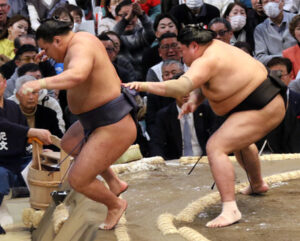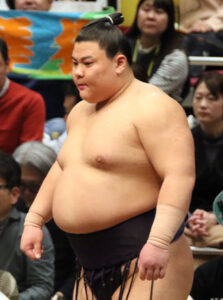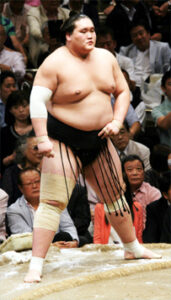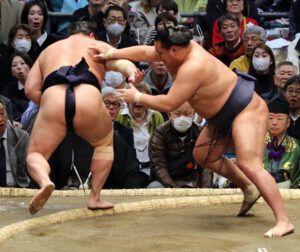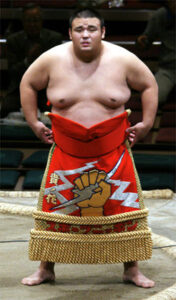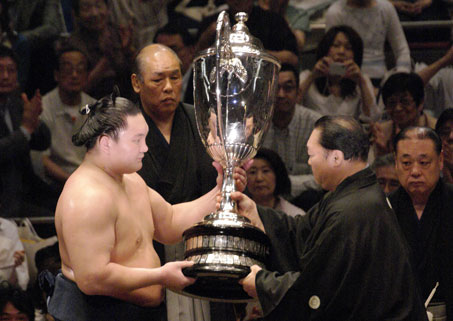
A yokozuna is the highest rank in professional sumo — the grand champion who stands above every other wrestler on the ranking sheet. Unlike the ranks below it, a yokozuna can never be demoted: a grand champion who can no longer perform at the level the title demands is expected to retire rather than slip down the order. As of October 2026 there are two active grand champions, Hoshoryu and Onosato, while Terunofuji has retired. This guide explains what a yokozuna is, how a wrestler is promoted, the records that define the rank, and the ceremonies that set a grand champion apart.
Yokozuna is the highest rank in sumo. No rank sits above the grand champion.
It is the only rank that cannot be demoted. A yokozuna who can no longer perform is expected to retire instead.
Promotion needs strength and dignity. The custom is two consecutive top-division championships or an equivalent record, judged alongside hinkaku — the dignity befitting a champion.
Hakuho holds the record with 45 championships. That is 13 clear of Taiho’s 32 and includes a record 16 perfect 15-0 titles.
The rope is the symbol. Only a yokozuna wears the white tsuna rope and performs the grand champion’s own ring-entering ceremony.
What a yokozuna is
Professional sumo ranks its wrestlers on a list called the banzuke. A wrestler climbs that list by winning, and falls back down it by losing. At the top of the salaried ranks sit the named titleholders — and above them all stands the yokozuna, the grand champion. The word is often translated as “grand champion,” and the rank represents the pinnacle of a sumo career. Most wrestlers, however accomplished, never reach it.
What makes the rank unusual is that it is more than a measure of results. A yokozuna is treated as the public face of sumo, expected to carry himself with composure and grace both on and off the dohyo, the raised clay ring. That expectation — captured by the Japanese word hinkaku, meaning dignity or class — is woven into how the rank is awarded and how a grand champion is judged once he holds it.
Two wrestlers hold the rank today. Hoshoryu and Onosato are the current grand champions, ranked on the East and West, after Terunofuji retired. Onosato is the first wrestler from the collegiate (student-sumo) ranks to reach yokozuna since Wajima, who took the title in July 1973 — a gap of more than half a century. Both men posted 11-4 in their first tournament as a new yokozuna.
The only rank you cannot be demoted from
For every other rank in sumo, the rule is simple: win and you rise, lose and you fall. A wrestler at the second-highest rank of ozeki who puts together poor tournaments can be pushed back down the ladder. The yokozuna is the single exception. Once a wrestler is promoted, the rank is his for the rest of his career — it cannot be taken away by a losing run.
That protection comes with a heavy obligation. Because a grand champion cannot be demoted, the burden falls on him to step away when he can no longer compete at the standard the title demands. A yokozuna who suffers a long decline, through injury or age, is expected to retire rather than continue at a level beneath the rank. In practice this means a grand champion’s career ends not with a slide down the rankings but with a decision to retire — a defining feature of what it means to wear the title.
This principle has a clear historical origin. In 1950 the Japan Sumo Association first decided that a yokozuna who lost two tournaments in a row would be demoted to ozeki. The public reaction was fierce: the prevailing view was that a yokozuna is not merely a champion but a figure who, once his strength fades, should retire rather than be demoted. The Association reversed the demotion rule, and out of that episode the Yokozuna Deliberation Council was created the same year. The “cannot be demoted, expected to retire” custom that defines the rank today traces directly back to it.
How a wrestler is promoted to yokozuna
There is no automatic promotion to yokozuna. A wrestler must already hold the rank of ozeki to be considered, and from there the path runs through two bodies: the Yokozuna Deliberation Council, an advisory panel of figures from outside the sumo world, and the Japan Sumo Association itself. The order matters. The Association first refers a promotion candidate to the Council; only after the Council approves does the Association make the final decision. You can follow the mechanics in detail in our guide to yokozuna promotion.
The benchmark most often cited is winning two consecutive top-division championships, or putting together a comparable record that shows the same dominance. This is an unwritten custom operated by the Council rather than a codified numerical rule, and the wording — results “equivalent” to two straight titles — leaves room for judgment. History bears that out. Futahaguro was promoted without winning a single championship at all, while Kagamisato, Yoshibayama, Kashiwado, Wakanohana II, Mienoumi, Onokuni, Kakuryu and Kisenosato all reached the rank on the strength of just one (first) top-division title. Those exceptions are exactly why the “or an equivalent record” wording exists, and why the Council’s judgment carries weight.
Crucially, raw results are not the whole story. A candidate is also weighed on hinkaku: the dignity, conduct and bearing expected of someone who will represent the sport. A wrestler can be the strongest competitor of his day and still be held back if the Council is not satisfied that he carries himself as a grand champion should. Because the bar combines sustained winning with this question of character, promotions are infrequent and closely followed. When a wrestler does break through, it is a major event in the sumo calendar — as it was when Onosato and Hoshoryu joined the rank as the sport’s current grand champions, and earlier when names like Terunofuji reached the title before stepping away from competition.
The white rope and the ring-entering ceremony
The most visible mark of the rank is the tsuna, the thick white rope a yokozuna wears tied around his waist. It is from this rope that the rank takes its name, and only a grand champion is permitted to wear it. The rope is reserved for ceremony rather than the bouts themselves, and seeing it worn is one of the clearest signals to spectators that they are watching the sport’s highest rank.
The rope is central to the dohyo-iri, the ring-entering ceremony. While wrestlers of the top division perform their own group ring-entering ritual, the yokozuna has a distinct ceremony performed alone, accompanied by two attendants. Wearing the white rope, the grand champion steps onto the dohyo and goes through a sequence of stylised movements — clapping, raising his arms, and stamping — that combine to present the champion before the crowd.
The ceremony comes in two styles, distinguished by how the grand champion holds his arms as he rises. In the Unryu style he extends the right arm while keeping the left hand to his body; in the Shiranui style he spreads both arms wide on the rise. Hoshoryu and Onosato both perform the Unryu style, while the retired Terunofuji performed the Shiranui. The names themselves carry a caveat worth knowing: the modern way of attributing these two styles traces only to the critic Kozo Hikoyama in 1941, and the historical basis for the labels is uncertain. The ceremony is one of the most recognisable images in all of sumo, and for many spectators it is the moment that captures what the rank means — not just the strongest wrestler in the ring, but its ceremonial figurehead.
The greatest yokozuna and the rank’s records
The rank stretches back across the long history of professional sumo, and each grand champion brings his own story to the title. Some are remembered for towering records, others for the way they carried the rank or for the era they defined. Hakuho stands among the greatest wrestlers the sport has ever produced, and the numbers explain why.
Hakuho holds the all-time record of 45 top-division championships — 13 clear of Taiho’s 32, and more than double Takanohana’s 22. He reached his 40th title at the age of 32 and took his final, 45th championship in July 2021. His durability set him apart as much as his winning: across a career spanning 20 years and 5 tournaments he made 65 full tournaments as a yokozuna against 19 absences, far more than Taiho’s 45 or Chiyonofuji’s 47 full yokozuna tournaments. He also recorded 16 perfect 15-0 championships (zensho-yusho), the most of the six-tournaments-a-year era, and his run of four consecutive perfect titles is second only to Futabayama’s five.
The rank’s history reaches back to its very first holders, too. The Japan Sumo Association recognises Akashi Shiganosuke as the first yokozuna — a designation it inherited from the bakumatsu-era yokozuna Jinmaku Kyugoro, who named Akashi as the first when he erected the yokozuna stone monument, even though Akashi has no record of ever receiving a yokozuna license. In those early days the license was not reserved for the top ozeki at all: Tanikaze and Onogawa both received their yokozuna licenses while ranked at sekiwake. As for sheer size, the heaviest grand champion in history was Musashimaru at 237 kg, ahead of Akebono at 235 kg and Onokuni at 203 kg — the only three to top 200 kg — while the lightest include Tochigiyama at 103 kg, Wakanohana I at 108 kg and Tochinoumi at 110 kg.
Rather than reduce a history this rich to a single line, the best way to understand the rank is to follow the grand champions themselves — from the current yokozuna shaping the sport today to the legends who came before them.
The yokozuna rank is unusual in being unable to fall. Every other titled rank can be taken away, and for ozeki there is a named rule for it: see kadoban.
Every yokozuna since 1958
Sumo has had 75 grand champions in all, and the Japan Sumo Association numbers them in one unbroken line from Akashi Shiganosuke. The table below takes the modern part of that list — every wrestler promoted since the six-tournament calendar settled into place in 1958 — with the association’s own figures for how long each man held the rank and how many top-division championships he won. The 45th grand champion, Wakanohana, is where that era starts. Blank cells are blank in the source.
| No. | Yokozuna | Birthplace | Held the rank | Top-division titles |
|---|---|---|---|---|
| 45 | Wakanohana 若乃花 | Hirosaki, Aomori | March 1958 – March 1962 | 10 |
| 46 | Asashio 朝潮 | Tokunoshima, Oshima District, Kagoshima | May 1959 – November 1961 | 5 |
| 47 | Kashiwado 柏戸 | Tsuruoka, Yamagata | November 1961 – July 1969 | 5 |
| 48 | Taiho 大鵬 | Teshikaga, Kawakami District, Hokkaido | November 1961 – May 1971 | 32 |
| 49 | Tochinoumi 栃ノ海 | Inakadate, Minamitsugaru District, Aomori | March 1964 – November 1966 | 3 |
| 50 | Sadanoyama 佐田の山 | Shin-Kamigoto, Minamimatsuura District, Nagasaki | March 1965 – March 1968 | 6 |
| 51 | Tamanoumi 玉の海 | Gamagori, Aichi | March 1970 – September 1971 | 6 |
| 52 | Kitanofuji 北の富士 | Asahikawa, Hokkaido | March 1970 – July 1974 | 10 |
| 53 | Kotozakura 琴櫻 | Kurayoshi, Tottori | March 1973 – May 1974 | 5 |
| 54 | Wajima 輪島 | Nanao, Ishikawa | July 1973 – March 1981 | 14 |
| 55 | Kitanoumi 北の湖 | Sobetsu, Usu District, Hokkaido | September 1974 – January 1985 | 24 |
| 56 | Wakanohana 若乃花 | Owani, Minamitsugaru District, Aomori | July 1978 – January 1983 | 4 |
| 57 | Mienoumi 三重ノ海 | Matsusaka, Mie | September 1979 – November 1980 | 3 |
| 58 | Chiyonofuji 千代の富士 | Fukushima, Matsumae District, Hokkaido | September 1981 – May 1991 | 31 |
| 59 | Takanosato 隆の里 | Aomori, Aomori | September 1983 – January 1986 | 4 |
| 60 | Futahaguro 双羽黒 | Tsu, Mie | September 1986 – November 1987 | 0 |
| 61 | Hokutoumi 北勝海 | Hiroo, Hiroo District, Hokkaido | July 1987 – March 1992 | 8 |
| 62 | Onokuni 大乃国 | Memuro, Kasai District, Hokkaido | November 1987 – July 1991 | 2 |
| 63 | Asahifuji 旭富士 | Tsugaru, Aomori | September 1990 – January 1992 | 4 |
| 64 | Akebono 曙 | Oahu, Hawaii, USA | March 1993 – January 2001 | 11 |
| 65 | Takanohana 貴乃花 | Nakano, Tokyo | January 1995 – January 2003 | 22 |
| 66 | Wakanohana 若乃花 | Nakano, Tokyo | July 1998 – March 2000 | 5 |
| 67 | Musashimaru 武蔵丸 | Oahu, Hawaii, USA | July 1999 – November 2003 | 12 |
| 68 | Asashoryu 朝青龍 | Ulaanbaatar, Mongolia | March 2003 – January 2010 | 25 |
| 69 | Hakuho 白鵬 | Ulaanbaatar, Mongolia | July 2007 – September 2021 | 45 |
| 70 | Harumafuji 日馬富士 | Gobi-Altai, Mongolia | November 2012 – November 2017 | 9 |
| 71 | Kakuryu 鶴竜 | Sukhbaatar, Mongolia | May 2014 – March 2021 | 6 |
| 72 | Kisenosato 稀勢の里 | Ushiku, Ibaraki | March 2017 – January 2019 | 2 |
| 73 | Terunofuji 照ノ富士 | Ulaanbaatar, Mongolia | September 2021 – January 2025 | 10 |
| 74 | Hoshoryu 豊昇龍 | Ulaanbaatar, Mongolia | March 2025 – present | 2 |
| 75 | Onosato 大の里 | Tsubata, Kahoku District, Ishikawa | July 2025 – present | 6 |
Frequently asked questions
Q. Who are the current yokozuna?
As of October 2026 there are two active grand champions, Hoshoryu and Onosato. Terunofuji, the previous yokozuna, has retired.
Q. Can a yokozuna be demoted?
No. Yokozuna is the only rank in sumo that cannot be demoted. A grand champion who can no longer perform at the level the rank demands is expected to retire rather than fall down the rankings. The Japan Sumo Association briefly introduced a demotion rule in 1950 but reversed it after a public backlash.
Q. How does a wrestler become a yokozuna?
A wrestler must already be an ozeki. The Japan Sumo Association refers the candidate to the Yokozuna Deliberation Council, and only after the Council approves does the Association make the final decision. The customary benchmark is two consecutive top-division championships or an equivalent record, judged alongside hinkaku.
Q. Who has the most yokozuna championships?
Hakuho, with 45 top-division championships — 13 more than Taiho’s 32. His total includes a record 16 perfect 15-0 titles.
Q. Why does a yokozuna wear a white rope?
The white rope, called the tsuna, is the symbol of the rank and gives it its name. Only a yokozuna may wear it, and it is worn for the grand champion’s own ring-entering ceremony, the dohyo-iri.
Q. What are the two ring-entering styles?
The Unryu style (right arm extended, left hand to the body) and the Shiranui style (both arms spread on the rise). Hoshoryu and Onosato perform Unryu; the retired Terunofuji performed Shiranui.
Photos by Michihiro Taguchi.