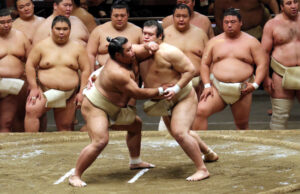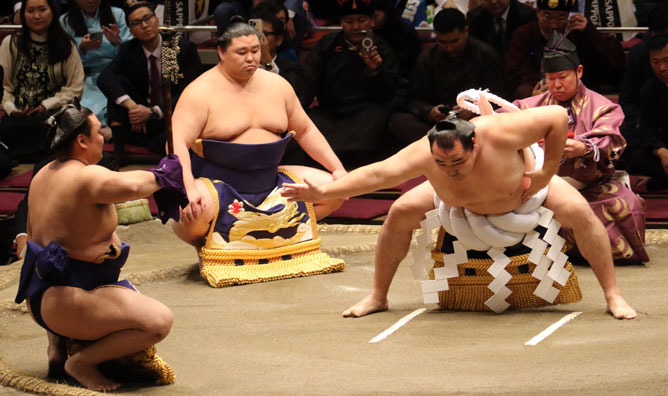
In a bout, a sumo wrestler wears exactly one thing: the mawashi, a silk or cotton belt wound around the waist and between the legs. The Japan Sumo Association describes the competition belt as heavy silk about 9 metres long and 80 centimetres wide, folded in six and wrapped around the waist four to seven times depending on the wrestler’s girth. Everything else you see — the embroidered apron in the ceremony, the white rope on the yokozuna, the fringe of cords across the front, the topknot — belongs to a specific occasion and a specific rank. This guide sets out every piece, who is allowed to wear it, and when.
One garment in competition. Nothing is worn under the mawashi. If it comes completely undone during a bout the wrestler is disqualified.
Rank decides almost everything. Silk belt or cotton, embroidered apron or none, ginkgo-leaf topknot or plain one — each is tied to where a man sits on the rankings.
The fringe in front is decoration. The stiffened cords, sagari, are silk stiffened with glue. They can fall off mid-bout and are simply discarded.
The yokozuna’s rope is worn by one rank only. A braided hemp tsuna of 11 to 15 kilograms, tied over the ceremonial apron.
The hair is part of the uniform. The association treats the topknot as rank dress, and notes it also cushions the head in a fall.
Every piece of sumo clothing, at a glance
Sumo has no kit bag. What a wrestler puts on is determined by two questions: what is happening right now, and what rank is he. The table below is the whole wardrobe in one view.
| Item | What it is | Worn when | Who wears it |
|---|---|---|---|
| Mawashi (fighting belt) | Heavy silk band, about 9 m by 80 cm, folded in six | Every bout | Every wrestler. Silk for the salaried ranks, plain cotton below |
| Keiko-mawashi | The sturdier training belt | Morning practice in the stable | Every wrestler |
| Sagari | Fringe of silk cords stiffened with glue, hung at the front of the belt | Every bout | Every wrestler |
| Kesho-mawashi | Embroidered silk apron with gold fringe | The ring-entering ceremony only | Juryo and above |
| Tsuna | Braided hemp rope, 11–15 kg, with zigzag paper strips at the front | The yokozuna’s solo ring-entering ceremony | Yokozuna only |
| Oicho-mage | Topknot spread into a ginkgo-leaf shape | In the ring and on formal occasions | Juryo and makuuchi |
| Chonmage | Plainer topknot tied with paper strings | All day, every day | The ranks below juryo |
| Montsuki haori-hakama | Formal crested Japanese dress | Formal occasions off the ring | Sekitori. A new one is made on promotion to juryo |
The mawashi: the only thing worn in a bout
The association’s own description is blunt: for their matches the wrestlers are naked except for a silk loincloth. There is nothing underneath it. The cloth is heavy silk roughly 9 metres long and 80 centimetres wide, folded in six and then wound around the waist four to seven times depending on how big the man is.
The belt is not only clothing. Of sumo’s 82 winning techniques, a large share are executed by manoeuvring an opponent with a grip on his mawashi, which is why the association says the belt may be considered to have determined the whole form of the sport. The full account of how it is wound, the grips it makes possible, and the rule that costs a wrestler the bout if it comes off is in our guide to the mawashi.
Rank shows in the cloth. The salaried top two divisions compete in silk, traditionally in a dark colour; below them the belt is plain cotton, usually black or deep indigo. Every wrestler also owns a separate, harder-wearing training belt, the keiko-mawashi, kept for the morning practice in the stable.
Sagari: the cords hanging at the front
The row of stiff cords across the front of the belt is called sagari. The association describes them as silk stiffened with glue, and says plainly that they are ornamental. They sometimes come off during a match and can simply be discarded — which is why you see them scattered on the clay after a violent exchange while nobody stops the bout to retrieve them.
Because the cords are glued rigid rather than left to hang soft, they keep their fan shape as a wrestler moves and swing back into line after each charge. That is the entire function. They are not a grip, not a target, and no rule attaches to them.
The kesho-mawashi: the apron for the ceremony
Before the top-division bouts, the wrestlers file into the ring for the dohyo-iri wearing embroidered aprons. These are kesho-mawashi: silk, richly embroidered with individual designs, hemmed with gold fringe. The association puts the cost at upwards of approximately one million yen apiece.
Nobody wrestles in one. The apron is for display, and the right to wear it starts at juryo — the point at which a wrestler joins the ring-entering ceremony at all. Who pays for it, why a newly promoted man needs one before he can take his place, and what the designs mean are covered in our guide to the kesho-mawashi.
The tsuna: the yokozuna’s rope
One rank wears something no one else may. Over his kesho-mawashi, the yokozuna ties a large braided hemp rope — the tsuna — usually weighing between 11 and 15 kilograms, knotted in a bow at the back and ornamented at the front with strips of paper hanging in zigzag patterns.
Those paper strips are not a sumo invention. The association points out that the same symbol hangs in Shinto shrines, and in homes above the kamidana, the shelf of the gods where offerings are made at New Year. The rope announces that the man wearing it is, for the duration of the ceremony, closer to a shrine ornament than to an athlete. He performs the ceremony alone, attended by a sword bearer and a forerunner, both of whom wear ordinary kesho-mawashi.
The hair counts as part of the uniform
Sumo is the rare sport where a hairstyle is regulated by rank. The association states it directly: the rank of a wrestler determines the style in which his long hair is arranged.
| Rank | Style | How it is finished |
|---|---|---|
| Makuuchi and juryo | Oicho-mage | The end of the topknot is spread across the crown into the shape of a ginkgo leaf |
| Makushita and below | Chonmage | A plainer style, tied with paper strings |
Both styles descend from the fashions of the Edo period. The association gives two reasons they survived: tradition, and the fact that a bound topknot serves as head protection in the event of a fall. Our guide to the chonmage covers how the hair is grown, tied and finally cut off at retirement, and our guide to the tokoyama covers the hairdressers who do the work.
What the officials wear
The men around the ring are dressed by rule too. The referees, the gyoji, wear kimono patterned after the style worn by samurai of the Kamakura period some 800 years ago, with a black court hat of gauze that resembles a Shinto priest’s. Their rank is legible at a glance in the colour of the tassel on the fan, and in whether they wear split-toe tabi socks and straw zori or go barefoot. The five judges seated around the ring, the shimpan, wear formal black kimono. The detail of who wears what is set out in our guide to the gyoji and shimpan.
Away from the ring
A wrestler does not change into ordinary clothes when he leaves the arena. One former wrestler, quoted in Taguchi’s archive, sums up the life a recruit walks into: hair dressed with scented oil and tied into a topknot, traditional Japanese dress whenever he goes out, and setta or zori sandals on his feet — an existence, as he puts it, particular from the head down to the toes. Reaching juryo changes what that dress looks like. On promotion, a new sekitori has a fighting belt, a kesho-mawashi and a set of crested montsuki haori-hakama made for him, and starts drawing a monthly salary at the same time.
That wardrobe is also the reason sumo announces juryo promotions when it does. As Michihiro Taguchi records, promotions to juryo have been announced after the tournament, rather than waiting for the rankings to be published, since the July 1971 tournament — precisely so a newly promoted man has time to have all of it made. The point is not ceremony. Wrestlers below juryo draw no salary, so the cost of a first kesho-mawashi normally falls to a support group, a former school, or a sponsor. Taguchi’s own view of that arrangement is sharp: the association hands over the status of sekitori and leaves the outfitting to other people.
Frequently Asked Questions
What is a sumo wrestler’s outfit called?
The belt worn in competition is the mawashi, and in a bout it is the only garment a wrestler has on. The embroidered apron worn for the ring-entering ceremony is a separate item called the kesho-mawashi, and the fringe of stiffened cords across the front of the fighting belt is called sagari.
Do sumo wrestlers wear anything under the mawashi?
No. The Japan Sumo Association’s own description of a bout is that the wrestlers are naked except for the silk loincloth. The belt is wound around the waist four to seven times and passed between the legs, and nothing is worn beneath it.
How long is a sumo mawashi?
About 9 metres, in heavy silk about 80 centimetres wide, according to the association. It is folded in six before being wound, and goes around the waist four to seven times depending on the wrestler’s girth.
What are the strings hanging from a sumo wrestler’s belt?
They are sagari. The association describes them as silk stiffened with glue, purely ornamental, and notes that they sometimes come off during a match and can be discarded. No rule governs them and they play no part in the grappling.
Why do only some sumo wrestlers wear the embroidered apron?
Because the kesho-mawashi belongs to the ring-entering ceremony, and only wrestlers ranked juryo and above take part in it. Below that rank there is no ceremony to dress for, so there is no apron.
How heavy is the yokozuna’s rope?
Usually between 11 and 15 kilograms. It is braided from hemp, tied in a bow at the back, and hung at the front with strips of paper folded in zigzags — the same Shinto symbol found at shrines. Only a yokozuna may wear it.
Why do sumo wrestlers wear their hair in a topknot?
The styles come from the Edo period and were kept for two reasons. One is tradition. The other, which the association states explicitly, is that the bound hair serves as head protection when a wrestler falls. Makuuchi and juryo wear the fanned oicho-mage; the ranks below wear a plainer chonmage tied with paper strings.
Sources
The mawashi dimensions and winding, the description of the sagari, the cost and materials of the kesho-mawashi, the weight and construction of the tsuna, the topknot styles by rank, and the referees’ and judges’ dress are all from the Japan Sumo Association’s official English introduction, Sumo (sumo.or.jp/pdf/en/sumo_introduction.pdf). The July 1971 change to the timing of juryo promotion announcements, the outfitting a new sekitori has to arrange, and the funding of a first kesho-mawashi come from the archive of Michihiro Taguchi at Dohyo no Mokugekisha (dohyounomokugekisya.net), “早めの十両昇進発表の意味” and “令和新十両事情“. Retrieved August 3, 2026.
Photo by Michihiro Taguchi.