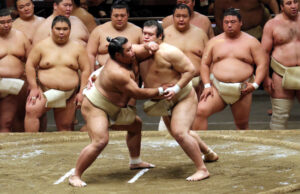
Kadoban is the tournament in which an ozeki’s rank is on the line. An ozeki who finishes a tournament with a losing record enters the next one as kadoban. If he posts a winning record there, the flag is cleared and nothing happens. If he loses again, he is demoted to sekiwake. A demoted ozeki gets one immediate chance to take the rank straight back: ten or more wins in the very next tournament restores it.
Two losing records in a row costs the rank. Not one. The first losing record only puts the ozeki on notice; the second one demotes him.
Kadoban is the notice, not the punishment. The word describes the tournament an ozeki fights while carrying that first losing record. Clearing it takes eight wins.
There is a ten-win door back. A demoted ozeki who wins ten of fifteen in the tournament immediately after demotion is restored. The provision has been in force since the July 1969 tournament.
Sitting out does not protect you. Absences are counted as losses, so an ozeki who withdraws from a whole tournament finishes with a losing record and goes kadoban.
Yokozuna have no equivalent. The top rank cannot be demoted at all. A yokozuna who keeps losing is expected to retire instead.
What does kadoban mean?
Kadoban (角番) describes an ozeki fighting a tournament he cannot afford to lose. He got there by finishing the previous tournament with more losses than wins. That first losing record does not cost him anything by itself. It sets up the next fifteen days, in which a second losing record will.
Ozeki is the second-highest rank in sumo and the highest one you can be demoted from. Everything below it moves up and down the rankings every two months according to results. Everything about ozeki is designed to make the rank sticky — you have to fail twice in a row to lose it — but sticky is not permanent, and the kadoban tournament is where the stickiness runs out.
The line between a winning and a losing record is the same one that governs every wrestler in the top two divisions: eight wins out of fifteen days is kachikoshi, a winning record, and eight losses is make-koshi. An ozeki at 8-7 is safe. An ozeki at 7-8 is kadoban next time out.
How the kadoban rule works, tournament by tournament
The whole system is a two-step sequence with one escape hatch at the end.
| Where the wrestler stands | How the tournament ends | What happens next |
|---|---|---|
| Ozeki, rank secure | Winning record (8-7 or better) | Nothing. Still ozeki, still secure. |
| Ozeki, rank secure | Losing record (7-8 or worse) | Goes into the next tournament as kadoban. |
| Kadoban ozeki | Winning record | Kadoban cleared. Back to a secure ozeki. |
| Kadoban ozeki | Losing record | Demoted to sekiwake. |
| Demoted ex-ozeki, ranked sekiwake | Ten or more wins | Ozeki restored immediately. |
| Demoted ex-ozeki, ranked sekiwake | Nine wins or fewer | The door closes. He has to climb back the long way. |
Two details in that table trip people up. The first is that clearing kadoban resets the counter completely — an ozeki who goes 7-8, then 8-7, then 7-8 again is never in danger, because the losing records are not consecutive. The second is that the ten-win door is open for exactly one tournament. Miss it and the wrestler is an ordinary sekiwake with no special claim on the rank.
Does withdrawing from a tournament count?
Yes, and this is where the rule bites hardest. Days missed through injury are recorded as losses, so an ozeki who withdraws early enough finishes with a losing record and is kadoban whether he fought or not. An ozeki who sits out an entire fifteen-day tournament is credited with fifteen losses.
Musoyama is the sharpest illustration in the archive. He missed his entire first tournament as a new ozeki, managed four wins in the next one, and had surrendered the rank inside two tournaments. He then took it straight back with 10-5 and held it for the rest of his career.
Because sumo has no injured list and no way to pause a career, this makes ozeki a punishing rank to hold. A wrestler who tears something in the first week of one tournament and has not healed by the start of the next is, through no fault of his form, two tournaments from demotion.
Where the rule came from
The demotion rule has been rewritten more than once. When sumo moved to six tournaments a year, the threshold was loosened from two consecutive losing records to three. That was judged too lenient and the rule went back to two consecutive losing records — and at the same time, as a counterweight, the ten-win return provision was added. Both changes took effect from the July 1969 tournament.
The trade in that revision is worth noticing. Tightening the demotion rule alone would have made ozeki a fragile rank in a six-tournament calendar. Pairing it with an immediate route back kept the punishment sharp without making it final. The result is the rule sumo still runs on: fail twice and you lose the rank, but win big once and you have it back.
What happens to demoted ozeki
The ten-win door is narrower than it sounds. A wrestler is offered it in the tournament immediately after demotion, which is often the tournament in which whatever broke him has not yet healed. Taguchi’s archive sorts the demoted ozeki since July 1969 by what became of them, and the categories are instructive.
| Outcome | Wrestlers | Note |
|---|---|---|
| Took the rank back, then rose to yokozuna | Mienoumi | The first wrestler to use the return provision successfully |
| Demoted twice, restored both times | Tochiazuma | The only wrestler to manage this |
| Took the rank back and held it to the end | Musoyama | Lost the rank in two tournaments, returned 10-5 |
| Restored once, then lost the rank again | Takanonami, Tochinoshin | Takanonami’s two demotions came only two tournaments apart |
| Climbed back from far down the banzuke | Kaiketsu, Terunofuji | Long returns made after the ten-win window had closed |
| Retired at or soon after demotion | Kotokaze, Chiyotaikai, Kotoshu, Kotooshu | Chiyotaikai retired during a tournament in which he needed ten wins |
The last category is the honest one. For a wrestler in his thirties whose body has already given the warning that produced the losing records, a demotion is frequently the end rather than a setback. The rank asks for double-digit wins on demand from a man whose knees have just told him he cannot supply them.
The long climb back is rarer still. Kirishima joined that short list in March 2026, winning the tournament from below and taking the rank back after eleven tournaments ranked at sekiwake and lower, at one point as far down as maegashira 2.
Why yokozuna have no kadoban
The rank above ozeki works on a completely different principle. The Japan Sumo Association is explicit that the yokozuna, alone among the ranks, can never be demoted no matter how badly a tournament goes. A yokozuna who keeps turning in poor records is not dropped down the rankings; he is expected to retire.
That contrast explains why ozeki is the hardest rank in sumo to sit in. A yokozuna who is struggling can withdraw and heal without losing his position. An ozeki in the same state is counting down. The difference in the two rules is also why promotion to yokozuna is guarded so carefully: once the rope is tied, the sport has no mechanism to take it away.
For the rank itself — what an ozeki is, how you get promoted to it, and what the job involves — see our guide to ozeki.
Kadoban is one of several sumo terms that describe a mechanism rather than a thing, which is why they resist translation. The rest are collected in our glossary of sumo terms.
Frequently asked questions
What does kadoban mean in sumo?
Kadoban is the status of an ozeki fighting a tournament with his rank at risk. He earned it by finishing the previous tournament with a losing record. A winning record clears the status; a second losing record demotes him to sekiwake.
How many losing records does it take to demote an ozeki?
Two in a row. One losing record makes an ozeki kadoban for the following tournament, and only a second consecutive losing record costs him the rank. If he posts a winning record in between, the count resets and he is secure again.
Can a demoted ozeki get the rank back?
Yes, but only in the tournament immediately after demotion, and only with ten or more wins out of fifteen. That provision has been in force since the July 1969 tournament. If he wins nine or fewer, the special route closes and he has to earn promotion again the ordinary way.
How many wins does a kadoban ozeki need?
Eight out of fifteen. Eight wins is a winning record in sumo’s top two divisions, and a winning record is all it takes to clear kadoban status, no matter how narrow. An ozeki who finishes 8-7 while kadoban is fully secure again.
Does an injured ozeki who sits out go kadoban?
Yes. Missed days are recorded as losses, so a withdrawal produces a losing record just as a run of defeats would. An ozeki who sits out a full fifteen-day tournament is credited with fifteen losses and enters the next tournament as kadoban. Our guide to kyujo, sitting out a tournament, sets out what an absence costs at every rank.
Do yokozuna go kadoban?
No. The Japan Sumo Association states that the yokozuna alone can never be demoted, whatever his record. There is no kadoban status at that rank. A yokozuna who continues to perform poorly is expected to retire rather than be ranked down.
Which rank does a demoted ozeki drop to?
Sekiwake, the rank directly below ozeki. From there he either takes the rank straight back with ten wins in that one tournament, or rejoins the ordinary promotion system and has to work his way up again like anyone else.
Sources
The demotion and restoration rules, the July 1969 effective date, the rule’s revision history, and the case-by-case record of demoted ozeki come from the archive of Michihiro Taguchi at Dohyo no Mokugekisha, “大関の降格・陥落の条件” (dohyounomokugekisya.net). The yokozuna’s exemption from demotion is from the Japan Sumo Association’s official English introduction, Sumo (sumo.or.jp). Retrieved August 3, 2026.
Photo by Michihiro Taguchi.