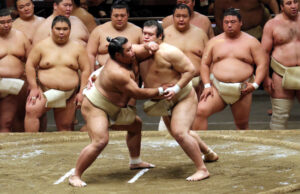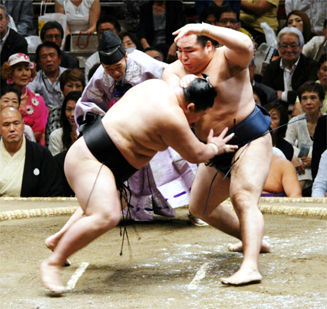
The tachiai is the initial charge that opens every sumo bout. From a crouch behind their lines, both wrestlers put both fists on the clay, then spring forward and collide. It must be synchronized; charging early triggers a matta, a false start that resets the action.
The tachiai is the opening charge. Two wrestlers explode out of their crouch and slam into each other to begin a bout, and the rest of the match flows from that first collision.
Both fists must touch the clay. Each wrestler must set both fists on the ground behind their lines before either may charge, which synchronizes the start so neither jumps first.
A matta is a false start. If a wrestler charges early or the two are not in sync, the gyoji and shimpan stop the action and reset the tachiai.
The first collision often decides the bout. A wrestler who hits lower, faster, and on better timing can drive under the opponent or knock them off balance before the match has really started.
A henka is legal but frowned upon. Sidestepping the charge instead of meeting it head-on is within the rules, yet it is widely seen as unsporting, especially from a high-ranked wrestler.
What the tachiai is
The tachiai (the initial charge) is the moment two sumo wrestlers explode out of their crouch and slam into each other to begin a bout. Everything before it is preparation; the rest of the match flows from how that first collision goes.
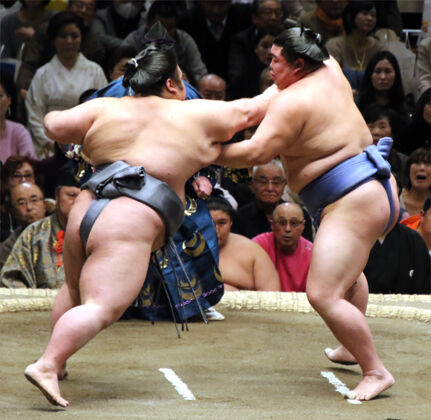
Both wrestlers start behind their own shikiri-sen (the two parallel starting lines marked on the clay). They drop into a crouch, set both fists on the ground, and launch forward together. The bout is live only once both have touched down and risen as one. For how a match is won and lost after that, see our guide to the rules of sumo.
Both fists down: the rule that makes it fair
The tachiai has one non-negotiable condition. Both wrestlers must put both fists on the clay behind their lines before either may charge. This shared touchdown is what synchronizes the start. Neither wrestler gets to jump first.
If a wrestler charges early, or the two are simply not in sync, it is a matta (a false start). The gyoji (the in-ring referee) and the shimpan (the ringside judges) stop the action and reset the tachiai. You can read more about who these officials are and what they control in our guide to the gyoji and shimpan.
Why timing is everything
Because both fists must be down and both wrestlers must rise together, the tachiai becomes a contest of timing as much as power. Each wrestler watches the other, reads the breath and the shift of weight, and tries to launch at the exact moment that gives an edge: lower, faster, and squarer than the opponent.
The build-up: shikiri and salt
The minutes before the charge are not dead time. They are shikiri (the pre-bout face-off), when the two wrestlers crouch, glare, step back, throw salt, and crouch again. This is a set preparation period, and how long it lasts differs by division. The wrestlers use it to settle their breathing and time the eventual launch.
The salt-throwing and the rest of the ceremony around the bout carry their own meaning, covered in our guide to the salt and pre-bout ritual.
Why the tachiai often decides the bout
Sumo can look like it is over in a blink, and the tachiai is the reason. Many bouts are effectively decided in this first collision. A wrestler who hits lower drives under the opponent’s center of gravity. One who hits faster and on better timing can knock the other upright or off balance before the match has really started.
From that opening contact, a wrestler works toward a finishing move. The catalogue of those finishes is enormous; see our guide to kimarite, the winning techniques.
Tachiai outcomes at a glance
| Term | Romaji meaning | What happens |
|---|---|---|
| Tachiai | the initial charge | Both wrestlers spring up and collide to start the bout |
| Matta | a false start | One charges early or they are out of sync; the gyoji and shimpan reset |
| Henka | a sidestep | A wrestler dodges at the charge instead of meeting it head-on |
The henka: legal but frowned upon
A henka is a sidestep at the tachiai. Instead of meeting the opponent’s charge head-on, a wrestler steps aside and lets the other rush past, sometimes off balance or out of position. It is within the rules. It is also widely seen as unsporting, and the criticism is sharpest when a high-ranked wrestler uses it, since fans and elders expect the top ranks to win by meeting force with force.
How to watch the tachiai
Next time you watch, do not blink as the wrestlers settle. Watch the fists hit the clay, watch them rise together, and watch who wins the half-second of timing. That half-second often tells you who is about to win.
From the moment of the charge, the referee narrates the bout out loud. The two calls he alternates between are explained in hakkeyoi and nokotta.
Frequently asked questions
What is the tachiai in sumo?
The tachiai is the initial charge that begins every sumo bout. Both wrestlers crouch behind their lines, put both fists on the clay, then spring forward and collide. The bout is live only once both have touched down and risen together.
Why do both wrestlers have to put their fists down before charging?
Putting both fists on the clay behind the starting lines is the rule that synchronizes the start, so neither wrestler launches first. The bout begins only when both have touched down and risen together. If they are not in sync, it is a false start.
What is a matta?
A matta is a false start at the tachiai. It happens when a wrestler charges early or the two are not synchronized. The gyoji (referee) and shimpan (ringside judges) stop the action and reset the tachiai before the bout begins again.
What is a henka, and is it allowed?
A henka is a sidestep at the tachiai, dodging the opponent’s charge instead of meeting it head-on. It is legal under the rules, but it is widely seen as unsporting, especially when used by a high-ranked wrestler.
Why is the tachiai so important?
Many bouts are effectively decided in this first collision. A wrestler who charges lower, faster, and with better timing than the opponent gains a decisive edge, which is why so much of sumo training and strategy focuses on the tachiai.
What happens in the minutes before the tachiai?
That time is the shikiri, the pre-bout face-off. The wrestlers crouch, glare, throw salt, and reset, using a set preparation period that differs by division to ready themselves and time the charge.