“Nokotta” means “still in” and “hakkeyoi” is a call to get moving. The referee shouts nokotta, nokotta while the two wrestlers are actively fighting, to tell them the bout is still live and neither has been put out. He switches to hakkeyoi when the action stalls and the pair lock up without moving, urging them to push on. Both calls come from the gyoji, the referee inside the ring.
Two calls, two situations. Nokotta while the wrestlers move, hakkeyoi when they stop moving. Once you hear the difference, you can follow a bout with your eyes closed.
Nokotta is plain Japanese. 残った is the past tense of “to remain” — you are still in, you have not gone out or gone down.
The referee never stops talking. The Japan Sumo Association describes the gyoji as keeping “an ever-watchful eye” on the wrestlers “while shouting words of encouragement” through the bout.
The chant before the bout is someone else. The long, rising call of the two names comes from a yobidashi, the ring attendant, not the referee.
The last word is not a shout. The bout ends when the gyoji points his war-fan at the winner and names the technique that decided it.
What does “nokotta” mean?
Nokotta (残った) is the past tense of the Japanese verb nokoru, to remain. On the dohyo it carries one meaning: you are still in this. Neither wrestler has stepped over the straw bales, neither has touched the clay with anything but the soles of his feet, so the bout goes on.
You hear it most often doubled and rapid — nokotta, nokotta, nokotta — as two men wheel around the ring with one of them backed onto the bales. It is the referee narrating the danger. Every repetition says the same thing: not yet, not yet, not yet. When the call stops, the bout is over.
That is why the word lands hardest at the edge of the ring. A wrestler bent backward over the straw with his heels a centimetre from the sand is, at that instant, still in. The referee is telling him so, and telling the crowd so at the same time.
What does “hakkeyoi” mean?
Hakkeyoi is the other call, and it does the opposite job. The referee uses it when the bout has gone still — when both wrestlers have a grip on the belt, have set their feet, and have settled into a standoff where neither wants to move first. Hakkeyoi is the push. Get on with it. Put something into it.
The word is usually written 発気揚々 and is commonly explained as an exhortation to summon your spirit and raise it. Several origin stories circulate for it, and the Japan Sumo Association’s own English primer does not settle the question, so treat the etymology as unsettled and the usage as certain. What the call does on the dohyo is not in doubt at all.
A single bout will often use both. The wrestlers charge, the referee calls nokotta as they trade position, the bout locks into a belt grip and goes quiet, the referee switches to hakkeyoi, one of them breaks the deadlock, and nokotta comes back. The soundtrack tracks the shape of the fight.
Hakkeyoi vs. nokotta: which one and when
The simplest way to keep them apart is to watch the wrestlers’ feet rather than listen to the words.
| Call | Japanese | Literal sense | When you hear it |
|---|---|---|---|
| Nokotta | 残った | “Remained” — still in | While the wrestlers are moving: pushing, wheeling, backed onto the bales |
| Hakkeyoi | 発気揚々 | Commonly read as “summon your spirit” | When the action stalls and the two lock up without moving |
Because most top-division bouts are decided in a few seconds of continuous movement, nokotta is by far the more common of the two. Hakkeyoi belongs to the longer bouts, the grinding belt battles where two wrestlers of similar strength cancel each other out.
Who is actually shouting?
The voice belongs to the gyoji, the referee in the lacquered black hat and the samurai-era kimono, who stands inside the ring for the whole bout. The Japan Sumo Association describes his job plainly: he signals the start of the bout with his fan and then “keeps an ever-watchful eye on their movements while shouting words of encouragement.”
Newcomers often credit the wrong man. The long, drawn-out chant of the two names that comes before the bout is not the referee at all — that is a yobidashi, the ring attendant, who steps onto the clay with a folding fan, calls the pairing up, and then leaves the ring to the referee. The gyoji also says the names once the wrestlers are in the ring, but in a different, clipped register.
The referee is not the final authority either. Five ringside judges sit around the dohyo, and they can overrule him. How that works is covered in our guide to the gyoji and shimpan and, for the review conference itself, our guide to the mono-ii.
The rest of the soundtrack of a bout
Hakkeyoi and nokotta are the two calls you will hear most, but they sit inside a longer sequence. Following the whole arc makes the ritual legible.
| Moment | Who | What happens |
|---|---|---|
| Before the bout | Yobidashi | Steps up with a fan and calls the two names in a long, rising chant |
| In the ring, before the charge | Gyoji | Announces the pairing, then oversees the staring-down ritual as the wrestlers crouch, rise, throw salt and return |
| The charge | Gyoji | Signals with the war-fan and the two wrestlers launch at each other |
| During the bout, moving | Gyoji | “Nokotta, nokotta” — still in |
| During the bout, stalled | Gyoji | “Hakkeyoi” — get moving |
| The finish | Gyoji | Points the gunbai war-fan at the winner and names the deciding technique |
| If the call is doubted | Shimpan | The five ringside judges climb up for a mono-ii and may uphold, reverse, or order a rematch |
The pre-bout staring-down sequence has its own name and its own clock — makuuchi wrestlers get four minutes of it — and it is explained in our guide to the shikiri. The launch itself is the tachiai, and the technique the referee names at the end is one of the 82 official kimarite.
Why the calls matter to a new viewer
Sumo gives a newcomer very little to hold on to. There is no clock on the wall, no score, no commentary you can follow if you do not speak Japanese. What there is, is a referee describing the state of the bout out loud, continuously, in two words.
Learn those two and the arena stops being noise. Nokotta means the thing you are watching has not finished. Hakkeyoi means it has gone quiet and someone needs to break it. Silence from the referee means it is over, and the fan is about to point.
Once those two are second nature, the rest of the vocabulary follows quickly. Our glossary of sumo terms gives every word you will hear on a broadcast in one line each.
Frequently asked questions
What does the sumo referee shout?
Mainly two things. He calls “nokotta” while the wrestlers are moving, which means neither has been forced out or put down and the bout is still live. He calls “hakkeyoi” when the action stalls and the two lock up without moving, urging them to push on. Both come from the gyoji, the referee standing inside the ring.
What does nokotta mean in sumo?
Nokotta (残った) is the past tense of the Japanese verb meaning “to remain,” and on the dohyo it means “still in.” The referee repeats it while the wrestlers grapple to signal that neither has stepped over the straw bales or touched the clay, so the bout continues.
What does hakkeyoi mean?
Hakkeyoi is the referee’s call to get moving, used when a bout has gone still and the two wrestlers are locked up without making progress. It is usually written 発気揚々 and commonly explained as an exhortation to summon your spirit, though the etymology is debated. Its function on the dohyo is not: it tells the wrestlers to push on.
What is the difference between hakkeyoi and nokotta?
They describe opposite situations. Nokotta is for a bout in motion and means “you are still in.” Hakkeyoi is for a bout that has stopped moving and means “get on with it.” A single long bout often uses both, alternating as the wrestlers break a deadlock and settle into another one.
Is it “hakkeyoi” or “hakkiyoi”?
Both spellings appear in English writing about sumo because the call is delivered as a drawn-out shout rather than a crisp word, and different ears transcribe it differently. Hakkeyoi is the more common romanization. They refer to the same call.
Who chants the wrestlers’ names before the bout?
That is a yobidashi, the ring attendant, not the referee. He steps onto the ring holding a folding fan and calls the two names in a long, rising chant, then leaves the ring. Yobidashi also build and sweep the clay ring, carry the sponsor banners, and beat the tournament drum.
How does the referee announce the winner?
He stops calling, points his gunbai — the lacquered war-fan he carries throughout — toward the winning side, and names the technique that decided the bout. He is never permitted to call a draw. If the ringside judges doubt the decision, they climb into the ring for a conference called a mono-ii and can uphold it, reverse it, or order the bout fought again.
Sources
Japan Sumo Association, Sumo (official English introduction, sumo.or.jp), on the gyoji’s role during a bout and on the shikiri time limits. Retrieved August 3, 2026.
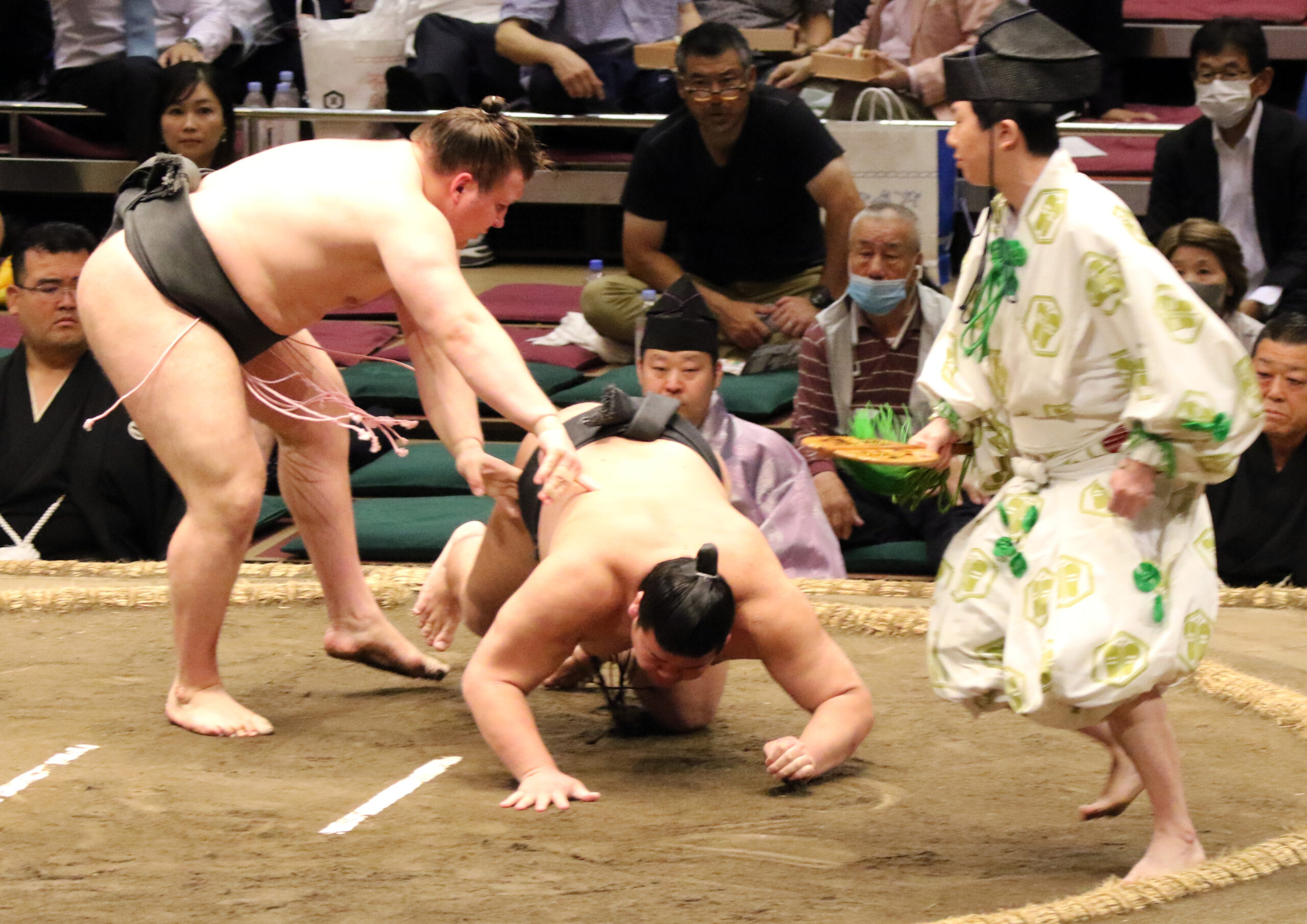
Photo by Michihiro Taguchi.