A kesho-mawashi is the embroidered silk apron a sumo wrestler wears for the ring-entering ceremony, and the Japan Sumo Association puts the cost at upwards of approximately one million yen. It is not the belt used in bouts. Nobody grapples in one. Only wrestlers ranked juryo and above own one, because only they take part in the ceremony — and most never buy their own. A first kesho-mawashi is usually paid for by a support group, a former school, or a sponsor, because a wrestler is still unsalaried right up to the moment he needs it.
About one million yen and up. That is the association’s own figure for a silk apron, richly embroidered and hemmed with gold fringe.
Juryo is the entry line. Wrestlers below juryo do not appear in the ring-entering ceremony, so they have no apron at all.
The wrestler rarely pays. Aprons are typically gifts from patrons, companies, hometown groups or an old school. A newly promoted man has been earning no salary at all.
It is the reason promotions are announced early. Juryo promotions have been announced right after a tournament since July 1971, specifically so a new sekitori has time to have the apron, the fighting belt and formal dress made.
The yokozuna wears a rope over his. The 11–15 kg braided tsuna goes over the kesho-mawashi, and only at the top rank.
What a kesho-mawashi is
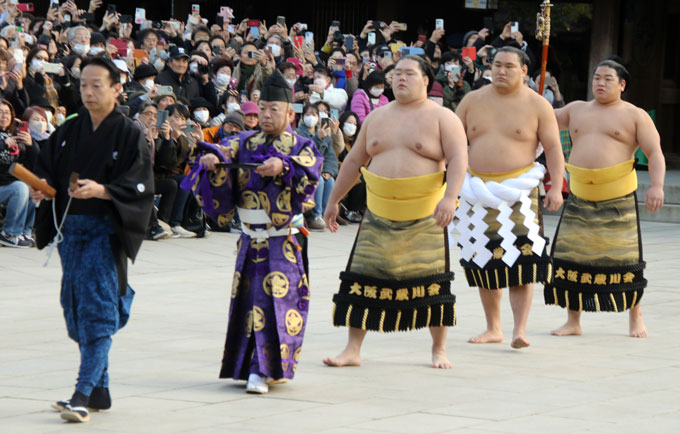
Before the top-division bouts each day, the wrestlers of one side come down the aisle in reverse order of rank and climb into the ring wearing full-length aprons that hang from the waist to the ankles. Those are kesho-mawashi. The association’s own description is short and precise: beautifully made of silk, richly embroidered with different designs, and hemmed with gold fringe.
The designs are individual. A wrestler’s apron may carry the landscape of the place he came from, something drawn from the meaning of his ring name, or the mark of the company or supporters’ association that gave it to him. It is the one piece of sumo dress that is allowed to say something about the specific man wearing it.
How much a kesho-mawashi costs
The association’s published figure is upwards of approximately one million yen. That is the only price stated by the governing body itself, and it is a floor rather than an average — the wording is “upwards of”. Silk, hand embroidery in gold and silver thread, and gold fringe along the hem are all slow work, and an elaborate design costs more than a plain one.
| Question | Answer | Source |
|---|---|---|
| What does one cost? | Upwards of approximately ¥1,000,000 | Japan Sumo Association, official English introduction |
| What is it made of? | Silk, richly embroidered, hemmed with gold fringe | Japan Sumo Association |
| Who normally pays? | A support group, a company, a hometown association or a former school | Michihiro Taguchi, Dohyo no Mokugekisha |
| Can a wrestler afford his own? | Not on promotion. The ranks below juryo receive no salary, only a tournament allowance | Michihiro Taguchi |
| Can the public buy one? | It is not a retail item. Souvenir miniatures exist; the real thing is commissioned | Michihiro Taguchi |
Who is allowed to wear one
The apron starts at juryo. Wrestlers ranked below that do not take part in the ring-entering ceremony, so there is nothing for them to dress for. Crossing the line into the salaried ranks — becoming a sekitori — is what brings a man into the ceremony, and the apron he wears there is one of the visible markers of having got there.
Within the ceremony, rank still separates people. The yokozuna does not line up with the others. He performs alone, attended by a sword bearer and a forerunner, and over his kesho-mawashi he ties a braided hemp rope, the tsuna, weighing between 11 and 15 kilograms and hung with zigzag paper strips at the front. The two attendants who walk with him wear ordinary kesho-mawashi.
Why a new sekitori needs one before he can start
There is a piece of sumo’s administrative calendar that only makes sense once you know what an apron costs. Promotions to juryo are announced immediately after a tournament, at the ranking committee meeting, rather than being left to appear when the rankings are published weeks later. Michihiro Taguchi records that this has been the practice since the July 1971 tournament, and gives the reason: a new sekitori has to have a kesho-mawashi, a fighting belt and a set of crested montsuki haori-hakama prepared. Announce early, and he has time to get them made.
The problem is money. A wrestler in the division below juryo draws no monthly salary at all — only a tournament allowance. On the day he is told he has been promoted, he is expected to acquire a garment the association itself prices at a million yen and up, and he has no salary to pay for it with. So the request goes out to a supporters’ association, an old school, or a company willing to attach its name to the embroidery.
Taguchi does not let that pass without comment. Handing a man the qualification of sekitori while the association itself does nothing to equip him, he writes, leaves the whole thing depending on other people — and he questions whether that is a fit way for the governing body to discharge the obligation. It is worth remembering when you watch a row of aprons come up the aisle: each one is a debt of gratitude as much as a garment.
Kesho-mawashi and the fighting belt are different objects
English-language coverage often blurs the two, because both are called “mawashi”. Inside sumo they have nothing to do with each other.
| Kesho-mawashi | Mawashi (shimekomi) | |
|---|---|---|
| Worn for | The ring-entering ceremony, to be looked at | The bout, to be grappled in |
| Appearance | Embroidered apron, gold fringe, individual design | Near-plain. Black, dark blue or white |
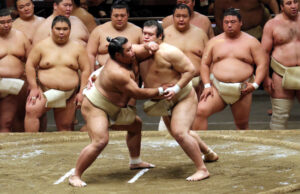
| Function | Ceremonial and decorative | The starting point of throws, pulls and force-outs |
| Grabbed by the opponent? | Never — it is not worn in competition | Constantly. Many of sumo’s 82 techniques begin with a grip on it |
| Who has one | Juryo and above | Every wrestler |
The apron comes off before anyone wrestles. What the fighting belt is made of, how it is wound, and the grips it makes possible are covered in our guide to the mawashi, and the rest of the wardrobe — sagari, topknots, the officials’ dress — in our guide to what sumo wrestlers wear.
The moment the apron is used
In the ceremony, the referee leads the procession and each wrestler’s ring name, birthplace and stable are announced as he steps up. The wrestlers circle the ring, line up facing the crowd, then turn inward, clap, and lift the front hem of the apron with their fingertips. That small lift is the whole reason the garment exists.
That format is not ancient. Taguchi dates it precisely: the ring-entering ceremony took its present shape at the January 1965 tournament, the same tournament that replaced the old lineage-based match-making with the stable-based system still in use. Until then the wrestlers simply trooped up together, formed a circle, clapped, lifted the apron and stepped down, with no individual introductions. Taguchi is blunt about the old version — it was, he writes, a ring-entering ceremony that made you laugh.
From January 1965 the referee led the procession, each man’s ring name, birthplace and stable were announced as he climbed up, and the wrestlers circled the ring and lined up facing the audience before turning inward. Fewer than twenty years after the war, in other words, sumo redesigned the ceremony so that spectators could actually see who was in front of them — and in doing so turned the kesho-mawashi from a costume into the visual centrepiece of the day’s opening.
Frequently Asked Questions
How much does a kesho-mawashi cost?
Upwards of approximately one million yen, according to the Japan Sumo Association’s own English introduction to the sport. That is a starting point rather than an average: the aprons are silk, embroidered by hand and hemmed with gold fringe, and an elaborate design costs more than a simple one.
What is a kesho-mawashi?
It is the embroidered silk apron worn for the ring-entering ceremony that precedes the top-division bouts. It hangs from the waist to the ankles, carries an individual design, and is never worn in competition. The belt used in bouts is a separate item.
Who pays for a sumo wrestler’s kesho-mawashi?
Usually not the wrestler. Aprons are typically given by a supporters’ association, a company, a hometown group or a former school. A newly promoted wrestler has been on no salary at all in the division below juryo, so he is in no position to buy one himself at the moment he first needs it.
Which wrestlers wear a kesho-mawashi?
Those ranked juryo and above. The ranks below do not appear in the ring-entering ceremony, so they never wear one. Owning an apron is therefore one of the markers of having reached salaried status.
What is the difference between a kesho-mawashi and a mawashi?
The kesho-mawashi is a decorative apron worn only for the ceremony; the mawashi is the plain, heavy belt worn in bouts and used as the main handhold in the sport. An opponent never touches a kesho-mawashi, because it has been taken off long before anyone wrestles.
Can you buy a real kesho-mawashi?
Not off a shelf. A kesho-mawashi is commissioned for a particular wrestler, normally by the people supporting him, and it is not a retail product. Souvenir miniatures and related goods are sold at tournaments, but they are ornaments rather than the garment a sekitori wears.
Does the yokozuna wear a kesho-mawashi?
Yes, with the rope over it. A yokozuna performs his ring-entering ceremony alone, wearing a braided hemp tsuna of 11 to 15 kilograms over his kesho-mawashi. His two attendants, the sword bearer and the forerunner, wear ordinary kesho-mawashi without a rope.
Sources
The price of approximately one million yen and upwards, the materials of the apron, the weight of the yokozuna’s rope, and the order of the ring-entering ceremony come from the Japan Sumo Association’s official English introduction, Sumo (sumo.or.jp/pdf/en/sumo_introduction.pdf). The rank limit, the funding of a first apron, the July 1971 change to the timing of juryo promotion announcements, the outfitting a new sekitori must arrange, and the January 1965 change to the ceremony format come from the archive of Michihiro Taguchi at Dohyo no Mokugekisha (dohyounomokugekisya.net), “化粧まわしとは?本まわしとの違い・誰が締められるかをやさしく解説“, “早めの十両昇進発表の意味”, “令和新十両事情” and “土俵入り事始め“. Retrieved August 3, 2026.
Photo by Michihiro Taguchi.